
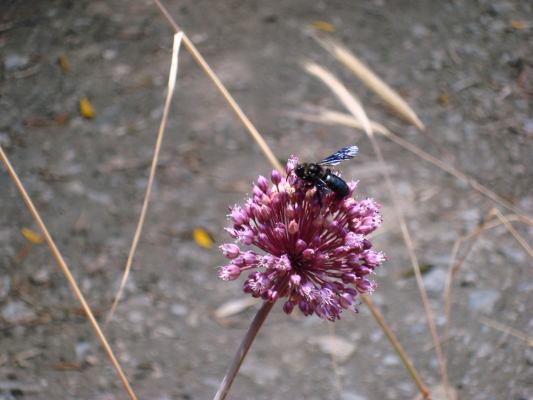
a carpenter bee is normally a big insect – 2.5-3 cm.
Photo credit: Diana Kordas
PDF of complete 18-page paper
[Ed. Please download and send this paper to your state and local Farm Bureau, Agricultural Commissioner and agriculture agency. Contains photos as examples.]
by Diana Kordas, ED.M., M.A.
February 8, 2024
Excerpt:
“…cells with irreparably damaged genomic DNA will result in cell senescence, cell death, cancer or mutated offspring, depending on cell type and specific biological/environmental conditions.” Panagopoulos et al., 20211
Introduction
A recent paper, ‘Human-made electromagnetic fields: Ion forced-oscillation and voltage-gated ion channel dysfunction, oxidative stress and DNA damage (Review) published in the International Journal of Oncology by biophysicist Dimitris J. Panagopoulos et. al. states unequivocally that electromagnetic radiation from wireless technology damages DNA. This leads to infertility, sterility, mutations and extinctions, and it explains the loss of biodiversity that we are currently experiencing on this planet. DNA damage from wireless radiation is not a new discovery. It has been confirmed over and over by numerous scientists using a variety of experimental subjects and frequencies. But do observations in the laboratory translate into the same effects in the real world? If these scientists are correct, they must do. In the real world things might be a lot worse, because in the real world we are not exposed to a single frequency or bandwidth but to a whole soup of them, from multiple sources. In the real world, exposure time is not limited to a few minutes or hours per day or week; the cell towers are on day and night.
DNA damage from wireless radiation is not a laboratory phenomenon; it is real. We are losing the insects—among them, the pollinators. We are losing the birds. Animals are dying out. We are wiping ourselves out.
…In 2006, Spanish biologist Alfonso Balmori wrote that amphibians were the most seriously endangered creatures on the planet4, and a great many of them were grossly deformed, with missing or extra limbs. Balmori ascribed this to interference with embryogenesis during development—in other words, developmental damage. This problem began after 1995 in many parts of the world (about the time that mobile phones started to become popular and cell towers started going up everywhere) and Balmori argued that electromagnetic radiation from wireless technology was, at the very least, a major contributing factor. The rate of deformity jumped to 25% in some populations, and such deformities were found even in pristine places such as national parks where pesticides and other pollutants could be excluded as the cause.
DNA damage doesn’t always cause deformities. It can affect living creatures in a great many ways, some of them invisible or unnoticeable. Numerous studies have shown that wireless radiation causes both impaired fertility and sterility, but you can’t see these with the naked eye; you’d have to autopsy the creature’s sexual organs. What we do notice is the results of infertility and sterility: a decrease in egg-laying or live births; a decline in the numbers of a given population until the species in question becomes extinct. This is what is happening to the fireflies, the bees, the beetles —indeed to all the insects. This is what is happening to the birds and to other, mostly small creatures. The rise in the number of people seeking help from fertility clinics says this is happening to us, too…
DNA and Developmental Damage in Insects Observed on Samos, Summer of 2023
When 4G came in, we saw big declines in many species of insects, among them fireflies and certain types of spiders, which seemed to vanish overnight.5 And it was after 4G came in that in one area of our property we started to see carrion flies with damaged wings. Some of these flies had deformed wings, some had vestigial wings, and some had no wings at all. For generation after generation, they have bred and produced more flies with the same defects. By now, the number of carrion flies in this area has fallen dramatically.
…DNA damage does not necessarily produce mutants. Sterility is the most likely outcome of serious DNA damage, because nature does not want to pass on disadvantageous traits to future generations. And sterility is only evident in the disappearance of species; they cannot breed, so they go extinct. If this is the gauge, then most of the insects we used to have must have become sterile, for most of them have died out and become—at least locally—extinct. We have lost almost all species of beetles, lacewing and other flies, most of the moths (and all the larger moths except for a few humming-bird moths), many butterflies, virtually all wasps and hornets, and many species of wild bees including wild honeybees. There are almost no mantises, no katydids, and very few grasshoppers and crickets. There are a few slugs, but no snails. There are very few woodlice, earwigs, millipedes, centipedes or silverfish, and very few web-spinning spiders. No species of insect remains unaffected; all species have either declined or vanished altogether, including soil insects such as earthworms (we have only seen two this year) grubs (none) and even ants. When the queens hatched after the first rain, there were very few of these flying ants compared to other years—a few dozen compared to hundreds. Many plants are not being pollinated properly…
Bad Seeds
For the past couple of years, Chinese farmers have been complaining about “bad seeds”; they say that the seeds the government supplies them with either do not grow or produce poor crops. It makes no sense that any government would deliberately give its farmers poor-quality seeds, but something is definitely wrong.
We are having similar problems on Samos. Two years ago, a market gardener I know had to replant her spinach crop three times before it germinated. We have been unable to grow spinach from bought seeds, though we’ve tried three years running. The seeds just won’t grow. It seems we’re not alone; this year, none of the market gardeners are selling spinach. We’ve had similar problems with bought beet seeds as well as with peas and green beans; few of the seeds germinate, and the plants don’t grow well. I think there are two problems: both are connected, though in very different ways, to electromagnetic radiation.
Our own seeds, saved from plants that we have let go to seed, have not always done much better than bought seeds. Last year we planted bought cauliflower seeds and saved broccoli seeds: neither germinated. This problem too appears to be general, since few of the market gardeners are selling broccoli this winter and cauliflowers are also hard to find. We grew chard last winter from our own seeds that were several years old—saved before we had so many cell towers around us— and had a good crop, but the new chard seeds from last spring’s crop were much smaller than the old seeds. We planted the new seeds this autumn and only a few germinated; we had to replant using the old seeds. Last spring we left several beets to go to seed, but they produced no seeds at all; they weren’t pollinated.
This past summer, a very ominous problem developed: many peppers and aubergines did not produce usable seeds. A fruit is, after all, a seed-pod, and a ripe fruit should contain welldeveloped seeds. I had trouble finding enough peppers from which to collect seeds for next year, as most of the seeds in all three varieties of peppers were small, black, shriveled and obviously unusable. Many of the aubergines we cooked had no seeds at all. Other aubergines have gone to seed (they change color when this happens, from purple to brown, or from white to yellow) while still tiny (usually they grow big first). I won’t know until next spring whether they have produced usable seeds, but I deeply suspect they haven’t. The tomato seeds I saved were also smaller than normal. I don’t know if any of the seeds from this past summer will germinate next year, or what sort of plant they will produce; the peppers and aubergines grown from last year’s seeds have not done well.
What is going wrong? If the electromagnetic radiation from the cell towers is damaging the plants and the soil they grow in, it is not surprising that seeds should also be affected. Nature does not want to pass on damaged DNA, so the seeds from DNA-damaged plants will not grow, or the plants that grow from them will not thrive and the fruits will exhibit deformations. It is also possible that the failure of seeds to germinate is developmental damage caused by EMR in the environment and in the soil itself. Neither possibility bodes well for the future.
…If there are no pollinators to pollinate plants, if the plants are so damaged by electromagnetic radiation that they cannot even produce normal seeds, and if the soil itself is unable to support life, we are going to starve. At first, it will be a question of higher and higher prices, as less and less food is being produced—this is already happening, and it is bad enough in itself. But if we do not get rid of all wireless technology, and very soon, there may come a day when no food at all can be produced, and every species including us will die.
I know this sounds bleak; I mean it to. I believe that we are rapidly arriving at a tipping-point where we will not be able to halt the insect declines, where the surviving insects (if any survive) may all have damaged DNA, as will the plants that produce food, as will every creature of the air, sea and land. That will be the end of the world as we know it, and of us. We are not separate from the ecosystem; we are part of it.
…Panagopoulos et al. say in their conclusion to their 2021 paper1: “When an organism is constantly under O[xidative] S[tress] due to a totally new cytotoxic agent such as human-made EMFs, no protective mechanism, evolved in the billions of years of biological evolution to protect from natural (non-polarized) EMFs/radiation or isolated hazardous events, can be effective enough.”
Why aren’t we listening?
See also https://safetechinternational.org/wp-content/uploads/2022/03/5G-causes-massive-insect-declines-on-Samos.pdf
5G Cell Towers Cause Massive Insect Decline on the Greek island of Samos, Diana Kordas
February 22, 2022
Diana Kordas’ papers are available at https://cellphonetaskforce.org/the-work-of-diana-kordas/
 Smart Meter Harm