The electrical grid can be crippled by several methods, including physical attack, hacking, solar electromagnetic pulses, and by disabling utility workers. This last method is a consequence of California’s Senate Bill 649i and other 5G/”small cell” tower initiativesii if they are adopted.
Under SB 649 and these initiatives, utility poles, light poles, traffic signals, and “vertical infrastructure” will be converted into cell towers. Cell towers will also be installed on public property including parks. Local regulatory authority will be virtually eliminated. Once these bills pass, the public will have no voice, and there will be cell towers on every block.
Microwave radiofrequency electromagnetic radiation is sensitizing and irritating. A single exposure can injure and sensitize a person, causing disabling health effects.iii Repeated exposure increases the likelihood of injury and disability. Electromagnetic sensitivities (EMS) were recognized in California by 1998iv and by the U.S. Federal Access Board in 2002, which issued a report on accommodating those with disabling EMS in 2005.v
Under SB 649, utility workers will work on and around these de facto cell towers every day.vi Research has found cancer clusters up to ¼ mile away from cell towers, but these workers will work within the envelope of highest microwave exposure and in the beam of the antennas. Wireless companies don’t turn off power to cell towers when workers are present, and two national surveys also found that cell towers even frequently exceed FCC limits.vii Workers’ exposure will routinely exceed FCC occupational exposure limits, which is based on a single 30 minute exposure not causing tissue heating. Cumulative, long-term, and non-thermal effects are not considered in FCC exposure guidelines.viii In addition, future 5G frequencies are used in military active denial systems and intensely absorbed by sweat ducts, causing acute burning pain.ix
Based on the research on microwave exposure, utility workers will be at extreme risk for cancers and tumors, cardiac problems including heart rhythm disturbances, DNA damage, changes in their blood, cellular stress and damage, breaches in the blood-brain barrier, neurological damage, brainwave changes and cognitive impacts, strokes, fertility impacts including having children with birth defects, electromagnetic sensitivity (EMS), seizures, blackouts, and what Europeans researchers call “burnout”.x They will likely experience nausea and vomiting, dizziness, headaches and migraines, vision problems including cataracts, insomnia, difficulty concentrating and remembering, impaired immunity, pain, ringing in their ears and other hearing problems, hair loss, and weakness and fatigue. The international literature from scientists and health care professionals is extensive.xi Last year the NIH National Toxicology Program announced significant carcinogenic effects from cellphone exposure levels after only two years of exposure — malignant brain tumors and heart tumors, and precancerous lesions, as well as DNA damage.xii Utility workers will have much greater exposure on a daily basis.
If utility workers start becoming impaired and then disabled, what happens? How much job loss can utility companies absorb before vital maintenance and repair work is jeopardized?
Six firefighters living under a cell tower were studied in 2004.xiii
Each of the men who had their brains scanned showed a hyper-excitability of the neurons, or brain cells. This is considered to be a precursor to early cell death and potentially early onset Parkinson’s, ALS, and Alzheimer’s. Now, 8 years later, two of the men have had psychotic breaks with reality and all are suffering from memory impairment. All the men tested in 2004 had tremors, and some were still in their 20’s.
These firefighters, among the least likely to admit pain or disability, after cell tower activation reported:
IBEW (International Brotherhood of Electrical Workers), other related unions, and utility companies should raise the alarm over Senate Bill 649. This California bill radically changes the working environment for electrical utility workers, creating significant hazards. SB 649 allows utility poles, light poles, traffic lights and other infrastructure to be converted into so-called “small cell” towers and eliminates local government regulation. Now, instead of just working on utility poles and electrical lines, electrical workers would, under this bill, work on or near cell towers all the time. What’s worse, they would work within the envelope of highest microwave exposure routinely, in or near the beam of antennas, in many cases exceeding FCC limits for occupational exposure. And wireless carriers don’t turn off the power to their transmitters when workers are present. And cell antennas also routinely exceed FCC limits by 600% or more. Workers’ exposure will be for hours every day, not the single exposure for 30 minutes on which FCC occupational guidelines are based.
No one is policing this.
“Small cell” antennas are often no different from the antennas mounted on macro cell towers — the size and power output can be the same, and exceed FCC limits at a distance from the antennas. Studies have found cancer clusters up to ¼ mile away from cell towers.
Under SB 649, these “small cell” towers will be everywhere in communities and next to homes (every 10-20 houses or less) and schools, throughout downtown areas, in parks, etc. There will be no down time for electrical workers because their homes will now be within yards of cell towers.
It gets worse. Hidden in SB 649 is AT&T’s experiment for broadband over powerline – BPL (also known as powerline communication – PLC). AirGig is the name of an AT&T project. SB 649’s previous version explicitly stated:
(4) Notwithstanding any other provision of this section, a city or county shall not impose permitting requirements or fees on the installation, placement, maintenance, or replacement of micro wireless facilities that are suspended, whether embedded or attached, on cables or lines that are strung between existing utility poles in compliance with state safety codes.
In the latest bill version, that explicit reference has been removed, but micro wireless antennas installed in or on electrical wiring is still a new permitted use under this bill. ———— SEC. 2. Section 65964.2 is added to the Government Code, to read:
65964.2.
(a) A small cell shall be a permitted use subject only to a permitting process adopted by a city or county pursuant to subdivision (b) if it satisfies the following requirements:
(1) The small cell is located in the public rights-of-way in any zone or in any zone that includes a commercial or industrial use.
(2) The small cell complies with all applicable federal, state, and local health and safety regulations, including the federal Americans with Disabilities Act of 1990 (42 U.S.C. Sec. 12101 et seq.).
(3) The small cell is not located on a fire department facility. … (g) For purposes of this section, the following terms have the following meanings:
(1) “Micro wireless facility” means a small cell that is no larger than 24 inches long, 15 inches in width, 12 inches in height, and that has an exterior antenna, if any, no longer than 11 inches.
(2) (A) “Small cell” means a wireless telecommunications facility, as defined in paragraph (2) of subdivision (d) of Section 65850.6, or a wireless facility that uses licensed or unlicensed spectrum and that meets the following qualifications: … (B) “Small cell” includes a micro wireless facility.
—————————-
If micro wireless antennas are installed and/or embedded on electrical lines, all electrical lines become de facto cell towers. Utility workers and all electricians will be handling wires not just with electromagnetic radiation emissions, but now with microwave electromagnetic radiation emissions which have known health hazards and were found to be carcinogenic last year by the NIH National Toxicology Program.
But there’s more. There is no down time for electrical workers on this exposure. Their heavy exposure will not stop at work. Microwave radiation on electrical lines cannot be shielded. It follows the lines into homes and buildings on the electrical wiring. People and all life will be exposed to these emissions constantly, especially when they’re indoors. The Austrian Medical Association opposed PLC/BPL in 2012 because of the enormous health hazards and constant exposure. The European Academy of Environmental Medicine issued guidelines for treating EMF-related diseases. The international literature is substantial on exposure impacts.
Disabling electromagnetic sensitivities was recognized by the U.S. Federal Access Board in 2002 which published a report in 2005 about accommodating people with this disability. EMS is on the rise worldwide. This is an environmentally-caused functional impairment. Reduced exposure is the only reliable solution. Electrical workers are at much increased risk for becoming disabled and unable to work due to their new high-level microwave exposure as a result of SB 649 and measures being pushed by the FCC.
Sensitivity and related health problems – neurological, cardiopulmonary, immunological, genetic, fertility, vision, dermatological — increase with exposure. Some people with EMS can no longer tolerate ordinary household current. Homelessness is already experienced by those with EMS who have not had the intense exposure of electrical workers. SB 649 may cause a new wave of homelessness, especially to former electrical utility workers.
Incidentally, fire fighters got an exemption in this bill because of the health hazard of cell towers.
The immense costs to California from growing disability, unemployment, and insufficient experienced electrical utility workers and electricians to maintain and repair the electric grid cannot be quantified. California’s economy would grind to a halt, and its society would fall into third world conditions. Utility companies should be adamantly opposed to this bill.
Communications Workers of America (CWA) leadership also misses the boat on this bill. AT&T and other companies have been pushing to eliminate copperline landline telephone service nationwide. They attempted this in California last year with AB 2395 and failed. AirGig and similar proposals means that telecommunications companies can appeal for relief from “carrier of last resort” rules by claiming that everyone now has access to telephone service through BPL/PLC. Not only would reliable and essential copperline landline service be eliminated, but all CWA legacy telephone workers would be eliminated as well.
So why isn’t union leadership loudly opposing SB 649 and “small cells”? Workers would do well to ask them. California union leadership has been contacted by the public. Labor leadership is no longer ignorant. What is the explanation for the silence in the face of extreme costs and health damage to workers and the public from this bill?
SB 649 has already passed the California Senate and has one final hearing before the Assembly Appropriations Committee on August 23 before it goes to a full Assembly vote.
For current information on SB 649, “small cells”, and 5G (the purported goal of small cell deployment),
On cell towers and their impact. Written and recorded in 2010-2011 with the advent of 4G, this is newly relevant with the push to convert utility poles into “death poles” — 4G/5G cell towers.
Roberts: Is a bombshell about to be dropped on Arizona’s power elite?
by Laurie Roberts
July 5, 2017
We now have public acknowledgement that the FBI is continuing its investigation, presumably into possible funny business involving the Arizona Corporation Commission.
Well, if charges that the then-chairman of the commission that regulates utilities took a bribe and committed fraud – with a powerful lobbyist who is a close friend of many of Arizona’s powers-that-be serving as a conduit– are small potatoes, then…
It’s long been known that the FBI was interviewing Pierce, among others, last summer. The agency at the time acknowledged that it was conducting “a long-term investigation related to the financing of certain statewide races in the 2014 election cycle.”
Many people in political circles thought the FBI investigation would go nowhere, given the players, once Donald Trump was elected president.
Then in May, Pierce, a Republican, was indicted, along with his wife, Sherry. Other indictees: Pinal County developer George Johnson and lobbyist Jim Norton, whose clients included the Arizona Chamber of Commerce and Industry and Arizona Public Service, a partner of “dark money” maestro Sean Noble and a friend of Gov. Doug Ducey since their days at Arizona State University.
The indictment alleges that then-Commissioner Pierce in 2011-12 led a successful drive both to raise rates for Johnson’s water and sewer company, Johnson Utilities, and to force utility customers to pick up the tab for income taxes owed by Johnson. This, after opposing both requests in 2010.
In return, the indictment says, Johnson via Norton handed over $31,000 to Pierce’s wife, Sherry, and was planning to buy Pierce a $350,000 piece of property.
Email confirms ‘much larger’ investigation
In the course of preparing a defense, the Pierces’ attorneys ran into a roadblock.
It seems the feds are refusing to provide any of the usual “discovery” material that prosecutors must supply to the defense – stuff like FBI reports and witness statements and financial and tax records “of third parties.” Prosecutors won’t turn over the goods unless the defense attorneys first agree to keep the stuff secret.
“The facts that resulted in the indictment of your clients were discovered during a much larger and more intensive investigation,” Assistant U.S. Attorneys Fred Battista and Frank Galati wrote last month in an email to Pat Gitre, attorney for Gary Pierce, and Ashley Adams, attorney for Sherry Pierce. “Mr. Pierce, Mr. Norton and many others have been interviewed by the FBI concerning that larger investigation.”
The prosecutors’ email came to light in court documents filed earlier this week. Gitre and Adams are asking a judge to force the feds to hand over the requested material. Prosecutors say that request could have “serious negative effects’’ on its larger case, should the information become public.
“We do not want persons who are unrelated to this case getting their hands on evidence that the FBI has gathered in an on-going investigation,” Battista and Galati wrote.
Who shouldn’t see the information?
The question is: what persons?
Might those persons be at Arizona Public Service/Pinnacle West Capital Corp? Maybe CEO Don Brandt and/or certain of his top staffers?
The FBI investigation began shortly after a whistleblower/former aide to Pierce, claimed, among other things, that Pierce dined privately with Brandt or his predecessor 14 times while on the commission – seven of them while APS was seeking a rate hike.
Or might the investigation have to do with concerns that APS secretly poured $752,000 into an independent dark-money campaign for Justin Pierce, who was running for secretary of state in 2014? This, as some sort of thank-you gift to his term-limited father Gary, who frequently carried APS’s water while on the commission?
Or might it have to do with the widespread belief that APS secretly pumped $3.2 million into independent dark-money campaigns to get Republicans Tom Forese and Doug Little elected to the Corporation Commission in 2014? Then again, that, alone, wouldn’t be illegal – just ethically challenged.
Here’s what we know: the FBI has interviewed Pierce and Norton as part of its investigation. It has subpoenaed documents from the Corporation Commission and it has contacted officials at APS.
And now it has acknowledged that criminal charges of bribery and fraud against the then-chairman of the commission that sets your utility rates are just a piece of “a much larger and more intensive investigation.”
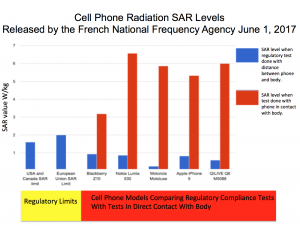
(Washington, DC) Under court order, the National Frequency Agency (ANFR) of France has just disclosed that most cell phones exceed government radiation limits when tested the way they are used, next to the body. Manufacturers are not required to test phones in shirt or pants pockets. French government tests on hundreds of cell phones reveal that in 2015, 9 out of 10 phones exceed the manufacturer’s reported radiation test levels when re-tested in positions where the phone is in contact with the body. The government had refused to disclose these test results until the court order.
Children handed cell phones as toys.
On June 1, 2017, ANFR posted the details of the make, model and test results for each phone that was tested, after months of legal action by French physician Dr. Marc Arazi. Arazi’s request for the information was initially denied. Popular brands such as Apple, Motorola, Samsung and Nokia were among the cell phone models tested. When tested in contact with the body, some phones have test results as high as triple the manufacturer’s previously reported radiation levels.
“As a physician, I am deeply concerned about what this means for our health and especially the health of our children. People have a right to know that when cell phones are tested in ways people commonly use phones – such as in direct contact with their body – the values exceed current regulatory limits. This is a first victory for transparency in this industry scandal,” commented Arazi.
Ricocheting in headlines throughout France, Arazi and his colleagues have coined the situation as “PhoneGate” because of the parallels to “Diesel Gate” – the Volkswagen emissions saga. Devra Davis, PhD, President of Environmental Health Trust explained, “Volkswagen cars passed diesel emission tests when tested in laboratory conditions, but when the cars were driven on real roads, they emitted far more fumes. In the same way, every one of these cell phones ‘passed’ laboratory radiation SAR tests. These phones are legally considered compliant. However, when these phones are tested in the ways that people actually use them in real life, such as in your jeans pocket or bra, the amount of absorbed radiation emissions in our bodies violates the regulatory limits.”
“This is an enormous international scandal. This is not only about France and Europe, as this applies to all persons who use cell phones in every country. If phones were tested in the ways we use them, they would be illegal,” stated Dr. Davis, pointing out that these findings were replicated earlier by a US FCC certified laboratory as part of an investigation by the Canadian Broadcasting Corporation. Findings of higher radiation levels than expected (and even higher after phones are fixed) were also documented by the Holon Institute of Technology in Israel and featured on Israeli news.
“Far more concerning is that the regulatory limits do not protect the public from adverse health effects related to long-term exposures,“ Davis commented, pointing to recently published research. A study in the American Journal of Epidemiology found cell phones associated with a doubled risk of glioma, a type of brain cancer. Studies performed by the US National Toxicology Program found glioma and DNA damage increased in rats exposed to long-term cell phone radiation.
“I see children cradling cell phones in their laps as their mothers do grocery shopping. Teenagers are sleeping with cell phones placed on their chest or directly beside their heads all night long. Pregnant women put cell phones and wireless devices on their abdomen. Parents have a right to know that when children use cell phones in these ways, their bodies are absorbing wireless radiation at levels that exceed limits set for adults 20 years ago,” stated Theodora Scarato, Program Director at Environmental Health Trust, referring to how the American Academy of Pediatrics has repeatedlycalled on the US Government to update cell phone testing to reflect current use patterns. The American Academy of Pediatrics has issued clear recommendations to reduce cell phone radiation exposures to children.
France’s National Agency of Health Security of Food, Environment and Labour (ANSES) July 2016 report “Radiofrequency Exposure and the Health of Children” conceded that the public is largely unaware of instructions to keep a distance between cell phones and anyone’s head and body. ANSES stated that it was “unlikely that people, especially children, are aware of the conditions of use close to the body, as defined by manufacturers.”
The Canadian Broadcasting Corporation (CBC) independent survey of more than 11,000 Canadians found that more than 80 percent were unaware of manufacturers’ recommended separation distance and 67 percent admitted they carry their phones against their bodies.
The newly released French data is also corroborated by the 2017 independently commissioned investigation by the Canadian Broadcasting Corporation that tested popular cell phones in a US government certified testing laboratory and found SAR values surpassed the US and Canadian allowable SAR values when the phones were tested in body contact positions. In response to the CBC report, manufacturers stated they were fully compliant.
The Wireless Industry Argues “No Evidence” To Update Testing Protocols
The CTIA, the wireless industry lobby group is opposed to mandatory disclosures about the manufacturer’s instructions and also is opposed to updating cell phone radiation testing methods to include body contact positions such as were performed by the French government. The CTIA argued that “there is no reliable evidence proving that current testing protocols fail to ensure compliance with RF standards, “ in their submission to the US Federal Communications Commission concerning the FCC Docket on Human Exposures to Radiofrequency Radiation. The CTIA stated that “a zero-measuring requirement would not accurately mimic real usage or increase safety.”
In California, the City of Berkeley was sued by the CTIA, a wireless industry lobby group, when the City passed an ordinance mandating consumers are informed of these manufacturers’ instructions by retail stores. The CTIA argued that the “Right To Know Ordinance” violated free speech rights and recently lost their case in court when the judges ruled that the Ordinance was “in the public interest”.
After litigation by UC Berkeley public health professor Dr. Joel Moskowitz, the California Department of Public Health (CDPH) released cell phone guidance that the Department scientists had drafted, but withheld from publicly posting for seven years. The guidelines aimed inform the public from possible health impacts from cell phone radiation.
Litigation is moving forward involving more than a dozen people in the U.S. who claim their brain cancer is related to their cell phone use. In Italy, a recent court ruling recognized a link between cellphone use and brain tumors and granted lifetime compensation to a man who developed a brain tumor after 15 years of work related cell phone use.
“Why does the public have to sue to get this information?” Scarato asked. “And what about children in schools? The Maryland State Children’s Environmental Health and Protection Advisory Council has recommended that schools reduce radiofrequency radiation exposures to children by installing wired networks rather than Wi-Fi, same as in Cyprus, France and Israel. Yet at the same time, schools are now allowing or even insisting children bring cell phones into classrooms. I am sure most of those children are carrying these phones from class to class in their pockets close to their body. They are not aware of the radiation exposures.”
Specific Absorption Rate Testing
Before a cell phone model is permitted to go on the market for sale, its manufacturer performs Specific Absorption Rate (SAR) tests to evaluate the radiation levels. SAR values are expressed in terms of watts per kilogram (W/kg) and are intended to measure the amount of cell phone radiofrequency radiation absorbed by the body when using a wireless device. SAR tests are performed in laboratories by measuring the SAR in a test dummy filled with liquid. The European Union regulations allow a maximum of SAR 2.0 W/kg. The United States and Canada allow a maximum of SAR 1.6 W/kg. Every cell phone is rated with a specific SAR value, and many countries mandate that these SAR values be prominently displayed to consumers on cell phone packaging.
Current wireless device SAR compliance testing regulations allow manufacturers to put a separation distance (usually about 15 mm) between the phone and the test dummy. Cell phone manufacturers are not required to test cell phones for SARs in positions which mimic direct contact between the phone and the body.
ANSES reported the following findings: In 2015, 89 percent of tested cell phones had a SAR greater than the maximum limit value of 2 W/kg and 25 percent had a SAR greater than 4 W/kg.
Since 2010, France law has ensured that SAR levels are placed prominently on cell phone packaging and the sale of cell phones was banned for young children. French legislation in 2015 included several new policies aimed at reducing exposure to radiofrequency radiation. Arazi called on the Health and Environment Ministers and Consumer Affairs and Fraud Prevention Agency to take immediate action on this new information by informing the public and issuing new protective policies.
He also warned that, “If we get to 20 billion things and don’t do thegateways, we will not have enough power generated in the United States todo the internet of things,” because of the immense amount of remote dataprocessing that would be required to handle the data from all thosedevices. DiFranco said “we’ll have to build 4,000 new data centers a year,with 100,000 servers in each data center, each one pulling 40 megawatts ofpower,” to handle it all.
From Fed Scoop
Technical concerns continue to muddle IoT’s long-term promise Wyatt Kash May 5, 2017
A variety of technical issues must be solved soon if the Internet of Thingsis to evolve as futurists envision, a group of government and commercialexperts warned during a forum Thursday.
As wireless sensors and other devices become cheaper, more powerful andmore universally deployed, that ubiquity will soon place overwhelmingdemands on the internet and put the nation’s infrastructure at risk if newtechnical new measures aren’t put in place, they said.
At the same time, government and industry must move faster to ensure thatstronger security safeguards are baked into billions of devices expected tobe added to the internet by 2020, along with systems capable of identifyingand disconnecting devices that have been compromised.
“The basic problem is we’re going to put 20 billion more devices on theinternet between now and 2020,” Stephen DiFranco, principal at the IoTAdvisory Group, said during the forum, hosted by ImmixGroup, in McLean,Virginia.
To put the challenge in a larger context, DiFranco said, there are about 5billion smartphones currently connected to the internet globally, about 3billion PCs and about 2 billion tablets. “So there are going to be more IoTdevices then there are everything else we’ve ever touched before and whichwe’ve done a lousy job securing.”
One of the primary problems in the IoT space is “the profit margins onthose devices are designed, by their nature, to be very, very small … andyou’re dealing with very, very small real estate on the device,” saysMichael Mestrovich, a director of technical services within the federalintelligence community. “Probably the last thing you’re thinking of is, howdo I ensure the security and integrity of that device.”
Another factor is that IoT devices are typically installed to monitorthings, like lighting controls in buildings that are designed to last 10 ormore years without anyone laying a hand on it, he said. “How do youmaintain that going forward in this connected world where … any hackercould potentially take down a building?”
From AARP Illinois, PR Newswire PDF May 31, 2017 PDF May 25, 2017 — on previous bill
May 31, 2017
Passage of SB1839 opens door to safety and security concerns for 1.2 million landline customers
Statement by AARP Illinois Director of Advocacy Ryan Gruenenfelder
The legislation, pushed by AT&T, deregulates the consumer telephone sector and will eliminate traditional landline phone service without providing customers with reliable and affordable alternatives.
The passage of the bill means that seniors living on fixed incomes, residents of rural areas, individuals who rely on landlines to connect with their health care providers and transmit information from lifesaving devices such as pacemakers, small businesses in many communities, and low-income families unable to afford mobile phones are at risk of being disconnected and increasingly isolated without the ability to afford alternatives.
Also of grave concern is the fact that the deregulation authorized by SB 1839 creates safety and security concerns across Illinois, as the reliability of using cell phones to access emergency services such as 911 has often been compromised.
AARP, on behalf of its 1.7 million Illinois members, is extremely disappointed at this decision, which will hurt the pocketbooks of countless Illinois residents and businesses and put the health and lives of many at risk.
It is outrageous that the General Assembly can once again work together to help a highly profitable telecomm company make even more money, but they haven’t been able to negotiate a state budget to help the people of Illinois.
AARP will make sure our members know how their legislators voted on this issue. We urge Governor Rauner to stand on the side of residential and business consumers who depend on traditional telephone service, and veto SB 1839 as soon as it hits his desk.”
To see how your legislator voted, click on the links below:
On May 31, Amendment 5 eliminating landlines in Illinois was introduced and added to a coal mining safety bill — SB 1839— then voted on and passed — the same day — by both houses of the Illinois legislature. For more information on the amendments and bill sponsor Sen. Bill Cunningham (D), see below. Changes become effective on July 1, 2017 unless the Governor vetoes it.
Californians are receiving a change of service notice from AT&T that says, as of July 1, 2017, customers agree to any and all changes to their telephone service and allow any equipment to be installed on their homes by AT&T, or “your telephone service may be disconnected”…”If you don’t agree with the terms of the agreement, call us to cancel your service.”
From the Illinois Review
Thorner: Illinoisans could be forced to abandon reliable telephone landlines
by Nancy Thorner
June 5, 2017
To preserve landlines, Governor Rauner must vetoSB 1839. With the passage of SB 1839 into law, Illinois residents and businesses will be stripped of their choice to have landlines.
Who will pay the price for AT&Ts aggressive push to end traditional landline service?
Seniors
Businesses
Working Families
People with health issues
Disabled and blind
Residents of rural areas
Individuals who want a choice
Loss of reliable 911 emergency services
Why is the loss of traditional, reliable landlines a travesty to all residents and businesses? 911 emergency services will not work during a power outage. This is critical for everyone concerned. All phone service available, including AT&T U-verse, requires electricity to operate the equipment. Even cell phones need to be charged, which is not possible during extended power outages.
Before the last hurricane in Florida, the Governor was repeating on TV and radio announcements, “Get a landline! Keep and maintain a landline.”
During Hurricane Sandy the only residents that could stay in touch with others were the ones who could use landlines. All communication devices dependent on electricity were useless. Cell phones could not be charged and computer-based phone lines dependent on a cable modem, would not work without electricity.
Illinois may not get hurricanes, but the state has had its share of floods, tornadoes, and severe thunderstorms that caused power outages.
AARP says, “Recent wireless 911 outages show that telecommunications companies have yet to offer a viable alternative for a significant number of customers. In March, for example, a wireless 911 outage hit AT&T wireless customers in 14 states for about five hours, forcing police departments to urge people to call alternative numbers in an emergency.”
AT&T motive for dismantling copper-wired landlines
AT&Ts reason for aggressively pushing legislation through the General Assembly is to release the corporation from the responsibility for maintaining copper-wired phone lines. AT&Ts agenda: Move customers to computer-based (VoIP) phone services. For the consumer this means using a high speed Internet connection through a cable modem which runs on electricity.
Citizens Utility Board says, “AT&T, which made $13 billion in profits in 2016, wants the power to end traditional phone service and force customers to use computer-based or wireless substitutes. That could subject those customers to higher bills and unreliable service.”
No reliable alternatives to landline phone services
“AT&T claims that its 1.2 million business and residential landline customers have viable alternatives to traditional service…for many people—including seniors, low-income families and rural residents—home phone service is the most reliable, affordable lifeline to vital services such as 911, home security systems and medical monitoring devices.”
A U. S. Senator leading the Committee on Commerce, Science, and Transportation (which has jurisdiction over the FCC) writes to a constituent:
Information & Perspective by Warren Woodward Sedona, Arizona ~ May 31, 2017
Some people weren’t satisfied that my last video was proof enough that “smart” meters affect the human heart. They want to see me get tortured repeatedly, and they want to see others get tortured.
According to one skeptic, I may have had a condition that just happened to coincide with the “smart” meter transmission. How did he know my secret? I must confess I do have a condition. It’s called being healthy, and what the video showed is what happens when a healthy heart gets zapped by a “smart” meter.
Part II of EKG Proof That “Smart” Meters Affect the Human Heart shows that the results of the first video are repeatable. There’s another victim in the video too, so it should be obvious to all that “smart” meters affect everyone. If it’s not obvious to you then hook yourself up to an EKG and hang out near a “smart” meter; I’ve done it enough.
Some people were also concerned that the “smart” meter may have interfered with the EKG device itself and not the human heart. So we have a segment showing what happens when the “smart” meter transmits with the EKG running but with no human hooked up to it. Spoiler alert: nothing happens!
Can we get “smart” meters removed now, or do I have to show someone getting a heart attack?
Watch EKG Proof That “Smart” Meters Affect the Human Heart, Part II here:
B. The Pervasiveness of Smart Meters Undermines Any Asserted Expectation ofPrivacy from Their Use as a Means to Gather Electricity Usage Information.
V. ASSERTIONS BY THE APPELLANT AND ITS AMICI THAT SMART-METER DATA REVEALSPRIVATE ACTIVITY WITHIN THE HOME ARE UNSUBSTANTIATED, AND ILLOGICAL.
Background:
Naperville Smart Meter Awareness’ lawsuit against the city of Naperville on the basis of privacy violation is now in the Seventh Circuit Court of Appeals.
In 2011 we filed a lawsuit against Naperville’s city-owned electric utility in United States Federal Court after they mandated “Smart meters” be installed on every home and business. Our case asks only for an analog electric meter option and nothing else.
…We have retained the prominent Chicago law firm ofThompson Coburn, LLPto take the case to the 7th Circuit Court of Appeals.
…Our appeal brief was filed in late February. We gained support for the case from Privacy Internationaland the Electronic Frontier Foundation. These internationally respected organizations agreed to be listed as Friends of the Court. They produced an amicus brief that was admitted by the court, further strengthening our case.
We are protected by the 4th amendment, but the Constitution was not written with today’s technology in mind. Our case is in uncharted waters of our national laws and in a position to set precedent, not just in Naperville, but nationally. A favorable outcome will echo nationwide, benefiting every property owner in America, re-establishing our right to privacy within their own homes.
—
On May 19, the American Public Power Association, the Edison Electric Institute, and the National Rural Electric Cooperative Association filed an amicus brief supporting the city of Naperville.
I. SMART METERS, ONCE NOVEL, ARE NOW A PERVASIVE PART OF THE NATION’S ENERGY INFRASTRUCTURE.
A. Smart Meters Have Become a Pervasive Tool in the Effort to AchieveGreater Energy Efficiency.
B. The Pervasiveness of Smart Meters Undermines Any Asserted Expectation ofPrivacy from Their Use as a Means to Gather Electricity Usage Information.
II. ONE REASON FOR THE PERVASIVE USE OF SMART METERS IS THEIR VALUE INMAINTAINING A HEALTHY ENERGY GRID.
III. SMART METERS ALSO HELP UTILITIES CONTROL AND REDUCE RATES BY REDUCINGOPERATIONAL COSTS.
IV. THE CITY’S SMART-METER PROGRAM IS REASONABLE WHEN THESE STRONGGOVERNMENT INTERESTS ARE BALANCED AGAINST THE NONEXISTENT OR MINIMALINVASION OF ANY LEGITIMATE EXPECTATION OF PRIVACY.
V. ASSERTIONS BY THE APPELLANT AND ITS AMICI THAT SMART-METER DATA REVEALSPRIVATE ACTIVITY WITHIN THE HOME ARE UNSUBSTANTIATED, AND ILLOGICAL.
VI. THE ABILITY OF PRIVACY ADVOCATES TO HYPOTHESIZE HOW MUNDANE DATAREGARDING A CUSTOMER’S CURRENT ENERGY USE COULD CONCEIVABLY BE PUT TOPERNICIOUS USE SHOULD NOT GIVE RISE TO A NEW CONSTITUTIONAL LIMITATION.


 Smart Meter Harm