Safe Tech for Schools Maryland parents featured in this report.
http://safetechforschoolsmaryland.blogspot.com
http://safetechforschoolsmaryland.blogspot.com/2016/02/fox-5-news-parents-concerned-about-wifi.html

Safe Tech for Schools Maryland parents featured in this report.
http://safetechforschoolsmaryland.blogspot.com
http://safetechforschoolsmaryland.blogspot.com/2016/02/fox-5-news-parents-concerned-about-wifi.html
From TelecomPaper
February 15, 2016
French power grid ERDF, an EDF subsidiary, is facing opposition to its Linky smart meter project, reports Le Figaro.
The project calls for all 35 million of the country’s electricity meters to be replaced by 2021 at a cost of EUR 5 billion. Some opponents are concerned that remote readings will result in higher bills, others worry about privacy, and yet others fear negative health consequences of electromagnetic emissions. France’s national safety and environment agency, Anses, is due to submit a report to the government on so-called electromagnetic hypersensitivity by the end of the year.
In the meantime, several groups, including Robin des Toits and Priartem-Electrosenibles, have called on citizens to refuse the smart meter, arguing that the law does not explicitly forbid it. According to consumer rights association 60 Millions de Consommateurs,
“You cannot, in principle, prevent an installation, but at this time, ERDF is not forcing its way into homes and does not impose Linky on users who refuse it.”
Another consumer group, UFC-Que Choisir reminds its members that electricity customers do not own the meter, which remains the property of local authorities that turn them over to ERDF for operation. In addition, municipalities and local residents groups across France are opposing the installation of Linky as well as its counterpart for gas, Gazpar. Le Figaro cites a half a dozen town halls and opposition groups around the country.
ERDF told the newspaper that the Linky project has obtained all necessary authorisations and that “no local deliberation can contradict the authorisations received by ERDF.” The company adds that it will deal with the cascade of local complains through dialogue and community relations with elected officials. ERDF has 1,000 local offices. The utility infrastructure operator said that any of France’s 36,000 French mayors can schedule a meeting with a dedicated staff member who will answer their questions.
http://www.telecompaper.com/news/french-consumers-resist-erdfs-electricity-smart-meters–1128160
Posted under Fair Use Rules.
“…we are actually in the ‘golden age of surveillance’.”
From the Guardian
By Trevor Timm
February 9, 2016
Many consumers are wholly unaware that the smart devices making their home more custom and responsive are making data that can be hacked or collected
Amazon Echo sees when you’re sleeping. It knows when you’re awake. Photograph: Uncredited/AP
If you want evidence that US intelligence agencies aren’t losing surveillance abilities because of the rising use of encryption by tech companies, look no further than the testimony on Tuesday by the director of national intelligence, James Clapper.
As the Guardian reported, Clapper made clear that the internet of things – the many devices like thermostats, cameras and other appliances that are increasingly connected to the internet – are providing ample opportunity for intelligence agencies to spy on targets, and possibly the masses. And it’s a danger that many consumers who buy these products may be wholly unaware of.
“In the future, intelligence services might use the [internet of things] for identification, surveillance, monitoring, location tracking, and targeting for recruitment, or to gain access to networks or user credentials,” Clapper told a Senate panel as part of his annual “assessment of threats” against the US.
Clapper is actually saying something very similar to a major study done at Harvard’s Berkman Center released last week. It concluded that the FBI’s recent claim that they are “going dark” – losing the ability to spy on suspects because of encryption – is largely overblown, mainly because federal agencies have so many more avenues for spying. This echoes comments by many surveillance experts, who have made clear that, rather than “going dark”, we are actually in the “golden age of surveillance”.
Privacy advocates have known about the potential for government to exploit the internet of things for years. Law enforcement agencies have taken notice too, increasingly serving court orders on companies for data they keep that citizens might not even know they are transmitting. Police have already been asking Google-owned company Dropcam for footage from cameras inside people’s homes meant to keep an eye on their kids. Fitbit data has already been used in court against defendants multiple times.
But the potential for these privacy violations has only recently started reaching millions of homes: Samsung sparked controversy last year after announcing a television that would listen to everything said in the room it’s in and in the fine print literally warned people not to talk about sensitive information in front of it.
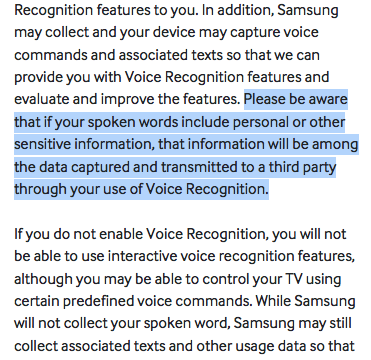

Parker Higgins @xor
Left [above]: Samsung SmartTV privacy policy, warning users not to discuss personal info in front of their TV
Right [below]: 1984
Then there are the rampant security issues with the internet of things that allow hackers – whether they are criminal, government or something in between – to access loads of data without any court order, like the creeps who were eavesdropping on baby monitors of new parents. Just a few weeks ago, a security researcher found that Google’s Nest thermostats were leaking users’ zipcodes over the internet. There’s even an entire search engine for the internet of things called Shodan that allows users to easily search for unsecured webcams that are broadcasting from inside people’s houses without their knowledge.
While people voluntarily use all these devices, the chances are close to zero that they fully understand that a lot of their data is being sent back to various companies to be stored on servers that can either be accessed by governments or hackers.
While Clapper’s comments are generating new publicity for this privacy worry, the government has known about the potential to exploit these devices for a long time. The then CIA director David Petraeus made clear that intelligence agencies would use theinternet of things to spy on people back in 2012, saying:
Items of interest will be located, identified, monitored and remotely controlled through technologies such as radio-frequency identification, sensor networks, tiny embedded servers, and energy harvesters – all connected to the next-generation internet using abundant, low-cost, and high-power computing.
As Wired put it, Petraeus was expressing excitement the CIA would soon be able spy on you through your dishwasher.
Author and persistent Silicon Valley critic Evgeny Morozov summed up the entire problem with the internet of things and “smart” technology in a tweet last week:
Evgeny Morozov @evgenymorozov
In case you are wondering what “smart” – as in “smart city” or “smart home” – means:
Surveillance
Marketed
As
Revolutionary
Technology
From the Guardian
February 9, 2016
Spencer Ackerman and Sam Thielman in New York
Clapper did not name specific agency as being involved in surveillance via smart-home devices but said in congressional testimony it is a distinct possibility
The US intelligence chief has acknowledged for the first time that agencies might use a new generation of smart household devices to increase their surveillance capabilities.
As increasing numbers of devices connect to the internet and to one another, the so-called internet of things promises consumers increased convenience – the remotely operated thermostat from Google-owned Nest is a leading example. But as home computing migrates away from the laptop, the tablet and the smartphone, experts warn that the security features on the coming wave of automobiles, dishwashers and alarm systems lag far behind.
In an appearance at a Washington thinktank last month, the director of the National Security Agency, Adm Michael Rogers, said that it was time to consider making the home devices “more defensible”, but did not address the opportunities that increased numbers and even categories of connected devices provide to his surveillance agency.
However, James Clapper, the US director of national intelligence, was more direct in testimony submitted to the Senate on Tuesday as part of an assessment of threats facing the United States.
“In the future, intelligence services might use the [internet of things] for identification, surveillance, monitoring, location tracking, and targeting for recruitment, or to gain access to networks or user credentials,” Clapper said.
Clapper did not specifically name any intelligence agency as involved in household-device surveillance. But security experts examining the internet of things take as a given that the US and other surveillance services will intercept the signals the newly networked devices emit, much as they do with those from cellphones. Amateurs are already interested in easily compromised hardware; computer programmer John Matherly’s search engine Shodan indexes thousands of completely unsecured web-connected devices.
…
Clapper’s admission about the surveillance potential for networked home devices is rare for a US official. But in an overlooked 2012 speech, the then CIA director David Petraeus called the surveillance implications of the internet of things “transformational … particularly to their effect on clandestine tradecraft”.
…
The White House’s new cybersecurity initiative, unveiled on Tuesday, pledged increased security for nontraditional networked home devices. It tasked the Department of Homeland Security to “test and certify networked devices within the ‘Internet of Things’.” It did not discuss any tension between the US’s twin cybersecurity and surveillance priorities.
Connected household devices are a potential treasure trove to intelligence agencies seeking unobtrusive ways to listen and watch a target, according to a study that Harvard’s Berkman Center for Internet and Society released last week. The study found that the signals explosion represented by the internet of things would overwhelm any privacy benefits by users of commercial encryption – even as Clapper in his testimony again alleged that the growth of encryption was having a “negative effect on intelligence gathering”.
The report’s authors cited a 2001 case in which the FBI had sought to compel a company that makes emergency communications hardware for automobiles – similar by description to OnStar, though the company was not named – to assist agents in Nevada in listening in on conversations in a client’s car.
In February 2015, news reports revealed that microphones on Samsung “smart” televisions were “always on” so as to receive any audio that it could interpret as an instruction.
“Law enforcement or intelligence agencies may start to seek orders compelling Samsung, Google, Mattel, Nest or vendors of other networked devices to push an update or flip a digital switch to intercept the ambient communications of a target,” the authors wrote.
Posted under Fair Use Rules.
The hack targets remote shut-off devices that utility companies install on air conditioners to conserve energy during peak summer periods. Many power companies offer discounts to customers if they agree to install the devices, which let the utility company remotely turn off their air conditioner when it’s hot outside and demand for power is high…A hacker could cut air conditioners during a heatwave—creating a potentially fatal condition for the elderly and sick…”
Question: What is the difference in risk to the public during a heatwave from a hacker versus the power company ?
Answer: There is no difference. Both endanger public health, especially for the elderly and sick.
More Smart Grid/Internet of Things “benefits”
From Wired.com
By Kim Zetter
February 2, 2016
TENERIFE, Spain—There are many ways we know of to cause a blackout. You could hack industrial equipment to spin a generator out of control. You could hijack operator machines and remotely open breakers. Or you could launch a sniper assault on substations and shoot out transformers.
Now researchers have found another way to take down the power grid: by remotely manipulating home and office air conditioners to create a surge. It’s an attack that grid experts told WIRED has the potential to be very serious.
The hack targets remote shut-off devices that utility companies install on air conditioners to conserve energy during peak summer periods. Many power companies offer discounts to customers if they agree to install the devices, which let the utility company remotely turn off their air conditioner when it’s hot outside and demand for power is high.
The devices, which can be installed on both central air conditioning systems as well as window-installed units, can be easily manipulated by hackers, say Vasilios Hioureas of Kaspersky Lab and Thomas Kinsey of Exigent Systems, who conducted their research as part of the Securing Smart Cities initiative. The two presented their findings today at the Kaspersky Security Analyst Summit.
The way the system works is that operators at regional power centers send a command via radio frequency that gets amplified through repeater stations installed throughout a city to reach the devices and shut down air conditioners. But because the systems Hioureas and Kinsey examined don’t encrypt that communication and don’t use authentication to prevent unauthorized parties or systems from communicating with them, anyone in the vicinity who can emit a stronger signal than the one the utility company sends out through the repeater stations can manipulate the devices as well.
“Anyone with $50 can generate a signal that can trump a repeater [to take out a few air conditioners]; and anyone with $150 can generate that through an [amplifier] and presumably take out a whole neighborhood,” says Kinsey. “And obviously you can scale that up as much as you want to [depending on the strength of your signal].”
A hacker could directly attack a group of homes or offices by taking advantage of the fact that unique IDs are assigned to groups of devices, allowing them to be singled out.
A hacker could cut air conditioners during a heatwave—creating a potentially fatal condition for the elderly and sick—or turn air conditioners on during peak energy periods, causing a surge that creates a widespread blackout. Or a hacker could directly attack a group of specific homes or offices by taking advantage of the fact that unique IDs are assigned to groups of devices, allowing them to be singled out.
According to another researcher, the hack could be even worse. If an attacker were to turn the air conditioners on and off repeatedly, the could create disturbances and imbalances in the grid that could trip breakers beyond the neighborhood they’re targeting and cause an even more widespread blackout.
“This is bad, and that’s why we need better security so that we don’t have the ability to manipulate the load,” says Eric Johansson, founder of Management Doctors, a security firm in Sweden that specializes in SCADA. “You shouldn’t be able to do this.”
The attack against the devices requires little skill. All a hacker would need is to be on the same radio frequency as the utility company, and then they could monitor and record the commands the company sends to the devices (a technique known as sniffing). From there, they could just play back those recorded commands to other devices to get them to turn on or off (a so-called “replay” attack).
“This is the funny part, to show how ridiculously insecure it really is, you don’t have to even know anything or reverse-engineer anything and you can reproduce the result [by doing a replay attack],” says Hioureas.
An attacker could also simply jam the RF traffic with noise to prevent the power company from communicating with the devices to turn air conditioners on or off, simply preventing them from shutting down the devices during peak hours.
The two researchers wouldn’t identify the devices they examined since they’re still in the process of reaching out to vendors. But Kinsey says that the chips used in some of them are so out-dated and limited—one system they examined used a chip made in 1995—that even if the vendors wanted to add authentication to make the devices more secure he doubts they could do it.
“It doesn’t look like there’s room [to add authentication]…it looks like the hardware is not capable of doing something like that,” he says.
http://www.wired.com/2016/02/how-to-hack-the-power-grid-through-home-air-conditioners/
Posted under Fair Use Rules.
From KQED
February 3, 2016
A trio of lawmakers proposed the most far-reaching reform of the embattled California Public Utilities Commission to date, rolling out legislation Wednesday that would ask voters to strip the agency’s constitutional authority and allow the Legislature to redistribute its power to other state agencies.
The constitutional amendment, which two-thirds of the Legislature would have to support in order for it to be placed before voters in November, comes as natural gas continues to spew from the Los Angeles County suburb of Porter Ranch.
And, as lead author Assemblyman Mike Gatto said, questions are being raised over whether the CPUC could have prevented the natural gas storage well leak in the first place.
“The people of the state of California are deeply concerned with the CPUC’s failures in recent years — you have people in the Bay Area, justifiably concerned about a pipeline explosion; you have folks in Orange County worried about nuclear waste; Sacramento and the Central Valley is on edge about rail safety, specifically oil trains; and of course Los Angeles is deeply concerned after a gas leak,” said Gatto, D-Los Angeles, chair of the Assembly’s Utilities and Commerce Committee.
“With each of these issues, lawmakers and the media have identified specific failures by the CPUC to do its job properly or, in some cases, ethically,” Gatto added. “With the Porter Ranch gas leak, the CPUC was notified in writing of serious corrosion and the likelihood of a leak as far back as 2014. And as far as we can tell, they did nothing.”
In a statement, the CPUC wrote that “there is still much to do, and we look forward to working with the Legislature on any constructive and helpful reform initiative that is put forward. Only by working together on real changes that have the ability to succeed can we make the CPUC stronger and more efficient, and our relationship with the Legislature more productive.”
The Porter Ranch situation is just the latest in a string of scandals to rock confidence in the CPUC’s regulatory track record and raise questions over whether the agency is too close to the companies it oversees. In September 2010, a Pacific Gas & Electric Co. gas line exploded in a San Bruno neighborhood, killing eight people; there are also ongoing questions over how much ratepayers were stuck with after the San Onofre nuclear power plant was shut down.
Last year, Gov. Jerry Brown vetoed six bills that would have changed how the commission conducts business. Three bills by now-Assembly Speaker Anthony Rendon would have established new oversight measures on the commission.
Another of the vetoed bills, by state Sen. Mark Leno, D-San Francisco, would have tightened rules on private communications between utility executives and state regulators. It also would have tightened conflict-of-interest rules and limited the CPUC president’s powers. And two bills from state Sen. Jerry Hill, D-San Mateo, would have set performance criteria for the agency and included commission meetings in transparency laws.
Brown’s office declined to comment.
Lisa Pickoff-White contributed to this report.
http://ww2.kqed.org/news/2016/02/03/lawmakers-propose-stripping-power-from-cpuc
Posted under Fair Use Rules.
From EMFacts
February 4, 2016
Following a similar vein as the last blog message,”Report from the Science and Wireless 2015 event in Australia” the 2014 book, Science For Sale by David Lewis PhD is relevant reading. The sub title is:
How the US government uses powerful corporations and leading universities to support government policies, silence top scientists, jeopardize our health, and protect corporate profits.
However the title would be just as accurate if it alternatively read: ‘How powerful US corporations use the government’, etc – considering the “revolving door” between corporate America and the government where govt. agencies are effectively given over to corporate control in exchange for large election donations. If it was in a 3rd World country it would be condemned as outright corruption. In the USA however, its just accepted as business as usual.
In 2015, former president, Jimmy Carter expressed concerns over widespread corporate influence over the American government, which he saw as an Oligarchy. To quote:
Now it’s just an oligarchy, with unlimited political bribery being the essence of getting the nominations for president or to elect the president. And the same thing applies to governors and U.S. senators and congress members. So now we’ve just seen a complete subversion of our political system as a payoff to major contributors, who want and expect and sometimes get favors for themselves after the election’s over. … The incumbents, Democrats and Republicans, look upon this unlimited money as a great benefit to themselves. Somebody’s who’s already in Congress has a lot more to sell to an avid contributor than somebody who’s just a challenger.
So, now to Science For Sale:
From the fly leaf:
When Speaker Newt Gingrich greeted Dr. David Lewis in his office overlooking the National Mall, he looked at Dr. Lewis and said: “You know you’re going to be fired for this, don’t you?” “I know,” Dr. Lewis replied, “I just hope to stay out of prison.” Gingrich had just read Dr. Lewis’s commentary in Nature, titled “EPA Science: Casualty of Election Politics.” Three years later, and thirty years after Dr. Lewis began working at EPA, he was back in Washington to receive a Science Achievement Award from Administrator Carol Browner for his second article in Nature. By then, EPA had transferred Dr. Lewis to the University of Georgia to await termination—the Agency’s only scientist to ever be lead author on papers published in Nature and Lancet.
The government hires scientists to support its policies; industry hires them to support its business; and universities hire them to bring in grants that are handed out to support government policies and industry practices. Organizations dealing with scientific integrity are designed only to weed out those who commit fraud behind the backs of the institutions where they work. The greatest threat of all is the purposeful corruption of the scientific enterprise by the institutions themselves. The science they create is often only an illusion, designed to deceive; and the scientists they destroy to protect that illusion are often our best. This book is about both, beginning with Dr. Lewis’s experience, and ending with the story of Dr. Andrew Wakefield.
Review by Robert F. Kennedy Jr.:
“David Lewis has been a beacon of integrity against the apocalyptical forces of ignorance and greed endeavoring to divert science from the noble pursuit of truth and pervert it into a tool that supports the most destructive policies of industry and government.”
“Without individual assumption of responsibility, proper function of government at any level cannot be assured.”
From the New American
by Kelly Holt
13 January 2016
When residents of Smithville, Texas, learned the city had contracted for major utility infrastructure changes, including an analog-to-smart meter conversion, no one was prepared for what happened next. At a citizen-led meeting on November 5, the city council endured what some believed was well-deserved backlash for not communicating the decision to the public. Also, many folks claimed concerns over bigger issues associated with Smart Meters, such as potential adverse health and fire hazards, privacy and cybersecurity concerns, and the probability that the city entered into a Public Private Partnership (P3) to fund the project. Weeks later a truce was reached when the council voted to provide an “opt-out” choice (at a cost) for utility customers wishing to retain their analog meters. Once in a while you can fight city hall. Sort of.
After learning that the city council wasn’t offering an opt-out (available in other Texas cities) with the conversion, a few opponents hosted the November meeting with startling results. By simple bulk-mail invitation, residents were encouraged to attend the meeting discussing potentialities of smart electric meters. An unprecedented number showed up to hear two representatives from Ameresco (the contract vendor) and two speakers (in opposition) from other Texas towns debate the apparatuses. But many attendees didn’t wait for the presentations to begin before shouting questions to anyone listening — the highly charged assembly became an unintended forum for residents voicing their anger that such an important, and expensive, decision had been made without any resident input or proper vetting of problems inherent with the devices. The gathering degenerated to a showdown when one council member who was present heatedly defended the council’s decision, but too little, too late — folks were angry.
One resident described the meeting as “almost an insurrection,” after which a woman in the hall secured the moderator’s notes, turned a page over, and started an on-the-spot petition to urge the council’s reconsideration of the entire project. The city quickly responded by hosting three meetings to explain the project, and then to offer a proposal for allowing a customer “opt-out.” In spite of the council’s quick and thorough response, it wasn’t enough to assuage all concerns — many residents began their own research and found that Smart Meters might not be such a smart Idea. In the meantime, some opponents urged the like-minded to pull out the paint — in Texas, believe it or not, a post or boundary marker painted purple is codified as a legitimate and binding “No Trespassing” warning — effectually putting meter installers on notice.
Yet lost in the shuffle was perhaps the most important discussion of all — in spite of council attempts to explain the project’s complicated funding, most folks still don’t understand it. Smithville, like many cities, moved away from traditional bid procedures when considering this new project.
Journalist Alex Newman has done comprehensive research when it comes to Smart Meters, including the funding mechanisms used for most U.S. projects.
Of course, the rollout of the smart meters in the United States, like countless other ongoing controversies, was funded in large part by billions of American taxpayers dollars through the 2009 “stimulus” scheme passed by Democrats in Congress and demanded by Obama. “It will make our grid more secure and more reliable,” Obama claimed at the time in announcing the stimulus-funded “Smart Grid” plot.
Smithville City Manager Robert Tamble recounted expressing incredulity when informed by vendor Ameresco Account Executive George Rash that the Smithville project could be implemented without cost to the city, a “revenue-neutral” project. Through a complex agreement using a Qualified Energy Conservation Bond (QECB) it is, at its source, funded by such stimulus monies as reported by Newman.
A QECB is defined as such: “In the American Recovery and Reinvestment Act of 2009 (ARRA), Congress increased to $3.2 billion the total face amount (‘allocation’) of QECBs that states, territories, large local governments, and tribal governments could issue to finance renewable energy and energy efficiency projects.”
Now you know what happened to the money you lost in 2008. But what does all that mean? P3s, not often identified as such in a contract, have this in common. Government (read taxpayer) funds are used to guarantee profits to a private investor contracted for a public project. Profits are generated at taxpayer expense, but due to the long-term nature of most P3s, it’s difficult to predict all possible contingencies. In the end, a P3 simply privatizes profits and makes the public pick up losses. Witness the granddaddy of all P3s (at the time) when the monstrously unpopular TransTexasCorridor (TTC) was exposed a decade ago. Funded by a P3 involving Cintra (Spain) and Texas Department of Transportation, the scheme put taxpayers on the hook for any toll-derived revenue that failed to materialize. A decade later, the only completed portion of the TTC faced exactly that. Due to a lack of toll road use, projected revenue wasn’t met, Cintra faced bankruptcy, and taxpayers were first up for the loss.
No wonder people struggle with new-fangled funding mechanisms, never mind the ethics involved. Jim Keller, a Smithville property owner and one of the folks leading the opposition, put it this way, “It’s a lot harder to ‘un-buy’ a high-tech solution, than it is for well-meaning leaders to borrow the money and unwittingly commit a boondoggle.”
Indeed. And in Texas, opposition continues. As early as 2012, after Smart Meter projects began rolling out across the state, hundreds of folks showed up at a Public Utilities Commission hearing seeking ways to opt-out of having Smart Meters installed on their homes. And the controversies remain. On November 6, one day after the Smithville citizen meeting, Texas House Speaker Joe Straus charged the Texas Legislature to (among other things):
Examine how the Public Utility Commission of Texas, when applicable, and utility providers, whether vertically integrated, privately owned, or municipally owned, can ensure consumer protection regarding metering devices for water, gas, and electricity service. Review recent examples of inaccurate or confusing billings and offer recommendations on appropriate consumer recourse and appeal.
Left unclear for now is what “ensured consumer protection” and “consumer recourse” will look like, but it’s a start. The issue’s once again on the radar at the state level.
Tamble responded to citizens’ concerns by crafting an opt-out, but said he hadn’t known about the idea until residents made him aware, although in this unorthodox way. He promised the city would do a better job in communicating with the public, but admonished residents to do their parts. In other words, had folks taken a more participatory role in civic affairs, they wouldn’t have been so surprised. Many still grumble that the project is here to stay, but securing the opt-out choice at the last minute was no small feat.
In fact, Tamble’s right. Without individual assumption of responsibility, proper function of government at any level cannot be assured. The take-away should be that with a proper government, and adequate citizen education, government creep and loss of liberty might look a whole lot different.
George Rash of Ameresco was contacted for this article, but hadn’t responded by press time.
http://www.thenewamerican.com/tech/item/22316-petitions-purple-posts-and-public-private-partnerships
Posted under Fair Use Rules.
From Alliance for Natural Health
January 6, 2016
As the huge and increasingly expensive smart meter rollout continues in many continents and countries across the world, there is now clear evidence that the ‘benefits’ of the controversial electro-magnetic radiation (EMR) emitting devices for consumers have been vastly overplayed, whilst the risks have been entirely underplayed.
In the UK, a particularly ambitious £1 billion mass rollout of electricity and gas smart meters is planned for 2016 with the installation of 7 million devices. However, it is believed the wider government plans on which the project depends, may spectacularly fail. The plans have to be accepted by industry players as well as the European regulators, and are at the mercy of continually changing specifications for both the hardware and government IT central communications system required for effective operation of the smart meters.
No health impact studies demonstrating safety of these wireless devices were undertaken prior to global rollout, but there have since been limited studies conducted that indicate that EMR exposure from these devices can detrimentally affect health.
As 2015 drew to a close, news reports indicated that further smart meter rollout was planned in Norway, Holland, France, Denmark, Eastern Europe, the Asia Pacific countries, as well as in the UK. In Gauteng, South Africa, plans are underway to install smart prepaid electricity meters.
Meanwhile, in North America, deployment is now slowing down, whilst concern is most certainly not. In Victoria, Australia, smart meter installation was completed in all homes and businesses by June 2104. The Victorian Auditor-General’s Office (VAGO) found that, despite a cost of of AU$2.2 billion, “only 80 percent of the benefits predicted originally are currently being realised”, and that there was “a real risk that the expected benefits will not be achieved”.
The UK government aims to have installed electricity and gas smart meters “in every domestic property in Great Britain by 2020”. The government has said installation is not obligatory, though citizens of other countries will need to check their rights where they live. The UK also plans to ‘force’ two million non-domestic premises to install the devices by then, too, including “small shops, schools and large businesses”. However, the latter organisations “can currently opt out of the scheme if they install lower-spec ‘advanced meters’ by April 2016”.
Yesterday, The Times reported that industry critic Alex Henny has described the project as a ‘ghastly mess’ that would not work and is a waste of money. Despite continuing promised benefits from smart meters, British Gas have reportedly admitted recently that consumer savings amount to a meagre £26 per year. Other energy-saving measures are said to be ‘far more cost effective’.
Of the 1.3 million smart meters already installed in the UK, 1 in 10 will be unable to function correctly until the associated central communications system is up and running later in the year. This is due to the incompatibility between the systems being used by different energy providers. Devices that have been installed in the first wave may need replacing altogether, along with many others which have been stockpiled awaiting installation.
More serious on the long list of smart meter issues of concern are the associated EMR health risks, which we have consistently highlighted. It was recently reported that the Maine Supreme Court was to “Hear Arguments Over Smart Meter Safety”.
After the completion of smart meter installation in Victoria, Australia in 2014, a case series article was published in Alternative Therapies in Health and Medicine, which evaluated information submitted by 92 of the residents, reporting “adverse health effects from wireless smart meters” via “an Australian public Web site using its health and legal registers”. The figure below shows the most common figures reported. Partially on the basis of this information, the American Academy of Environmental Medicine (AAEM) in 2013 “called for a moratorium on the deployment on smart meters in favor of using safer technology”.

Smart meters are still being rolled out globally with no safety testing. The late, respected environmental activist, Dr Ilya Sandra Perlingieri, stated back in 2012 that, “We have been given no informed consent to this dangerous but invisible exposure” and nothing much has changed in the last 3 years. No wonder there is growing opposition to global smart meter rollout as more and more people become informed.
Get informed and do your research before you agree to having a smart meter in your home. If you’re in the UK, you can still opt out by writing to your energy company.
Look up and make contact with your local group or groups opposed to smart meters, and find out about your rights to refuse or opt out, and the steps you would need to take.
Share information with your neighbours and local community, particularly if you live in terraced, conjoined housing or apartments
Keep up to date with developments, both local and global
Please like and share our posts, to help spread awareness and support the work we do.
From the Times
January 4, 2016
by Robin Pagnamenta, Energy Editor
An £11 billion project to install more than 50 million smart electricity and gas meters in homes is a “ghastly mess” that will not work, according to a leading figure in the energy sector.
Alex Henney has written to Amber Rudd, the energy secretary, warning that the rollout, due to start this year, is a disaster in the making.
Mr Henney, who advised a previous Conservative government on the privatisation of the electricity market and is a former director of London Electricity, said that at best the scheme would be regarded as a waste of money.
For the complete article, http://www.thetimes.co.uk/tto/business/industries/utilities/article4655613.ece
Subscription required to read full article

