New Hampshire energy cooperative says all Elster Smart Meters purchased are defective

The Cooperative claims that the meters are accurate, however. 

From the Laconia Daily Sun

New ‘Smart’ Electric Meters Not So Smart
By Bea Lewis, for the Laconia Daily Sun
October 4, 2016

NHEC sues device manufacturer

PLYMOUTH – The New Hampshire Electric Cooperative claims the 83,000 “smart” meters it bought as part of a multi-million-dollar system upgrade are defective, and have flooded their dispatch center with erroneous electronic messages reporting power outages.

The complaint filed Wednesday in U.S. District Court in Concord, names as plaintiffs Elster Solutions LLC, the North Carolina-based manufacturer of the allegedly flawed Type RS2 digital meters, as well as Honeywell International Inc., headquartered in New Jersey, who acquired Elster in a $5.1 billion deal announced in July 2015.

Prior to its sale, Elster claimed between 2001 and 2011 to have deployed more than 200 million metering devices worldwide, making it one of the largest electricity gas and water measurement and control providers.

The meters at issue in the suit, were purchased as part of a $35 million Advanced Metering Infrastructure project the member-owned and controlled electric distribution utility undertook to provide better service. The intent was twofold, to bolster operational efficiency and to improve outage reporting and management.

The nonprofit rural electric cooperative picked the Elster platform because it is capable of providing advanced services in the future, including allowing the NHEC and its members the ability to manage their energy usage during peak pricing periods by alerting consumers to the costliest hours of the day to use electricity.

The suit claims Elster continued to supply the NHEC with defective meters even after discovering the problem, and may even have been aware that a defect existed at the time it signed the contract with the state’s second largest utility, headquartered in Plymouth.

Attorneys Edward M. Kaplan and Derek D. Lick of Sulloway & Hollis PLLC of Concord, assert that NHEC was “compelled” to file suit, because Elster sold them meters known to contain a manufacturing defect, making them prone to failure, undermining the reliability and core functionality of the Cooperative’s entire smart grid system.

“We are aware of a complaint by the New Hampshire Electrical Cooperative, and while as a matter of policy Honeywell does not discuss pending litigation, we stand behind the quality of our products, and the service and support we offer our customers. Elster was acquired by Honeywell in January of this year,” said Bruce Anderson Director of Public Relations for Honeywell.

The NHEC notified the state’s Public Utilities Commission that it was launching litigation against the meter maker on Wednesday, the same day the suit was filed, said Amanda Noonan, Director of Consumer Services and External Affairs for the PUC. As a rural electric cooperative, Noonan said, the NHEC is subject to different types of regulation and that they didn’t need PUC approval for meters they plan to install. The PUC does however review capital investments made by the NHEC to assure that they are prudent, she said.

The suit asserts that the meters that work in conjunction with a new communication “backbone” including a microwave and fiber optic network connecting 20 tower sites, are an integral component of the Smart Grid Project.

Unlike traditional meters that must be individually read manually by a NHEC employee physically going to a property, the smart meters, relay encrypted power consumption statistics wirelessly several times a day. When working properly, the meters are also designed to send a “last gasp” signal reporting a loss of power, allowing the NHEC to promptly send a repair crew to the precise affected area.

According to the NHEC, the defect does not affect meter accuracy.

“NHEC has always had internal procedures/processes to test and assure that each meter is properly reading/counting kilowatt hour useage – regardless of the type of meter used,” said company spokesman Seth Wheeler. “These best-practice procedures remain in place today. If, for any reason, a meter fails to report its usage, NHEC has internal prodecures to get the usage data or use a process to estimate the bill based on hourly data previously reported.”

NHEC signed a contract with Elster in February 2011 to provide the meters and software necessary for their integration into the overall electrical system. According to the suit, the NHEC relied on representations by Elster that its meters had a failure rate of 3/10ths of one percent or less. Based on that representation the NHEC believed that only 250 of the meters would be expected to fail over the 20-year period the manufactured cited as the expected lifespan of its product.

The NHEC began replacing its old meters with those made by Elster in June 2011, with the manufacturer supplying about 5,000 a month to allow for rolling installations throughout the 115 towns and cities that the cooperative serves.

In March 2012, after NHEC had installed about 50,000 of the new meters, Elster issued a formal bulletin announcing that a manufacturing defect had been identified in the main circuit board on the type of meters NHEC had purchased. The bulletin detailed that the defect manifested itself in three different ways, including that the “meter indicated that there is a power outage when one is not present and stops communicating,” or the is data stops being added and shows zero consumption.

Elster initially told NHEC that 54,000 of the 83,000 meters it had bought were affected by manufacturer defects. The suit says Elster later advised the NHEC that the problems were traced to a too small computer chip that was replaced with a larger one during the manufacturing process, and that it cured the defect. All 83,000 of the meters bought by NHEC contained the defective small chip, the suit charges.

The NHEC is making claims for breach of contract, breach of the covenant of good faith and fair dealing, breach of implied warranty of fitness for a particular purpose, unjust enrichment, fraudulent misrepresentation/concealment, negligent misrepresentation, and breach of the N.H. Consumer Protection Act.

Shortly after the contract was signed, Mark Munday, president and CEO of Elster, said the company had successfully deployed Smart Grid projects of different sizes across varied terrains, helping utilities around the world improve both energy delivery and customer service and was bringing “this depth of experience” to the NHEC project.

“NHEC understands the importance of ensuring its Smart Grid deployment is done right the first time and that members are engaged in its many benefits,” Munday said in a press release posted on his company’s web site dated Feb. 24, 2011.

http://www.laconiadailysun.com/newsx/local-news/98483-new-smart-meters-proving-to-be-not-so-smart-xx

Posted under Fair Use Rules.
Posted in Uncategorized | Tagged , , , , | Comments Off on New Hampshire energy cooperative says all Elster Smart Meters purchased are defective

UK: Smart Meter rollout suffers further delay

How about a moratorium, a cease and desist, a complete work stoppage and program cancellation?

BEIS is still rolling out Smart Meter technology despite the UK and international expert reports on cost, security, and other problems. It’s too late in the international roll-out to claim ignorance. 

From Building, Design & Construction Magazine

October 4, 2016

The full smart meter rollout has been hit with a further delay, as the smart meter network operator missed its deadline for go-live.

The Data and Communications Company (DCC) was due to go live on September 30, after a number of delays since its initial date in December 2015.

The Department for Business, Energy and Industrial Strategy (BEIS) have not yet confirmed a new date but the infrastructure is crucial to connect smart meters to business systems of energy suppliers, network operators and other authorised service users of the network.

A spokesperson for the DCC commented: “The national data and communications infrastructure is in the final stages of testing and is making good progress. We are working hard to deliver the network at the earliest possible opportunity to the energy industry.”

The government has set out deadlines for the use of the DCC and meter installation as part of its plans to ensure a “timely” rollout, and ensure both energy suppliers and distribution network operators are ready to commence the rollout from the DCC go-live date.

All domestic suppliers are required to be using the DCC by August 1, 2017, while major suppliers will also have to install 1,500 SMETS2 meters by February 1, 2017.

A BEIS spokesperson said: “Smart meters will enable suppliers to deliver innovative products and services and help consumers to bring down their energy bills. This new infrastructure will make it easier for consumers to switch and is in the final stages of testing.”

The industry is already concerned about meeting the target of offering a smart meter to all UK householders by 2020. Consultancy business KPMG has warned that the current installation rate would have to rise five-fold in order to meet the target.

KPMG power and utilities director Amy Marshall added: “The number of smart and advanced meters operating in UK homes and small businesses now stands at 4.2 million, as the race towards hitting the 2020 government target intensifies.

http://www.bdcmagazine.com/civil-engineering/energy-utilities/smart-meter-rollout-suffers-delay-14267

Posted under Fair Use Rules.

Posted in Uncategorized | Tagged , , , , , | Comments Off on UK: Smart Meter rollout suffers further delay

Illinois approves Ameren’s accelerated Smart Meter/AMI deployment; ComEd partners in smart water meter pilot

From Metering.com

October 4, 2016

In the US, the Illinois Commerce Commission approved Ameren Illinois’ revised smart grid AMI deployment plan.

In 2012, the Missouri-based power company received approval from the Illinois Commerce Commission for its advanced metering infrastructure (AMI) deployment plan, which provided for, among other things, deployment of AMI to 62% of the company’s electric delivery customers by 2019.

The Illinois Commerce Commission approved Ameren Illinois’ revised smart grid AMI deployment plan

Ameren filed a verified petition in May requesting that the ICC revise its proposal to consider changes to the AMI plan. The power company plans to accelerate the AMI deployment schedule to complete 62% of its smart meters deployment by 2018, as well as the expansion of AMI deployment to 100% of its electricity customers. [ Illinois Energy Innovation Board issues grants to further smart meter literacy ]

The company said that the AMI plan originally approved in Docket No. 12-0244 assumed that the company would complete the deployment of AMI to 62% of electric customers by the end of 2019, but Ameren now proposes to complete deployment of AMI to 100% of electric customers by the end of 2019.

Ameren Illinois, a unit of Ameren Corporation, launched its grid improvement initiative in 2012 after the state passed the Energy Infrastructure Modernization Act, which enables the company to recover the costs of capital for infrastructure improvements and enhancements to the electric distribution system.

Under its modernization plan, Ameren Illinois said that it has installed storm-resistant utility poles, stronger power lines, and outage detection technology in communities throughout central and southern Illinois. The company also said that more than 345,000 customers have received new two-way meters that facilitate access to energy saving tools and programmes. Smart water pilot

In related news, US water utility Illinois American Water parnered with power utility ComEd in March this year for the rollout of a smart water meter pilot. [ ComEd and Illinois utility collaborate on smart water meter pilot ]

American Water set out to better manage its distribution network by utilising ComEd’s smart grid network to transmit water data.

In a press statement, ComEd said the main aim of the project is to test the use of smart water meters on its network.

The development follows ComEd’s lab test of its network’s ability to connect smart water meters.

Chairman of the Illinois Commerce Commission, Brien Sheahan, said: “To develop innovative energy policy, regulators must be forward-thinking and aware of the critical issues facing cities, and utilities must address such issues head on by delivering programs that seek to increase customer value through advancements in smart grid technology.”

https://www.metering.com/news/illinois-utility-ami-rollout-approved

Posted in Uncategorized | Tagged , , , , , , | Comments Off on Illinois approves Ameren’s accelerated Smart Meter/AMI deployment; ComEd partners in smart water meter pilot

France: Village sued for refusing Linky (Smart) meters; 270 municipalities refuse meters

Posted on Connexion
October 12, 2016

Tiny Dordogne commune of just 160 residents has been taken to court in Bordeaux after refusing to allow Linky smart electricity meters to be installed.

Montferrand-du-Périgord, about 30km east of Bergerac, was taken to court by the prefecture and national grid company Enedis which wanted the suspension of an anti-Linky by-law and the payment of €4,000 in costs and damages.

It is just one of about 270 communes across the country opposing installation of the Linky meters, which are intended to give consumers information on their consumption but also to allow Enedis to make large savings by allowing tasks to be done without an on-site technician.

About 20 of the communes are in Dordogne, where the first of the meters is due to be installed next summer, with Montferrand not listed until 2019.

In court, a lawyer for Enedis (the former ERDF) said about three million meters had already been installed in France and had been working for months without any problems.

Montferrand council passed the anti-Linky by-law in July after complaints from residents about possible abuses of confidential data on their energy usage, fears of danger from electromagnetic waves and the fear of very high bills in future.

Enedis said that there was no possible data misuse as all information was anonymous and the data was transmitted by wire, so there was no aerial and no electromagnetic waves.

After the hearing, municipal councillor Patrick Delègue told reporters the €4,000 damages demanded would be equivalent to eight years of grants for the school library – and he hoped the judge would be understanding.

http://connexionfrance.com/Linky-meter-Montferrand-Perigord-court-Enedis-18515-view-article.html

Posted in Uncategorized | Tagged , , , , | Comments Off on France: Village sued for refusing Linky (Smart) meters; 270 municipalities refuse meters

Colorado: Energy bill quadrupled after Xcel installed “Smart” Meter

Protest a high bill and report it to the consumer affairs or attorney general’s office in your state or province. There is usually an appeal process where a customer does not have to pay the contested amount. This information is normally  on the back of the utility bill. Consider notifying local officials and the news media as well.

Before the customer contacted the news media, energy company Xcel said the bill was correct. After the customer contacted the news media, Xcel said the bill was a mistake and would issue a credit. 

From Fox 31 Denver:

September 5, 2016

DENVER — People around the Denver metro area are talking about new meters being installed by Xcel Energy in homes and saying they seem to be anything but smart.

However, Xcel says these new meters are not “smart meters,” even though many customers believe they are. The company has asked regulators for permission to start installing those types of meters starting next year.

One customer, Patsy Smith, lives in a 700-square-foot home and said she is conscientious about her energy use by unplugging things when they are not in use.

But with the new meter, her bill jumped from an average of $50 a month to $180. She has called Xcel several times, but it said there is nothing that can be done about her bill.

After sharing Smith’s story, the FOX31 Problem Solvers heard from many other Xcel customers who saw bills go up after new meters were installed.

This month, Xcel said Smith used more than 1,100 kilowatts of electricity, up from her average of 300. According to Xcel’s website, that’s more than a small commercial business uses in an average month.

“That’s impossible,” she said.

It’s also about four times more electricity use than her highest month.

“I thought it was a mistake,” she said. [It is.]

Smith said she has called Xcel three times and time she was told that it was normal.

“I will have to work my hours just to pay my electric bill and I’m working quite a few right now,” she said.

The Problem Solvers reached out to Xcel and spoke to an official on Tuesday.

A company spokeswoman said it looks like there was a mistake with Smith’s bill.  They are investigating whether it was a mechanical or human error, but they will correct her bill.

Xcel adds it has been a hot summer and people may notice higher than average utility bills.  But the spokeswoman says if you suspect a mistake, contact their customer service at the number on your bill.

Problem solved: Woman’s energy bill quadrupled after Xcel installed new meter

Posted under Fair Use Rules.

Posted in Uncategorized | Tagged , , , , , | Comments Off on Colorado: Energy bill quadrupled after Xcel installed “Smart” Meter

Your kitchen appliances and Smart Meter are watching you, security expert warns

From Bloomberg

Posted in Uncategorized | Tagged , , , , , | Comments Off on Your kitchen appliances and Smart Meter are watching you, security expert warns

Maine: CMP customers who refuse to pay opt-out fees get disconnect notices

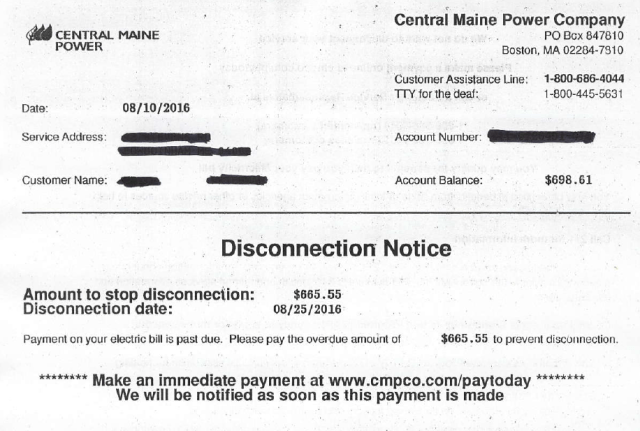
In Maine, people have been fighting Smart Meters at the public utility commission and in the courts. In addition, some customers of Central Maine Power have refused to pay Smart Meter opt-out fees ordered by the PUC. They have clearly stated that these fees amount to extortion in order to protect their health and privacy, and as such are illegal.

Now CMP is threatening to disconnect their electricity. Notices were received last week. Here is an example:

CMP disconnect notice

These decisions can be appealed. Here is the information for CMP customers:

CMP right to appeal info

Posted in Uncategorized | Tagged , , , , | Comments Off on Maine: CMP customers who refuse to pay opt-out fees get disconnect notices

UK: National smart meter initiative is “ongoing saga of cash burning”; £11bn later, Smart Meter project delayed again

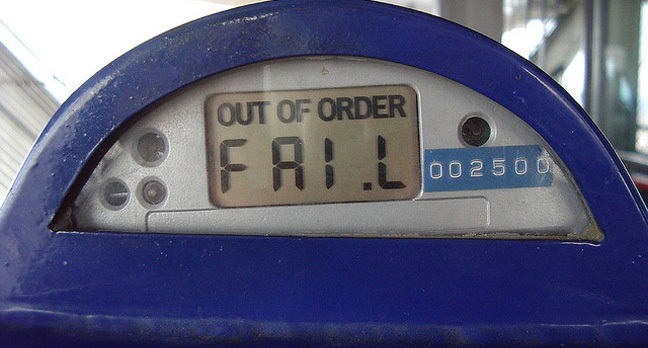
The photo below is a parking meter, but if the shoe fits……

From the Register

This would be funny if it wasn’t worth 31 years of non-existent Brexit NHS funding

17 Aug 2016
by Alexander J Martin

fail_parking_meter_648

There has been yet another delay in the ongoing saga of cash-burning that is the UK’s national smart meter initiative.

While the communications infrastructure was due to be switched on today, the £11bn project’s turn-on has now been delayed again until September, the BBC has reported.

The Data and Communications Company (DCC), which is responsible for providing the communications infrastructure for smart meters’ readings, is a subsidiary company owned by Crapita (often comically referred to as “Capita” by Private Eye), infamous for its outsourcing “successes”.

At the moment, Crapita has only managed to complete the design and build phase of the project, and despite plans to have it in operation by April last year, DCC is still testing the system ahead of the new live-date in September this year.

A spokesperson for the subsidiary told The Register: “As indicated by the Department, the timetable for the roll-out of the new infrastructure will allow for testing of the system to ensure that it will deliver a long-lasting and effective system.”

The project, which according to a 2014 Impact Assessment will arrive with a £11bn bill for consumers, was previously described as in danger of becoming a “costly failure” by a government report after a farcical number of delays and internal government warnings that it would most likely not be completed for another 50 years.

Last year, the Institute of Directors warned that the smart meter project would add billions to consumers’ bills and that the rollout “should be ‘halted, altered or scrapped’ to avoid a potentially catastrophic government IT disaster”.

Formerly run by the Department for Energy and Climate Change (DECC) — which has now become the Department for Business, Energy and Industrial Strategy (BEIS) — the project was initially intended to be operational by April 2015, though it was subsequently delayed until April 2016, then August 2016, and is now slated for September 2016.

Responding to The Register when we enquired regarding the delay, a BEIS spokesperson acknowledged the delay’s existence but did not provide any explanation of its cause, instead stating: “The roll-out of smart meters is the one of the most significant upgrades to Britain’s energy infrastructure making it fit for 21st century life.

“The new infrastructure is planned to go live at the end of September.” BEIS added, “It is currently being tested to deliver a long-lasting, world class system to bill payers. In the meantime energy suppliers continue to drive forward the programme, rolling out more than 3.6 million smart meters to homes and business across the country.”

http://www.theregister.co.uk/2016/08/17/smart_meters_delayed_again/

Posted under Fair Use Rules.

Posted in Uncategorized | Tagged , , , , , , | Comments Off on UK: National smart meter initiative is “ongoing saga of cash burning”; £11bn later, Smart Meter project delayed again

Maryland: Pepco disconnects electricity to family refusing to pay opt-out fees despite heat wave

The newspaper uses the key phrase “lack of any conclusive evidence”. This and similar phrases are repeatedly used by utility companies and regulatory agencies to confuse and deny. 

Who is responsible for “concluding?” With the rampant conflicts of interest throughout governmental agencies, so-called regulatory associations such as ICNIRP, and scientific journals, strong political pressure insures no “conclusion” will ever be reached to interfere with corporate profit.

When a term such as “no conclusive evidence” is used, the public is being frauded. The appropriate, science-backed response is, “There is substantial evidence of harm including the federal government’s own NTP results showing this radiation causes cancer. Are you willing to repeat another disaster like the tobacco, asbestos, and DDT cover-ups? How much evidence are you willing to ignore before you do your job?”

Pepco cannot even do proper record-keeping. I have seen the Pascalev’s payment record, and Pepco appears grossly incompetent in its bookkeeping. Whether this is intentional and retaliatory against the Pascalevs would be known only if there is an investigation. If other Pepco customers experience routine anomalies in their bills and improper crediting of payments, contact the Attorney General’s office
https://www.oag.state.md.us/consumer/

From the Bethesda Magazine

Bethesda Family Lives without Power While Refusing To Pay Pepco Fees
Pascalev family has been without electricity for 13 days during the hottest period of the summer

By Aaron Kraut
8-16-16

Tuesday is day 13 without power for the Pascalev family of Bethesda.

Pepco disconnected electricity service to the home on Sleaford Road after almost two years of husband Mario Pascalev and wife Assya Pascalev refusing to pay the utility’s $14-a-month fee for customers who opt out of its smart meter program.

Despite sweating through record heat over the weekend and more high temperatures Monday, the Pascalevs said they will continue their protest against smart meters, the opt-out fee requirement and what they claim is a series of inaccurate billing statements from Pepco. The couple has copies of checks sent to Pepco through certified mail showing they paid for their electricity use, but not the smart meter opt-out fee.

“There is the notion of unjust laws and civil disobedience against unjust laws,” Mario Pascalev said Friday while sitting in a downtown Bethesda Starbucks. “It is wrong and [Pepco] should not be able to force it on you.”

The family, which includes two teenage children age 13 and 18, have coped with the lack of air conditioning in the house by hanging out in Bethesda coffee shops and bookstores.

Chevy Chase resident Deborah Vollmer, whose power has remained on as she goes through a formal review process over her own refusal to pay Pepco’s smart meter opt-out fees, helped pay for part of the Pascalev family’s stay over the weekend in a downtown Bethesda hotel.

From 2011 to 2013, Pepco began replacing old electricity-reading meters on homes with digital smart meters—technology the utility and state regulators say provides more detailed information on energy use and can save customers money.

Maryland’s Public Service Commission, which regulates the utility industry, issued an order in February 2014 that established a $75 upfront charge and $14-per-month fee for Pepco customers who don’t get a smart meter. The regulators ruled utility companies around the state should be allowed to recover “incurred costs created by opt-out customers” still using the older meter technology.

Like Vollmer, the Pascalevs object to the smart meters by claiming they could emit harmful radiation, are a fire hazard and are a privacy concern because they could help Pepco track exactly when electricity is being used in the house.

When asked about the lack of any conclusive evidence linking the smart meters to harmful radiation, Assya Pascalev said the family would “rather err on the side of safety.”

“Until there is clarity one way or another, we’d rather take a precautionary approach,” said Assya Pascalev, a philosophy professor at Howard University. “I realize that under this current arrangement, we owe them the fees, but I disagree with the arrangement. I disagree with the principal by which this is being allowed to happen.”

The Pascalevs also disagree with how much Pepco says they owe in overdue payments. Pepco’s notice in May that electricity would soon be disconnected said the family owed $855.35 in overdue fees, an amount the Pascalevs said exceeded the opt-out fees they haven’t paid plus any additional late fees.

Confusing matters further is the fact the Pascalevs said they unknowingly paid the initial $75 upfront charge through three $25 payments in July, August and September 2014 because they had set up auto-pay for their Pepco bills and spent part of that summer on a vacation.

Assya Pascalev showed a reporter Pepco bills from October and November 2014 that contained two more $25 fees for the smart meter opt-out fee upfront payment. She also showed a reporter a copy of one payment the family sent Pepco in January 2015 that wasn’t deposited until earlier this month.

In a statement provided by Pepco after Bethesda Beat forwarded the Pascalev family’s complaints about billing inconsistencies, the company said “Pepco works with all of our customers to address any billing concerns.”

“Monthly opt-out fees are authorized by the Maryland Public Service Commission to cover the additional costs to maintain the legacy metering system, including paying for meter reading, for customers that refuse a smart meter,” the statement from Pepco read. “We have the right to disconnect service as a last resort if a customer refuses to pay their bill in entirety.”

Pepco spokesperson Marcus Beal said there are 1,489 customers in Montgomery and Prince George’s counties who have opted out of the smart meter program, about 0.3 percent of the company’s total customer base in those two counties.

The Pascalevs have asked for help from the Public Service Commission and elected officials such as Rep. Chris Van Hollen. They said their goal is to get Pepco to turn the power back on as they sort through the billing issues, but they acknowledged they can only last so long without power.

The first day of school is Aug. 29. “You can’t do school work in a Starbucks,” Mario Pascalev said.

“This makes it really hard because it’s not just the two of us,” Assya Pascalev said. “We have two children and we have a dog in the house. And we are responsible for them and although they are patiently supportive, the thing is it’s a lot of extra work. Just physically, it wears you down.”

http://www.bethesdamagazine.com/Bethesda-Beat/Web-2016/Bethesda-Family-Lives-without-Power-While-Refusing-To-Pay-Pepco-Fees/

Posted under Fair Use Rules.

Posted in Uncategorized | Tagged , , , , , , , , | Comments Off on Maryland: Pepco disconnects electricity to family refusing to pay opt-out fees despite heat wave

“The cloud never forgets”: Every move you make, every click you take, every appliance you use, they’ll be watching you

“[I]t’s already built a profile on every American adult, including young people who wouldn’t be swept up in conventional databases…”

Smart Meters and the Home Area Network provide the equivalent of a video feed of daily life inside homes and businesses, coupled with the actual data from computer cameras and security cameras. All archived.

Not just adults. Children and teenagers are the most lucrative market. Marketing firms and the government may not admit it, but databases on children are actively being compiled. Google is used by many school districts for district email. Data companies are hired by school districts to collect, organize, and create “individualized” learning plans. Where does that data go, along with Facebook, Twitter, online gaming, and all the online activity and school work of  children and teenagers? It is treasure archive for stalkers, marketers, and blackmail. The title “No Child Left Behind” was no mistake. It’s a dragnet.

Online buying means everything is tracked, versus in-person cash purchases. “Convenience” and “ease” replace safety and privacy.

Reminder: StartPage — http://www.startpage.com — is one of several internet search engines that allows you to search the internet anonymously.

From Bloomberg

August 5, 2016
By David Gauvey Herbert

Every move you make. Every click you take. Every game you play. Every place you stay. They’ll be watching you.

Forget telephoto lenses and fake mustaches: The most important tools for America’s 35,000 private investigators are database subscription services.

For more than a decade, professional snoops have been able to search troves of public and nonpublic records-known addresses, DMV records, photographs of a person’s car-and condense them into comprehensive reports costing as little as $10. Now they can combine that information with the kinds of things marketers know about you, such as which politicians you donate to, what you spend on groceries, and whether it’s weird that you ate in last night, to create a portrait of your life and predict your behavior.

IDI, a year-old company in the so-called data-fusion business, is the first to centralize and weaponize all that information for its customers. The Boca Raton, Fla., company’s database service, idiCORE, combines public records with purchasing, demographic, and behavioral data. Chief Executive Officer Derek Dubner says the system isn’t waiting for requests from clients-it’s already built a profile on every American adult, including young people who wouldn’t be swept up in conventional databases, which only index transactions. “We have data on that 21-year-old who’s living at home with mom and dad,” he says.

Dubner declined to provide a demo of idiCORE or furnish the company’s report on me. But he says these personal profiles include all known addresses, phone numbers, and e-mail addresses; every piece of property ever bought or sold, plus related mortgages; past and present vehicles owned; criminal citations, from speeding tickets on up; voter registration; hunting permits; and names and phone numbers of neighbors. The reports also include photos of cars taken by private companies using automated license plate readers-billions of snapshots tagged with GPS coordinates and time stamps to help PIs surveil people or bust alibis.

IDI also runs two coupon websites, allamericansavings.com and samplesandsavings.com, that collect purchasing and behavioral data. When I signed up for the latter, I was asked for my e-mail address, birthday, and home address, information that could easily link me with my idiCORE profile.

The site also asked if I suffered from arthritis, asthma, diabetes, or depression, ostensibly to help tailor its discounts. Users and industry analysts say the addition of purchasing and behavioral data to conventional data fusion outmatches rival systems in terms of capabilities-and creepiness. “The cloud never forgets, and imperfect pictures of you composed from your data profile are carefully filled in over time,” says Roger Kay, president of Endpoint Technologies Associates, a consulting firm. “We’re like bugs in amber, completely trapped in the web of our own data.”

When logging in to IDI and similar databases, a PI must select a permissible use for a search under U.S. privacy laws. The Federal Trade Commission oversees the industry, but PI companies are largely expected to police themselves, because a midsize outfit may run thousands of searches a month.

Dubner says most Americans have little to fear. As examples, he cites idiCORE uses such as locating a missing person and nabbing a fraud or terrorism suspect.

IDI, like much of the data-fusion industry, traces its lineage to Hank Asher, a former cocaine smuggler and self-taught programmer who began fusing sets of public data from state and federal governments in the early 1990s.

After Sept. 11, law enforcement’s interest in commercial databases grew, and more money and data began raining down, says Julia Angwin, a reporter who wrote about the industry in her 2014 book, Dragnet Nation.

Asher died suddenly in 2013, leaving behind his company, the Last One (TLO), which credit bureau TransUnion bought in bankruptcy for $154 million.

Asher’s disciples, including Dubner, left TLO and eventually teamed up with Michael Brauser, a former business partner of Asher’s, and billionaire health-care investor Phillip Frost. In May 2015, after a flurry of purchases and mergers, the group rebranded its database venture as IDI.

Besides pitching its databases to big-name PIs (Kroll, Control Risks), law firms, debt collectors, and government agencies, IDI says it’s also targeting consumer marketers. The 200-employee company had revenue of about $40 million in its most recent quarter and says 2,800 users signed up for idiCORE in the first month after its May release. It declined to provide more recent figures. The company’s data sets are growing, too. In December, Frost helped underwrite IDI’s $100 million acquisition of marketing profiler Fluent, which says it has 120 million profiles of U.S. consumers. In June, IDI bought ad platform Q Interactive for a reported $21 million in stock.

IDI may need Frost’s deep pockets for a while. The PI industry’s three favorite databases are owned by TransUnion and media giants Reed Elsevier and Thomson Reuters. “There’s no shortage,” says Chuck McLaughlin, chairman of the board of the World Association of Detectives, which has about 1,000 members. “The longer you’re in business, the more data you have, the better results.” He uses TLO and Tracers Information Specialists.

Steve Rambam, a PI who hosts Nowhere to Hide on the Investigation Discovery channel, says marketing data remains a niche monitoring tool compared with social media, but its power can be unparalleled. “You may not know what you do on a regular basis, but I know,” Rambam says. “I know it’s Thursday, you haven’t eaten Chinese food in two weeks, and I know you’re due.”

—With Olga Kharif

The bottom line: IDI’s marketing databases may help PIs predict people’s moves or digitally peek into their cars or medicine cabinets.

http://www.bloomberg.com/news/articles/2016-08-05/this-company-has-built-a-profile-on-every-american-adult

©2016 Bloomberg L.P. All Rights Reserved

Posted under Fair Use Rules.

Posted in Uncategorized | Tagged , , , , , , , | Comments Off on “The cloud never forgets”: Every move you make, every click you take, every appliance you use, they’ll be watching you