CCST Report criticized by public health experts and scientists

Energy companies often cite the California Council on Science and Technology (CCST) report on Smart Meters as proof of Smart Meter safety.

What is the CCST Report?

In July 2010, California Assemblyman Jared Huffman (later joined by Assemblyman Bill Monning) asked the CCST to review Smart Meter safety. The CCST is a politically-appointed advisory panel for the state of California, representing aerospace, industry, university, government, and technology interests. It is not impartial or independent.

An independent, science-based study by the California Council on Science and Technology would help policy makers and the general public resolve the debate over whether SmartMeters present a significant risk of adverse health effects. Toward that end, I request that the Council specifically determine whether FCC standards for SmartMeters are sufficiently protective of public health taking into account current exposure levels to radiofrequency and electromagnetic fields, and further to assess whether additional technology specific standards are needed for SmartMeters and other devises that are commonly found in and around homes, to ensure adequate protection from adverse health effects.
Assemblyman Jared Huffman — Letter to CCST, July 30, 2010

Huffman believes it’s time to put the issue to independent scientists. “It is in everyone’s interest to bring credible, independent science to this question,” Huffman said. “If the FCC standards are deemed adequate, then the SmartMeter program can move forward with greater public confidence in the safety of the devices. If the standards are inadequate, we need to know that so that we can get to work on better standards.”
Assemblyman Jared Huffman — Press release, 8-6-10

The final report was released in March 2011. http://www.ccst.us/publications/index.php

CCST conclusions: FCC guidelines are protective for thermal impacts from Smart Meters; non-thermal impacts are unknown. It made recommendations that were ignored (see below).

The CCST panel did not conduct any research. It relied on government agencies and the energy industry for much of its analysis, data, and recommendations. The report based its conclusions on so-called “consensus” science. It is astoundingly unscientific; despite its claims of being scientifically rigorous, it committed serious and basic statistical errors. And though the WHO IARC declared RF to be a Class 2b carcinogen in May 2011, there has been no call by the CCST to change its conclusions.

The report states:

Non‐thermal effects, however, including cumulative or prolonged exposure to lower levels of RF emissions, are not well understood. Some studies have suggested non‐thermal effects may include fatigue, headache, irritability, or even cancer. But these findings have not been scientifically established, and the mechanisms that might lead to non‐thermal effects remain uncertain.  – p. 9

There currently is no conclusive scientific evidence pointing to a non-­‐thermal cause-­‐and- ‐effect between human exposure to RF emissions and negative health impacts. For this reason, regulators and policy makers may be prudent to call for more research while continuing to base acceptable human RF exposure limits on currently proven scientific and engineering findings on known thermal effects, rather than on general concerns or speculation about possible unknown and as yet unproven non-­‐thermal effects. Such questions will likely take considerable time to resolve. The data that are available strongly suggest that if there are non-­‐thermal effects of RF absorption on human health, such effects are not so profound as to be easily discernable. – p. 18

The report was criticized by:

    • California Department of Public Health, which actually did EMF research in the past,
    • Dr. Raymond Neutra (Director Emeritus, Occupational and Environmental Health Unit, California Department of Public Health — the CDPH unit that conducted EMF research),
    • Dr. De-Kun Li (Senior Research Scientist, Kaiser Permanente),
    • Dr. Karl Maret (electrical engineer and medical doctor) who reviewed the research in his critique,
    • Dr. David Carpenter (Director of the Institute for Health and the Environment, University of Albany, New York),
    • Daniel Hirsch (nuclear policy expert; UCSC lecturer; President, Committee to Bridge the Gap),

and other scientists and health care professionals. Links are below.

A prominent chart in the CCST report has serious errors which undermine CCST conclusions. This chart is often used by utility companies in Smart Meter marketing materials[i]. The CCST panel used different units of measurement when comparing Smart Meter radiation exposure to that of wireless devices, such as cell phones. These fundamental errors reveal the lack of statistical knowledge and lack of scientific background of the panel members.

When Daniel Hirsch corrected these basic statistical errors in his comments (and Hirsch does not claim his answers are definitive but merely estimates), it revealed the following figures (with charts):

    • exposure from one Smart Meter is far greater than exposure to wireless devices, such as cell phones.
    • at 10 feet from a Smart Meter, a person receives 5 – 16 times the whole body radiation exposure from a cell phone held to the head
    • at 3 feet from a Smart Meter, a person receives 53 – 160 times the whole body radiation exposure from a cell phone held to the head
    • using the inverse square calculation, at 1 foot, one Smart Meter exposes people to 450 – 1400 times the whole body radiation exposure of a cell phone held to the head.                                (Figure 3 and 4)
      http://eon3emfblog.net/wp-content/uploads/2011/02/110212_GBG-on-Smart-Meters.pdf

Many children and adults sleep against walls where Smart Meters are mounted. Many apartments and condominiums have groups of meters installed on the walls of living units or facing public areas. In some areas, Smart Meters are installed inside homes and businesses.
Berkeley restaurant, SM

Smart Meter installers were never warned about the hazard of being in close proximity while installing hundreds of Smart Meters, including in situations such as this.
Senior center, bank of meters

Recommendations in CCST report included:

  • Consumers should be provided with clearly understood information about the radiofrequency emissions of all devices that emit RF including smart meters. Such information should include intensity of output, duration and frequency of output, and, in the cases of the smart meter, pattern of sending and receiving transmissions to and from all sources.
  • The California Public Utilities Commission should consider doing an independent review of the deployment of smart meters to determine if they are installed and operating consistent with the information provided to the consumer.

Unfortunately, these were ignored. California bill AB 37 by Asm. Huffman, which would have required utilities to disclose RF information to the public, was withdrawn by him.

Links to expert critiques:

http://www.ccst.us/projects/smart2/documents/letter3.pdf
California Department of Public Health

http://sagereports.com/smart-meter-rf/?page_id=282
Karl Maret, David Carpenter, Magda Havas, Olle Johansson, Raymond Neutra, others

http://eon3emfblog.net/wp-content/uploads/2011/02/110212_GBG-on-Smart-Meters.pdf
Daniel Hirsch

http://eon3emfblog.net/?p=1515
Susan Foster (Medical Social Worker)

Comments
De-Kun Li (Senior Research Scientist, Kaiser Permanente Northern California) with contact information and research background included


[i] For example, ComEd (Illinois) https://www.comed.com/Documents/newsroom/Grid_Mod_Fact_Sheet_RF_2013.pdf
Posted in Uncategorized | Tagged , , , , , , | Leave a comment

How many RF pulses per day from a Smart Meter?

Utility companies have repeatedly claimed that their Smart Meters emit

    • Only 6 times a day
    • Less than a minute
    • Only a few minutes each hour (Southern California Edison — SCE)
    • Once every 4-6 hours (Pepco)
    • “Does not continuously broadcast all day long” (Commonwealth Edison – ComEd)

Members of the public have measured Smart Meter pulses occurring every few seconds. Yet the utility companies consistently denied this, and even the FCC claimed that Smart Meters emit pulses “for less than one second a few times a day”. [i]

On October 18, 2011, CPUC Administrative Law Judge Yip-Kikugawa ordered California utilities PG&E, SCE, SDG&E, and SoCal Gas to answer questions on Smart Meter radiofrequency transmissions. http://docs.cpuc.ca.gov/efile/RULINGS/145652.pdf

Here are the reports filed on November 1, 2011 by the utility companies:

PG&E               Landis & Gyr and GE Smart Meters, with Silver Spring Networks software, Aclara gas Smart Meters
SCE                  Itron Smart Meters
SDG&E           Itron Smart Meters

Question #2 How many times in total (average and maximum) is a smart meter scheduled to transmit during a 24-hour period?

PG&E electric Smart Meters transmit about 14,000 (mean average) to 190,000 times each day, including the “only 6 times” for data transmission [***].

SCE and SDG&E’s answers are less clear. Their electric Smart Meters transmit 1270 times (average), a maximum of 26,000 times per day, and 97% transmit less than 2500 times per day.

Most of the transmissions are for network maintenance (though duty cycles for data transmission can increase). Also, these transmission totals may not include the relay transmissions from neighboring meters in the mesh network.

There is other information in the reports as well.

List of Smart Meters and utility companies (partial):

GE Smart Meters are used by ComEd (Illinois), PG&E (California), CMP (Maine), FP& L (Florida), Pepco (Maryland)

Landis & Gyr Smart Meters are used by MID (Modesto, CA), SMUD (Sacramento, CA), PECO (Pennsylvania), PG&E (California), CMP (Maine)

Itron Smart Meters are used by SCE (California), SDGE/Sempra (California), LADWP (California), National Grid (Massachusetts), BC Hydro (British Columbia), Fortis BC (British Columbia)

Unfortunately, no public agency has required data from Sensus, Elster, Siemens, Neptune, Mueller, Metrix, or the other Smart Meter manufacturers.


[***] Note: There is a technicality that’s important in PG&E’s data.

The figure in PG&E’s Table 2-1, about number of transmissions, used median average. That number is 9600 pulses. Median average is simply the middle number in a group of numbers. It is not an indicator of the true average, and it is a way to lie about numbers. PG&E did not provide the actual data they were analyzing.

Mean average is what is used to get the average of a group of numbers, not median average.

In the footnote to the chart as well as in Response 1 (two pages previously), PG&E states that the mean average duration of transmissions is 62 seconds, not 45.3 seconds.

If you divide the length of transmission into the number of seconds, it raises the average transmissions per day to 13,778 or almost 14,000.

Keeping the transmissions below 1 minute and below 10,000 is a psychological ploy, just like the advertisements selling something for $19.99. The utility companies do it by playing with averaging..

By the way, PG&E doesn’t state the length of each transmission. Using their stats, the length is approximately .0045 seconds.


An article by EMF Safety Network about these results:
http://emfsafetynetwork.org/?p=6030
PG&E’s Big Confession


[i] Letter to Congresswoman Lynn Woolsey, April 21, 2011


Posted in Uncategorized | Tagged , , , , , , , , , , , , , , , , , , , , | 2 Comments

Illinois Attorney General — Smart Meters are “an experiment too expensive for consumers”

Editorial in the Chicago Tribune
by Lisa Madigan, Illinois Attorney General
June 21, 2011

Last month, as the Illinois General Assembly’s spring session rushed to a close, ComEd, Ameren and their army of lobbyists were able to muscle a bill through the legislature that will mean a decade of higher prices for consumers if it becomes law. That must not happen.

The bill mandates up to $3.76 billion in spending on dubious plans to upgrade the electric grid and replace customers’ electric meters with so-called smart meters. While ComEd and Ameren will do the spending, we’ll be footing the bill thanks to large annual rate increases — about 9 percent a year. The utilities want to experiment with expensive and unproven smart grid technology, yet all the risk for this experiment will lie with consumers. The utilities cleverly crafted a law that poses no risk for them and guarantees them huge profits.

ComEd and Ameren have failed to prove there’s an urgent need for this excessive spending. In fact, even utility executives admit doubts about the benefits of these investments and question whether they are worth the cost.

John Rowe, the CEO of ComEd’s parent company, Exelon, recently said of the smart grid:

“… it costs too much, and we’re not sure what good it will do. We have looked at most of the elements of smart grid for 20 years and we have never been able to come up with estimates that make it pay.”

Wow! Really? Then why are ComEd and Ameren pushing so hard to have us pay for this technology?

I believe this legislation is nothing more than a thinly veiled attempt by ComEd and Ameren to protect their revenues for the next decade at great expense to consumers. It would guarantee these monopolies a yearly profit of 10 percent or more.

So far, most legislators have bought the utilities’ smart sell and slick ad campaign.

Their pitch is that smart meters will allow consumers to monitor their electricity usage, helping them to reduce consumption and save money. But the $63 million smart grid pilot program consumers are currently paying for has turned in disappointing results that reinforce what Rowe already knows. On hot summer days, people continue to run their air conditioners no matter how much information they have from their smart meter.

Consumers don’t need to be forced to pay billions for so-called smart technology to know how to reduce their utility bills. We know to turn down the heat or air conditioning and shut off the lights. The utilities have shown no evidence of billions of dollars in benefits to consumers from these new meters, but they have shown they know how to profit.

I think the only real question is: How dumb do they think we are?

—————————————————————————–

Published in the Chicago Tribune
http://articles.chicagotribune.com/2011-06-21/news/ct-oped-0621-madigan-20110621_1_smart-grid-ameren-comed
An experiment too expensive for consumers

Reprinted here under Fair Use Rules.

Posted in Uncategorized | Tagged , , , | Leave a comment

“You sure drink a lot of tea” — what Smart Meters can tell about you

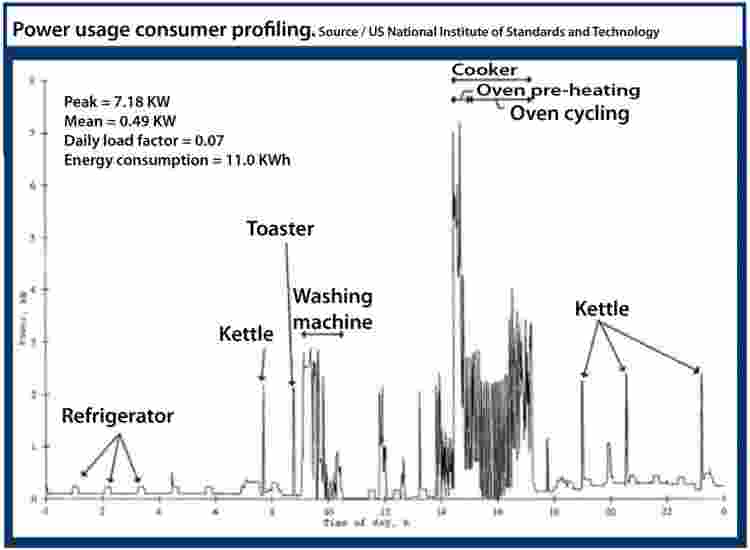
NIST power-usage-graph_web

Graph: National Institute of Standards and Technology

You Sure Drink a Lot of Tea: Smart meter data can show what’s going on in a home, because tea kettles, toasters, and other appliances have identifiable load signatures.

Back in 2007, when the Dutch government announced that all 7 million homes in the Netherlands would be equipped with smart meters by 2013, it anticipated little resistance…But consumers worried that such intelligent monitoring devices, which transmit power-usage information to the utility as frequently as every 15 minutes, would make them vulnerable to thieves, annoying marketers, and police investigations. They spoke out so strongly against these “espionage meters” that the (Netherlands) government made them optional.

It all sounds less paranoid when you consider that each appliance — the refrigerator, kettle, toaster, washing machine — has its own energy fingerprint, or “appliance load signature,” that a smart meter can read. Anyone who gets hold of this data gets a glimpse of exactly what appliances you use and how often you use them.
Privacy on the Smart Grid, Ariel Bleicher, October 2010 http://spectrum.ieee.org/energy/the-smarter-grid/privacy-on-the-smart-grid
IEEE — the Institute of Electrical and Electronics Engineers — is a professional and industry organization.

Denver (Colorado) Post —

The “smart” electric grid may be just a little too smart. Once a smart meter is attached to a home, it can gather a lot more data than just how much electricity a family uses.

It can tell how many people live in the house, when they get up, when they go to sleep and when they aren’t home.

It can tell how many showers they take and loads of laundry they do. How often they use the microwave. How much television they watch and what kind of TV they watch it on.

“This is technology that can pierce the blinds,” said Elias Quinn, author of a smart grid privacy study for the Colorado Public Utilities Commission.
“New electricity grids may be smart, but not so private,”  May 18, 2010: http://www.denverpost.com/frontpage/ci_15106430)

Smart Meters collect finely detailed personal energy usage data and wirelessly transmit that data to the utility company and to whoever has access to the feed. The level of detail collected by the meter can also be increased. Individual privacy was considered so important as to be enshrined in the California Constitution. This is an invasion of our privacy.

This recent article on a report by that Smart Meter data, without the Home Area Network of smart appliances — http://smartgridawareness.org/2014/05/16/smart-meter-privacy-invasion-alert/

Spectrum IEEE

Each appliance has its own energy fingerprint.

Smart Metering and Privacy: A Report for the Colorado PUC (Public Utilities Commission), Spring 2009

 “…the load signatures of various appliance categories are surprisingly unique, and an impressive amount of detail concerning customer usage habits could be discerned… smart meters allow for the collection and communication of highly detailed electricity usage information…all told, 52 million smart meters would be installed throughout the country over the next five to seven years. Smart-metered information, collected at levels as fine as one-minute intervals, can be disaggregated into its constituent appliance events, allowing both consumers and utilities (and anyone else with access to the information) to see exactly what makes up an individual household’s electricity demands.”
Elias L. Quinn: “Smart Metering & Privacy: Existing Law and Competing Policies,”
http://www.dora.state.co.us/puc/DocketsDecisions/DocketFilings/09I-593EG/09I-593EG_Spring2009Report-SmartGridPrivacy.pdf

Chaos Communication Conference, Germany (January 2012) –

Hackers analyzed Smart Meter data and were able to identify “the number of PCs or LCD TVs in a home, what TV program was being watched, and if a DVD movie being played had copyright-protected material.”            http://www.networkworld.com/community/node/79486
Hacking For Privacy: 2 days for amateur hacker to hack smart meter, fake readings

At the Las Vegas Consumer Electronics Show, January 2012:

Tech companies are poised to gather unprecedented insights into consumers’ lives– how much they eat, whether they exercise, when they are home and who they count as friends. Silicon Valley is in a gold rush for information, highlighted by Google’s announcement Tuesday that it would incorporate data posted by users on its social networking service into the results of its main search engine.

Microsoft’s Kinect game console collects some biometric information that Chief Executive Steve Ballmer said on Monday is a potential springboard for health-care and other industries.

“We are collecting data second by second,” said Tivo Senior Vice President Tara Maitra.

LG was among several companies to showcase “connected homes,” where appliances are connected to one another as well as energy grids via the Web. http://www.washingtonpost.com/business/economy/privacy-rights-activists-worry-about-potential-abuse-of-high-tech-devices-featured-at-ces-event/2012/01/10/gIQAX3kJpP_story.html

Harvard Business Review, October 2010

Aside from the home consumers, let’s imagine a company’s data center is making energy efficiency a top priority. The company management is keen on monitoring energy and reporting usage back to the grid. The data center facility controllers will communicate with smart meters and send data to the utilities to be analyzed. If in some way this data is leaked, it could pose serious issues to the overall security posture of the company and data center.
How Private Is Your Smart Grid Data? Usman Sindhu October 13, 2010
http://blogs.hbr.org/cs/2010/10/how_private_is_your_smart_grid.html 

The profile at the beginning of this section is from the National Institute of Standards and Technology. Much finer data collection is planned through the Home Area Network (HAN), with transmitters in all appliances, and additional “Smart” devices.

The UCLA Smart Grid project installed wireless sensors in rooms which can tell how many people are in the room. These “vacancy sensors” are becoming required in new building codes.


This and additional information on privacy and surveillance are on pages 19-27, https://smartmeterharm.org/2012/12/14/report-smart-meter-problems-dec-2012/

Posted in Uncategorized | Leave a comment

Your energy data — Who wants it and what can they do with it?

Who wants our information and why?

Who wants smart meter data? How could the data be used?
Utilities To monitor electricity usage and load; to determine bills
Electricity usage advisory companies To promote energy conservation and awareness
Insurance companies To determine health care premiums based on unusual behaviors that might indicate illness
Marketers To profile customers for targeted advertisements
Law enforcers To identify suspicious or illegal activity*
Civil litigators To identify property boundaries and activities on premises
Landlords To verify lease compliance
Private investigators To monitor specific events
The press To get information about famous people
Creditors To determine behavior that might indicate creditworthiness
Criminals To identify the best times for a burglary or to identify high-priced appliances to steal

Source: ”Potential Privacy Impacts that Arise from the Collection and Use of Smart Grid Data,” National Institute of Standards and Technology, Volume 2, pp. 30–32, Table 5-3.  http://spectrum.ieee.org/energy/the-smarter-grid/privacy-on-the-smart-grid Reprinted in www.burbankaction.com

California Public Utilities Commission:

Currently, there are about 200 firms or other providers of energy efficiency services who have Commission authorization to conduct energy efficiency programs or energy efficiency program evaluations and have access to information for this primary purpose under contract with the Commission. Beyond these firms, other government entities, such as local government and state agencies, implement energy efficiency programs and obtain access to consumption data under the Commission’s supervision.

…Still other third parties may acquire consumption data: (including) from the utility via the “backhaul” with the consumer’s authorization and pursuant to tariff conditions (currently Google obtains information in this matter from San Diego)…
CPUC Decision Adopting Rules to Protect the Privacy and Security of the  Electricity Usage Data, Rulemaking 08-12-009, p. 34, 35, 7-29-2011
http://docs.cpuc.ca.gov/WORD_PDF/FINAL_DECISION/140369.PDF

Data fusion

At a California PUC workshop on Dec. 9, 2011, PG&E representatives said that customers would be able to compare their energy usage online to others with the same home square footage. Asked how PG&E would know the square footage of our homes, a rep quickly responded, “That’s public information.”

Smart Grid TMC-Net.com:

 “GridGlo is working with utilities to combine consumer household behavioral data with energy usage data—along with a dollop of data on weather, demographics, motor vehicle registrations, and even satellite imagery—and from all that, to draw strategic operational and marketing conclusions. The process is called data fusion.
Behave Yourself! The Utilities ‘Have Got Your Numbers’ and Next They’ll Know Your Habits, Too
http://smart-grid.tmcnet.com/topics/smart-grid/articles/176270-behave-yourself-utilities-have-got-numbers-next-theyll.htm

 From the GridGlo website:

Our technology can tell a utility if their customers are married, have kids, living in a 5,000 square foot home, if and when they installed solar panels, if they drive a hybrid electric vehicle, if they had the same job for the last ten years, havent moved in that time and more. You put those components together and you begin to build an understanding of how this is all related to energy consumption.

A New York research firm that turns massive amounts of data into streamlined information, the companies revealed today.

GridGlo sells software and services that help utilities see how and why their customers, primarily homeowners, are using electricity in real-time. They also provide utilities with an Energy People Scoring Mechanism, or EPM score that the company hopes will become a standard like the FICO score is to credit card issuers and other financial institutions.

,,,GridGlos platform uses advanced data fusion technology to merge AMI data with social and behavioral data, providing new ways for Utilities to forecast, segment, and monetize their data.
http://www.gridglo.com/

GridGlo has now changed its name to “Trove”, as in treasure trove.

The possibilities for data fusion are endless, particularly with the implementation of the Home Area Network. Medical and pharmaceutical records, and data collected from intelligent transportation systems are just a few examples of the data that can be “fused” together to create complete portraits of our daily lives.

Data marketing

Smart Grid TMC-Net.com:

‘We realized utilities were getting all this data from advanced metering infrastructure (AMI) deployments and there was no clear understanding [of] how to monetize the data or use the data,’ said Isaias Sudit, CEO of the origins of GridGlo.”

 “’Smart grid utilities are evolving into brokers of information,’ says industry analyst Marianne Hedin.”

Behave Yourself! The Utilities ‘Have Got Your Numbers’ and Next They’ll Know Your Habits, Too
http://smart-grid.tmcnet.com/topics/smart-grid/articles/176270-behave-yourself-utilities-have-got-numbers-next-theyll.htm

From the CPUC proceeding on privacy and the Smart Grid, Docket #: R 08-12-009 (July 28, 2011)

  • Commissioner Timothy Alan Simon, “I support today’s decision because it adopts reasonable privacy and security rules and expands consumer and third-party access to electricity usage and pricing information. I hope this decision stimulates market interest in the data.”
  • “The privacy rules in today’s decision establish a solid framework for creating balance between protecting consumer privacy and fostering a new market for third-party participants,” said Commissioner Mark J. Ferron.

Press Release regarding Docket #: R 08-12-009, July 28, 2011

In May 2012, AT&T and Verizon filed comments on the CPUC’s Smart Grid Workshop summary about market access to consumer data from Smart Meters:

A means to achieve a greater degree of certainty is to establish forward-looking, pro-competitive principles from the beginning that prohibit barriers to market entry. New entrants need prompt, unfettered and reasonable access to the detailed customer usage data collected by a Smart Meter. And such access needs to reflect consistent, standardized methods across utilities. Principles such as these will spur investment and innovation in Smart Grid-enabled products and services and, in turn, will benefit customers, the environment and the economy. In short, the Commission should not delay the principles for access to detailed data at the customer side of the smart meter.

Joint Reply Comments of AT&T and Verizon to March 1, 2012 Smart Grid Workshop Summary, A. 11-06-006 et al., May 17, 2012


This and additional information on privacy and surveillance are on pages 19-27,

https://smartmeterharm.org/2012/12/14/report-smart-meter-problems-dec-2012/

Posted in Uncategorized | Leave a comment

Smart Meters, the internet of things, and surveillance

Surveillance meets 1984

CIA Director David Petraeus on the “internet of things” at In-Q-Tel summit, April 2012:

“‘Transformational’ is an overused word, but I do believe it properly applies to these technologies,” Petraeus enthused, “particularly to their effect on clandestine tradecraft.”

“Items of interest will be located, identified, monitored, and remotely controlled through technologies such as radio-frequency identification, sensor networks, tiny embedded servers, and energy harvesters — all connected to the next-generation internet using abundant, low-cost, and high-power computing,” Petraeus said, “the latter now going to cloud computing, in many areas greater and greater supercomputing, and, ultimately, heading to quantum computing.”
Reported in http://www.wired.com/dangerroom/2012/03/petraeus-tv-remote/

 The Washington Post included Smart Meters in this chart on NSA surveillance — http://timepoy.files.wordpress.com/2013/12/2_1.png?w=753

New cellular phone technologies (University of Texas, 2012), and conceivably Smart Meters as well, will be able to see through walls. This is the field of “remote sensing”. University of Illinois professor and Bioelectromagnetics Editor James Lin has demonstrated that the Soviet microwaving of the Moscow Embassy between 1953 and 1976 could have been for testing just such remote sensing capability. Much research has been done since then on remote sensing applications, including for medical purposes, including

 — “Behind thick layers of nonconductive walls”, “up to 30 meters”
Microwave sensing of physiological movement and volume change: a review, James Lin, 1992

— Under sponsorship of the U.S. Army, researchers used 850 MHz and 2.4 GHz microwave frequencies to monitor respiration and heart rate at a distance.
Note: electric Smart Meter frequencies are 900 MHz and 2.4 GHz.
A Digital Signal Processor For Doppler Radar Sensing Of Vital Signs, Lohman et al.,2001.

New devices, such as “baby radar” (University College Cork, Ireland, 2011), and other medical applications are being reported in the media frequently.

NBC News, “The Wi-Fi in your home can track your moves like Xbox Kinect”

A team at the University of Washington has rigged a standard Wi-Fi home network > to detect your movements anywhere in the home and convert them into commands to control connected devices ..The system is also capable of tracking people as they wander through rooms or out of the house, turning off lights or adjusting music volume depending on their location. http://www.washington.edu/news/2013/06/04/wi-fi-signals-enable-gesture-recognition-throughout-entire-home/
http://www.nbcnews.com/technology/wi-fi-your-home-can-track-your-moves-xbox-kinect-6C10194118

“Wi-Fi can give us all Superman-like vision, according to boffins at MIT”

Can Wi-Fi let you see people through walls?

It isn’t exactly Superman-like X-ray vision, but cheap, low-power Wi-Fi technology is gaining more attention as a remote sensing tool.

Do you really wish you had X-ray vision? Sure, it would be fun to see what your neighbors are doing behind those walls — until you see something you wish you hadn’t.

Regardless, researchers at MIT have developed a sensing technology that uses low-power Wi-Fi to detect moving people. It follows other wall-penetrating sensor tech using radar and heavy equipment.

…The Wi-Vi system by Dina Katabi and Fadel Adib sends out a low-power Wi-Fi signal and tracks its reflections to sense people moving around, even if they’re in closed rooms or behind

…Or the NSA could use it to see how badly you dance in front of your mirror.

http://people.csail.mit.edu/fadel/papers/wivi-paper.pdf
Reported at http://news.cnet.com/8301-17938_105-57591355-1/can-wi-fi-let-you-see-people-through-walls/#

The Home Area Network and Smart Meter mesh network are Wi-Fi systems.

New Samsung LED HDTVs

“will now include built-in, internally wired HD cameras, face tracking and speech recognition capabilities, and twin microphones. In the 2012 8000-series plasmas, the cameras and microphones are built directly into the screen bezel. The 7500 – 8000ES-series TV’s, however, will have the cameras permanently attached to the top of the set.”
http://info.themicroeffect.com/2012/04/06/cia-home-invasion-smart-tvs-and-the-internet-of-things/

In 1999:

“You have zero privacy anyway,” Scott McNealy told a group of reporters and analysts Monday night at an event to launch his company’s new Jini technology.

“Get over it.”

 McNealy’s comments came only hours after competitor Intel (INTC) reversed course under pressure and disabled identification features in its forthcoming Pentium III chip.

… Sun Microsystems is a member of the Online Privacy Alliance, an industry coalition that seeks to head off government regulation of online consumer privacy in favor of an industry self-regulation approach.

 … McNealy made the remarks in response to a question about what privacy safeguards Sun (SUNW) would be considering for Jini. The technology is designed to allow various consumer devices to communicate and share processing resources with one another.

 “I think Scott’s comments were completely irresponsible and that Sun and Intel and many of these leaders are creating public policy every time they make a product decision,” said Lori Fena, chairman of the board of the Electronic Frontier Foundation.
Sun on Privacy: ‘Get Over It’, Polly Sprenger, Jan. 26, 1999
http://www.wired.com/politics/law/news/1999/01/17538

2012:

In 2009, McNealy’s assessment was confirmed by Google’s CEO, Eric Schmidt. In an interview with NBC’s Mario Bartiromo, he proclaimed, “If you have something that you don’t want anyone to know maybe you shouldn’t be doing it in the first place.” Schmidt’s words have become Google’s new mantra. Welcome to 21st-century corporate morality….

In 2010 it was revealed that Google partnered with the CIA in a venture called “Recorded Future.” Google’s vast data archive can be harnessed to meet “security” needs. This is especially troubling in light of a controversial bill being pushed through Congress, the Cyber Intelligence Sharing and Protection Act (CISPA). The act would allow sharing of data between companies like Google and the National Security Agency (NSA) to combat alleged cyber-security threats.
The Terrifying Ways Google Is Destroying Your Privacy, David Rosen, May 20, 2012
www.alternet.org/story/155479/the_terrifying_ways_google_is_destroying_your_privacy

Journalist James Bamford talked to Democracy Now on March 21, 2012 about the new facility being constructed in Bluffdale, Utah, by the National Security Agency to store collected data. http://www.democracynow.org/2012/3/21/exposed_inside_the_nsas_largest_and#.T5F22Ve7pFU.mailto

There will certainly be a great deal of it.


This and additional information on privacy and surveillance are on pages 19-27,

https://smartmeterharm.org/2012/12/14/report-smart-meter-problems-dec-2012/

Posted in Uncategorized | Leave a comment

SMUD smart meter causes electrical failure & fire hazard in Sacramento, California

From EMF Safety Network
Posted on July 1, 2014

Margie Rothwell was having serious problems with the electricity in her home.  The power turned on and off for no apparent reason. The house fire alarm kept going off and the noises were scaring her dog.

She called her brother, who was a master electrician, to help her.  He found electrical lines not working and the smart meter digital readout was unreadable.  He recommended she call the utility SMUD right away, which she did.  (SMUD stands for Sacramento Municipal Utility District.)

A couple hours later, the SMUD technician came and when he got closer to the smart meter he said he smelled “burn”.

Margie recalled, “He had a very horrified look on his face when he looked at the burnt smart meter and meter socket.” The technician removed the smart meter and quickly put it in his truck, concealing the evidence.

The technician installed a temporary adapter which left her home with only 110 volts and limited power in parts of her house.

She was left with no dryer, no air conditioner, no electricity in the master bedroom, or anything that required 220 volts.

She asked the SMUD technician for a business card. He said he didn’t have one. She asked him for his name and he would not give her his full name.

Read the full story, with photos and video — http://emfsafetynetwork.org/smud-smart-meter-burn-out-causes-electrical-failure-fire-hazard/

Posted in Uncategorized | Tagged , , , , | Leave a comment

Low intensity RFR causes oxidative stress in cells, could cause broad spectrum of health disorders and diseases

RFR = radiofrequency electromagnetic radiation
Examples: cell phones, cellular antennas, wireless Smart Meters, Wi-Fi, cordless phones, wireless baby monitors, Wii, iPads

http://www.scopemed.org/fulltextpdf.php?mno=154583
Low intensity radiofrequency radiation: a new oxidant for living cells
Igor Yakymenko, Evgeniy Sidorik, Diane Henshel, Sergiy Kyrylenko

Published March 29, 2014

Excerpts:

“Unexpectedly, a strong non-thermal character of biological effects of RFR has been documented. As low as 0.1 μW/cm2 intensity of RFR [current U.S, FCC guidelines are 200-1000 μW/cm2] and absorbed energy (specific absorption rate, SAR) of 0.3 μW/kg were demonstrated to be effective in inducing significant oxidative stress in living cells.”

“Oxidative stress is an induced imbalance between pro-oxidant and antioxidant systems resulting in oxidative damage to proteins, lipids and DNA; and is closely connected to overproduction of reactive oxygen species (ROS) in living cells.”

“Whatever the particular first-step molecular mechanisms, it is clear that the substantial overproduction of ROS in living cells under low intensity RFR exposure could cause a broad spectrum of health disorders and diseases, including cancer in humans. Undoubtedly, this calls for the further intensive research in the area, as well as to a precautionary approach in routine usage of wireless devices.”

Click to access df_pm_ros-yakymenko_engl_140414.pdf

Press Release: Group of Ukrainian scientists assesses available studies on ROS:

Mobile phone radiation leads to oxidation in cells

The Ukrainian group of scientists around Igor Yakymenko at the Institute of Experimental Pathology, Oncology and Radiobiology in Kiev consider it to be proven that mobile phone radiation leads to harmful oxidation processes in cells through the overproduction of free radicals. In the editorial ” Low intensity radiofrequency radiation: a new oxidant for living cells” in the scientific journal “Oxidants and Antioxidants in Medical Science” of 29 March 2014 the group reported that of 80 studies, they had assessed, 92,5 % (= 76 studies) confirmed that mechanism of inflicting damage. “Unexpectedly, a strong nonthermal character of biological effects” had been documented, the group of scientists wrote. Low intensity radiofrequency radiation (RFR) emitted by mobile phone end-user devices “could lead to mutagenic effects through expressive oxidative damage of DNA”, because “the substantial overproduction of ROS in living cells under low intensity RFR exposure could cause a broad spectrum of health disorders and diseases, including cancer in humans”.

Oxidative stress is considered to be the main cause of exhaustion, headaches, inflammatory diseases, all the way to heart attacks. The results of the scientists from Kiev explain the acutely critical nature of the hype around mobile phones, smartphones and wifi. According to latest statistics, children and young people use mobile phone end-user devices near their bodies on average for more than 8 hours a day. Therefore, they are permanently exposed to potential damage.

These findings once again strip the German and international legal limits, based on the guidelines by ICNIRP, of their legitimacy. The legal limits are based on the denial of such non-thermal effects. These research results show, how – for the sake of profit – users are exposed to this radiation unprotected. The time of denial of non-thermal effects and the relativization of the current state of research in order to protect business interests must stop. Diagnose-Funk e.V. asks all scientists to confront public authorities with these study results, and to demand a change in favour of the precautionary principle.

Link and Download:

Full text Yakymenko et al. & Diagnose-Funk ‘Brennpunkt’: http://www.mobilfunkstudien.de
http://www.scopemed.org/fulltextpdf.php?mno=154583

1 Oxidative stress occurs when oxidative effects by free radicals (e.g. hydrogen peroxide) exceed the ability of antioxidant systems to neutralize them and the balance is in favor of oxidation. The damage in the cells can be oxidation of unsaturated fatty acids, proteins and DNA.

2 ROS ( Reactive Oxygen Species) : Oxygen containing molecules that are highly unstable and highly interactive with other molecules. They are formed by the incomplete one-electron reduction of oxygen. They extract electrons from other molecules becoming radicals themselves. Thus a chain reaction is initiated which can cause cellular damage by oxidative stress. These ROS include superoxides, peroxides, hydroxyl radical and hypochlorous acid.

3 “Increasing incidence of burnout due to magnetic and electromagnetic fields of cell phone networks and other wireless communication technologies”, Ulrich Warnke, Peter Hensinger, umwelt -medizin – gesellschaft | 26 | 1/2013, Download from
http://mobilfunkstudien.de/dokumentationen/v-z/warnke-mobilfunk-foerdert-stress-und-burnout.php

Posted in Uncategorized | Leave a comment

Are Smart Meters accurate? — the Structure Group report

Bakersfield Californian columnist Lois Henry has written extensively on the problems with PG&E Smart Meters. Below are links to many of her articles.

After high bills plagued Bakersfield residents, they and a few legislators, chiefly former California State Senator Dean Florez, put a great deal of pressure on the California Public Utilities Commission to halt the roll-out and investigate. After months of delay, the CPUC finally agreed to hire a consultant to investigate these problems.

However, the CPUC hired the Structure Group, an industry consultant specializing in the Smart Grid. Many opposed this choice because of the conflict of interest, but the CPUC went ahead anyway. This is covered on pages 11-18 here: https://smartmeterharm.org/2012/12/14/report-smart-meter-problems-dec-2012/

After the Structure Group finished their report, many questions were raised by the public. The CPUC’s Division of Ratepayer Advocates also questioned the findings (October 29, 2010):

“The Commission should establish a process that allows interested parties to evaluate and comment on the Structure Group Report. The Commission should then make its own findings on the reasons for the problems consumers have experienced with PG&E’s SmartMeters, and decide whether they have been adequately addressed.“
DRA Reply Comments on What the Commission Should Do in Light of the Structure Group Report, p. 3-5, 6, Application 07-12-009, October 29, 2010

DRA also stated in another proceeding that there is more work to be done to evaluate these meters to

“restore public confidence in SmartMeters (if such confidence is warranted)”
DRA Response to Application of Californians For Renewable Energy, Inc. (CARE) To Modify Decision 06-07-027, A.10-09-012, page 10, October 20, 2010

But the CPUC did not launch an investigation. CPUC Chairman Michael Peevey responded:

In particular, we find that the argument of CCSF, DRA, and TURN that the Commission should use this proceeding to review the Structure Group Report is unpersuasive. As noted previously, the facts alleged in the record of this proceeding, even if true, fail to warrant the suspension of the SmartMeter installation program. The PG&E reports cited by CCSF and the customer complaints reported in the media do not warrant the costly action of suspending the installation of a major infrastructure program that offers important conservation and demand response benefits. Thus, the Commission does not need the findings of the Structure Report to decide the matter before us.

As a general proposition, the Commission’s requesting of a report does not trigger a proceeding. The Commission orders, sponsors, and receives many reports that do not become the subject of a Commission proceeding. An investigation of the Structure Report is not warranted in this proceeding nor necessary to its resolution.
Final Decision (10-12-031) Denying the City and County of San Francisco’s Petition to Modify Decision 09-03-026, December 2010, p. 19, 20

This issue is important because the Structure Group report has been widely used by the utility industry as proof that Smart Meters are accurate and reliable.

Since the CPUC did not follow the DRA’s recommendations and refused to review the report or launch their own investigation, the DRA began its own investigation of the Structure Group report.

This is what Lois Henry wrote about their investigation.
[‘splaining’ is American slang for ‘explaining’]

Smart meters still have ‘splaining to do

The Bakersfield Californian | Sunday, Jul 24 2011

The California Public Utilities Commission has a chance to do the right thing and, finally, side with consumers on the SmartMeter debacle.

But it will take outside pressure.

The Division of Ratepayer Advocates, an agency within the PUC, told PUC commissioners recently that it has serious questions about a report issued last fall on SmartMeter accuracy.[Structure Group — DRA report 7-15-11]

That PUC unit, however, has been forced to abandon its efforts to get at the truth as it could not get the report’s authors, The Structure Group, to answer questions.

The Structure Group is a power industry consulting group that was hired by the PUC (for $1.4 million) to do an “independent” evaluation of SmartMeters overall and specifically to determine if a spike in bills in Bakersfield and elsewhere in 2009 was caused by the new meters. I put independent in quotes because it was discovered that Structure had contracted with PG&E for several years and at least one of Structure’s vice presidents was a former PG&E vice president.

Oh, and I hate to be picky, but since I am, I will point out that SmartMeter billing issues came up long before the summer of 2009. That’s a convenient timeframe for PG&E because they would like people to think the freaky bills were caused by a heat wave and rate hike. But I started writing about wacky bills in the winter of 2007/2008, a few months after the first SmartMeters showed up on Bakersfield homes. No heat wave and no rate hike involved.

Even then dozens, if not hundreds, of people saw their bills spike to three and five times normal. Then they dropped back to normal. No one has ever been able to explain why.

Back to The Structure Group report.

Released last September, the report concluded the meters were accurate, overall. However, it faulted PG&E for poor customer service and for installing meters faster than its infrastructure could handle.

But the Ratepayer Advocates division and others outside the PUC had serious questions about the report’s conclusions and methodology.

“We did jump up and down at the time,” Ratepayer Advocates interim director Joseph Como said when I asked why his agency was just now squawking about the report. “We filed responses with the (PUC) and asked them to open the process to critical analysis and we filed a preliminary analysis saying the report didn’t say there were no problems with the meters and, more importantly, it doesn’t say what the root cause was of the unexplained high bills.”

Did I mention we paid $1.4 million for a report that didn’t answer that key question? Sheesh!

As an example of just how slipshod the report was, Como noted that in its own testing The Structure Group found some meters overestimated power usage when their internal temperatures got too high. But they didn’t follow up or do any further testing. It was a buried bit of stray information until PG&E was finally forced to admit in May that, uhhh, yeah, some of its meters do have that problem.

Former State Sen. Dean Florez was among the frustrated third parties last fall who wanted more information. He initially scheduled hearings for mid-September. But one of PG&E’s gas pipelines exploded beneath San Bruno killing eight people a few days before the hearings, which were then canceled.

“I still believe that ratepayers deserve a fair and accurate analysis of the SmartMeter program, which should come at the expense of the utilities,” Florez wrote in an email.

He discounted PG&E’s assertion that the high temperature problem only affects a few meters. Even in their flawed analysis, he noted, The Structure Group reported that one out of the six meters tested had that malfunction.

“With 5.1 million SmartMeters in PG&E territory that could mean 850,000 meters.”

So what can we do about it?

“Frankly, I don’t know,” Como said in exasperation. CC’ing the media about its concerns was kind of a last ditch effort, an attempt to “try to embarrass the commission.”

Didn’t work.

PUC President Michael Peevey was too busy to chat but sent comments through a spokesperson: “Structure’s report found that the meters, software, and billing systems are performing accurately. Structure and the CPUC stand behind the report’s findings.”

Clearly, he would like that to be the end of the story. Well, it’s not. The folks here in Bakersfield who got hosed on their power bills still deserve to know what went wrong.

There are three newly appointed commissioners, Mike Florio, Catherine Sandoval and Mark Ferron, who are coming up for confirmation before the Senate Rules Committee in the next month or so.

I’m hoping committee members, including our own Jean Fuller, will grill them and get a commitment to reopen the report and give it a full, public airing.

Fuller told me she’s perfectly happy to put the screws to the new commissioners over this report.

Good, we’ll be watching.

Opinions expressed in this column are those of Lois Henry, not The Bakersfield Californian. Her column appears Wednesdays and Sundays. Comment at http://www.bakersfield.com, call her at 661-395-7373 or e-mail lhenry@bakersfield.com
http://www.bakersfield.com/news/columnist/henry/x1206332530/Smart-meters-still-have-splaining-to-do

The CPUC never compelled the Structure Group to answer the questions of the DRA. Nothing was ever done.

Though the industry cites the Structure Group report as proof that all is well, the problems continue. Pacific Gas and Electric Company and the utility industry are still making excuses. And most utility oversight agencies are protecting the utility industry and refuse to address these serious problems.

When will public stand up and take action?

———————————————————————

http://www.bakersfield.com/news/columnist/henry/x746309880/Lois-Henry-Smart-meters-leave-us-all-smarting

http://www.bakersfield.com/news/columnist/henry/x876262202/Spinning-SmartMeters-PG-Es-story-continues-to-evolve

http://www.bakersfield.com/news/columnist/henry/x1303782421/LOIS-HENRY-SmartMeters-dont-do-well-under-heat-and-neither-does-PG-E

http://www.bakersfield.com/news/columnist/henry/x1206332530/Smart-meters-still-have-splaining-to-do

http://www.bakersfield.com/news/columnist/henry/x1766489177/Heres-whats-also-broken-our-faith-in-PG-E 10-26-11

http://www.bakersfield.com/news/columnist/henry/x860822891/If-it-stinks-it-may-be-PG-E 10-31-11

Used under Fair Use Rules.

Posted in Uncategorized | Tagged , , | Leave a comment

High energy bills shock Canadians as Smart Meters roll out; Ontario newspaper investigates thousands of complaints

From Ontario, Canada:
Sudbury electricity bill skyrockets, CBC News Sudbury – June 16, 2014:

A Sudbury man is worried his whopping electricity bill could make it impossible to sell his property.

When Pierre Bonin bought his Sudbury area cottage five years ago, he knew hydro bills for the property were on the high side — in the range of $800 per quarter.

But he never expected what came in the mail recently.

The first shock was a bill for nearly $4,000.

“I lost my mind,” Bonin recalled. “I said, ‘there has to be a mistake’.”

That bill was followed by another for about $2,000.”

Bonin complained to Hydro One, but the only remedy offered so far has been a payment plan.

“I’m at a loss. I’m literally at a loss,” he said.

Hydro One has been under fire in recent months for problems with smart metres and billing.

…Since smart metres were installed, Hydro One has been dealing with billing problems and upset customers. The Ontario Ombudsman is investigating nearly 8,000 complaints about Hydro One bills and is expected to provide an update in the coming weeks.
http://www.cbc.ca/news/canada/sudbury/sudbury-man-s-cottage-electricity-bill-skyrockets-1.2677115
Posted on http://emrabc.ca/?p=4626

From Saskatchewan, Canada:
Some SaskPower bills double after smart meter installation, Prince Albert. Right Now! — June 18, 2014

Before her new smart meter was installed, Chelsey Lemke was paying about $75 for power every month for her 1,100 square foot bungalow in Regina. Then in the summer of 2013, her old power meter was removed and a new smart meter was installed. Her first bill after that was more than $1,000.

“Since then, I’ve seen nothing (on my power bill) under $180 a month, and some months it’s $300, some months it’s $280. It’s double what we were paying before,” said Lemke…

Approximately 80,000 smart meters have already been installed; the full 500,000 will be installed by the end of 2016.

Some of the 80,000 customers already upgraded are getting shocking bills, like Lemke following the installation. Lemke said she called SaskPower’s customer service line after getting her first inflated bill but didn’t get much help.

“They have nothing to say about it,” Lemke went on to paraphrase, “this is exactly what you’re using and that’s the end of the story, if you want power this is what you’re paying for it.”…

Lemke’s family has actually been cutting back on their power use since then; she said it hasn’t really helped.

“After I got that bill for a thousand dollars, we started unplugging everything that we weren’t using. We did a bunch of research online about phantom power and ghost power.”

Lemke called the situation ridiculous and wants a better explanation from SaskPower.

“I don’t think it’s a fair enough explanation to just say ‘well that’s what it is.’ There’s something wrong, there’s something amiss, there’s something that’s counting faster than it should be, or something’s happening because there’s no way that I’ve gone from using 500 kilowatts to 1,000 or whatever they’re saying it is.”…

Lemke isn’t alone; Ashley Haus ran into the same situation. The smart meter on her home was installed three months ago. Since then, her bills have also doubled.

“Our first bill was over $300 … and then each month since, it’s been consistently over $100 – at least $120 each month,” Haus said.

Haus explained that before the new meter the bill had been closer to $50, and like Lemke, she says her household hasn’t changed their power usage.
http://panow.com/node/457184
Posted on http://emrabc.ca/?p=4624

Other examples

From Johannesburg, South Africa:
Joburg’s not-so-smart meters, May 31, 2014

When the meters were installed in Kensington last year, residents believed their bills would no longer be based on inflated estimates and they wouldn’t have to worry about having strangers on their property to read the meters.

Residents now say that instead of reduced bills, many have seen steep increases and a local councillor has labelled the smart meters “a waste of money”…

Ralf Meysel said: “My electricity bill has doubled since they installed the smart meter.”

Another resident Amelia Theron said she was not sure if her meter was read by the council because no one did physical readings. She had also received a “very high” electricity bill this month. http://www.iol.co.za/news/south-africa/gauteng/joburg-s-not-so-smart-meters-1.1696790

From Bakersfield, California:
Who is benefiting from PG&E’s SmartMeters? California Sen. Dean Florez, October 03 2009

Welcome to the world of PG&E SmartMeters. Wonder why the people of Kern County are angry and want answers? Most have told my office they have lowered their power usage and yet they’ve seen double- and triple-sized energy bills since the installation of SmartMeters.
http://www.bakersfieldcalifornian.com/opinion/community-voices/x2067559376/Who-is-benefiting-from-PG-Es-SmartMeters

Laughter, jeers: Frustrated PG&E customers pack SmartMeter hearing, October 6, 2009

Emotions ran high at a public hearing on Pacific Gas and Electric Co.’s SmartMeter program. Many customers told of astronomical hikes in energy bills after the utility company installed the new devices. But, PG&E defended its program, saying the meters are not to blame.

June Hahn received her Pacific Gas and Electric Co. bill three months after the company installed a SmartMeter in her home.

“My bill was $2,281, and we were gone three weeks,” said Hahn, who said she’s continued to see a 400 percent increase in her energy bill ever since.

Marisa Banks told a similar story. Her mother went on vacation in July, but, she said, “In that month her bill was $873.”

Other PG&E customers told of their frustrating experiences in trying to get answers from the utility company.

…”The most important thing to us from our customers is that they trust us,” said Felicia Lokey of PG&E before her comments were drowned out by a chorus of boos and jeers from a skeptical public.

The giant monopoly was on the defensive, defending its SmartMeter program.

“We have found no relationship between the implementation of the SmartMeter and the increases in customer bills,” said Bill Devereaux, PG&E’s senior director for the SmartMeter program. (see [i]]

That comment, as well, was greeted by a round of boos and disbelief from a standing-room only crowd.
http://www.bakersfieldnow.com/news/63581287.html http://www.bakersfieldnow.com/news/63581287.html?tab=video  TV News Video (3 minutes)

Bakersfield’s SmartMeter trouble worries industry, Feb 27 2010

“This is a serious threat. It cannot be overstated,” said Ahmad Faruqui, an economist and consultant on energy pricing and technology issues…

Faruqui, who occasionally does consulting work for PG&E, was at a London conference in October when the Bakersfield situation was brought up. It came up again shortly afterward at a meeting he attended in Cairo. Since then he has received e-mails from Australia and Canada asking what happened here.

“It has been coming up at every meeting and conference I’ve gone to in the last several weeks,” Faruqui said last week. “Nobody is convinced that they know what’s happening, and there is this apprehension now that it was the meters that was the problem.”

Travis Miller, a senior analyst who watches utilities for Chicago-based Morningstar, said the industry needs an explanation as to what caused the uproar in Bakersfield.

“There are questions about whether it was a one-off problem or whether it’s something that was systemic across the whole smart meter industry,” he said. http://www.bakersfield.com/news/business/economy/x1305354119/Bakersfields-SmartMeter-trouble-worries-industry

After speaking to the San Francisco County Board of Supervisors in California about Smart Meters In January 2011, a police officer in the room told me his energy bill tripled after Smart Meters were installed.

From Florida:
Customers look for answers after OUC bills increase, June 10, 2014

Dozens of Orange County residents are looking for answers after their Orlando Utilities Commission bill spiked.

Some people who live in the Conway area said their bills increased as much as $50 to $100. They’re now questioning the new digital meters that were installed by OUC.

“I just looked at it and said, ‘Wow’,” resident Mary Tiffany said.

Records show Tiffany pays about $100 per month in the spring, but last month she said she paid almost $50 more.

“Because we had such a cool, unseasonal month I was thinking I was going to get a lower bill, but then I got this, a really high bill,” Tiffany said.

So she took to social media to see if anyone else was experiencing the same with their bill. More than 200 people responded to Tiffany and they all had one thing in common: digital smart meters recently installed.

“We all have questions. We have not gotten those answers,” Tiffany said.
http://www.wftv.com/news/news/customers-look-answers-after-ouc-bills-increase/ngH9t/

And it’s also smart water meters

Skyrocketing water bills mystify, anger residents; Water wars: Bills rise to the thousands March 2, 2011

    • Atlanta woman reacts to her $3,000 water bill: I’m “sinking in a hole of water”
    • City water officials received more than 22,000 calls in January
    • Many problems arise after installation of automated water meters
    • Similar water bill spikes reported in Ohio, Massachusetts, North Carolina and Florida http://www.cnn.com/2011/US/03/01/water.bills.war/index.html

From Monterey County, California,

Among the dozens of complaints from Monterey Peninsula residents about sudden, sky-high California American Water bills, Gervais Davis’ tale may have topped them all.

Last week, the 81-year-old retired Monterey attorney received a $24,028.86 bill that reflected 228,813 gallons of usage — enough to fill a medium-sized water tower tank — over a two-month period from mid-December to mid-February. http://www.montereyherald.com/news/ci_25309925/monterey-man-gets-24k-water-bill-whopper

For other stories on high water bills in Monterey County, California: http://www.montereyherald.com/calambills https://smartmeterharm.org/2014/03/10/24000-water-bill/

What do the utility companies say?

Ontario, Canada:

Hydro One claims the installation of smart metres coincided with the implementation of time-of-use pricing, which has increased some people’s bills. The utility points to the exceptionally cold winter as a factor as well.

Saskatchewan, Canada:

When asked about the problem, SaskPower president and CEO Robert Watson said the provider hadn’t heard much at all from customers.

“We’ve had very few complaints about the installation of the smart meters, and we’ve had very few complaints about any accuracy with billing,” Watson said.

Watson insists the smart meters are accurate.

“It is not the meters. The meters, we’re finding very reliable and very accurate,” he continued. Watson explained the smart meters have been verified, independently verified, and audited.

Florida:

“There is nothing wrong with these meters, they are probably more accurate than what we have before,” OUC spokesperson Tim Trudell said.

OUC said the weather is part of the problem. This year in May it was 2-3 degrees warmer so customers paid more to use air conditioning, according to the company.

California:

Bakersfield —
“We have found no relationship between the implementation of the SmartMeter and the increases in customer bills,” said Bill Devereaux, PG&E’s senior director for the SmartMeter program…

PG&E contends energy bills are high because of “an extremely hot summer” and two rate increases, one in October of last year and another in March.

Palo Alto —
PG&E told them they were using more energy than they thought. “When we would communicate with PG&E, they had no real reason to explain why it was so high,” said [Andreina] Parisi-Amon. – http://abclocal.go.com/kgo/story?section=news/7_on_your_side&id=7424533

Monterey County —
Cal Am spokeswoman Catherine Stedman said company officials realized the Monterey district needed someone specifically dedicated to dealing with high bills, especially because unintended usage such as leaks could drive the bills as high as several thousands of dollars due to the district’s steeply tiered rate design.

“I think we realize high bills due to the rate design and leaks are very burdensome on customers,” Stedman said. “The steeply tiered rates are there to encourage conservation, and they’ve been very effective. But we need to learn how to deal with the rate design. Now we have a person in Monterey focused just on the high bills situation.

…However, both Lopez and Stedman told The Herald that the company still believes its meters are accurate, and that even a stratospheric reading like Davis’ can be explained.
http://www.montereyherald.com/local/ci_22827190/cal-am-drops-request-recover-costs-courtesy-leak

South Africa:

But City Power insists the 34 000 they have installed are working just fine…

Excuses and no action

“It’s new rates. it’s the weather. It’s a leak. You’re using too much energy. You’re using too much water.”

Something is wrong.
———————————————————————–

[i] http://www.mercurynews.com/pge/ci_20481577/pge-employee-who-spied-activists-support-management-cpuc

PG&E employee who spied on activists had support of management, a CPUC probe finds

Posted in Uncategorized | Tagged | Leave a comment