California government report on SCE Smart Meter program: Rising costs eliminate consumer savings

In 2007, Southern California Edison (SCE) projected a net cost benefit from their Smart Meter program  to consumers of only $9 million over the lifetime of the project. By 2012, that “very slim margin” had disappeared under increasing costs.

The Division of Ratepayer Advocates in California investigated SCE’s program (called SmartConnect) and reported their findings in 2012. Here are excerpts from their Executive Summary:

Executive Summary:

Key Findings presented in Section V of this report include:

  • According to SCE’s AMI business case, the total cost to customers will be greater than $5 billion, rather than the $1.6 billion cost explicitly approved by the CPUC, which only included nominal deployment costs;
  • Many forecasted benefits have been delayed or reduced, which erases the projected margin of net benefits as calculated in SCE’s business case [see below];
  • SmartConnect-related costs not anticipated in SCE’s original business case have already been approved by the CPUC in other proceedings, beyond the over $5 billion cost referenced above. In many cases, these costs were approved without a showing of incremental benefits, and DRA anticipates that more will be requested;
  • SmartConnect features such as remote disconnect and SmartConnect-enabled time-varying rates have a high potential for adverse impacts for low-income and other “at-risk” customers… (p. 2)

SCE was the last electric IOU to file an AMI application (2007). At the time that PG&E and SDG&E submitted their applications (2005), SCE’s business case analysis, including multiple scenarios, showed that AMI deployment was not a cost-effective endeavor. Two of its scenario analyses showed a Present Value Revenue Requirement (PVRR), largely due to the added Demand Response from large customers that already had interval meters. SCE stated that “the technology envisioned by the Ruling is unproven and commercially unavailable at this time.” (p. 7-8)

…SmartConnect was adopted based on an estimate of $9.2 million in net benefits on a PVRR [Present Value Revenue Requirement) basis owing to the time-discounted value of money… (p. 10)

Conclusion:
The CPUC required California’s large IOUs to file AMI applications and required a demonstration that AMI systems could produce net customer benefits. Initially, SCE found that AMI was not cost-effective for its customers, but AMI technological developments in 2005 and 2006 led to the SmartConnect application in 2007, which forecasted a very slim margin of lifetime net benefits on a present value basis. The CPUC authorized SmartConnect deployment costs of $1.634 billion, and SCE customers in aggregate have so far experienced a revenue requirement increase in excess of $193.1 million to cover these costs. This is a real cost increase, one which will certainly rise as more meters are purchased and deployed, and as SCE begins to incur post-deployment costs.

…Total SmartConnect costs paid by customers will actually be more than $5 billion (nominally), accounting for post-deployment costs and the financing costs incurred over the 20 years life of the SmartConnect system. This total cost will be even greater if the cost of future AMI-enabled investments and programs are included. While SCE’s incremental cost requests have thus far been relatively conservative, it is important to note that PG&E and SDG&E have so far requested much higher amounts in incremental AMI funding: PG&E has requested and received approval for funding in excess of $500 million, and SDG&E has received funding approval for over $93 million. (p. 50)

Case Study of Smart Meter System Deployment: Recommendations for Ensuring Taxpayer Benefits; Hieta, Kao, Roberts, March 2012

California Looks Harder at the ‘Smart Grid

After pointing out numerous funding requests in other areas that are really for AMI, DRA summarized that “(t)he full cost of SmartConnect will be more than double the $1.6 billion approved for deployment costs.” They hardly needed to note what that does to the $9 million.

Robert Michaels, May 3, 2012 http://www.masterresource.org/2012/05/cpuc-dra-smart-grid/
(also, comment by Guillermo Jones)

DRA has repeatedly criticized Smart Meters. In 2011, they called for a halt to SoCal Gas’s rollout of Smart Meters.

“Safety, not smart meters, is the priority for consumers,” said Joe Como, acting director of the Division of Ratepayer Advocates. “Circumstances have changed since the [commission] approved these unnecessary meters and in the environment of escalating energy bills, customers should not have to foot the billion-dollar bill for technology that provides them little, if any benefits.”

Consumer advocates call SoCalGas ‘smart’ meters too costly, November 2011http://latimesblogs.latimes.com/money_co/2011/11/consumer-advocates-call-socalgas-smart-meters-too-costly.html#comments

And in a PG&E Smart Meter upgrade proceeding in 2008 –

A few examples should set the tone for what should be a very circumspect review of many of PG&E’s claims in this Application:

• PG&E has already spent one third of its initial $1.7 billion authorization, but has only activated 2% of electric meters;

• PG&E has exhausted $70 million of its $88 million Program Management budget when the project is barely off the ground and already in need of change;

• PG&E’s information technology (IT) budget is already 33% over budget. But that should come as no surprise since history shows that PG&E has repeatedly failed in the area of IT.

Despite the fact that the Commission has clearly given California’s utilities the green light to proceed with AMI deployment, it needs to send a message to all utilities that although the sky is the limit in terms of possibilities, the reality is that ratepayers today can ill afford to spend their hard earned money fixing problems that they did not cause. It is well known now that DRA supports AMI, but only if the utilities’ business cases can reasonably assure the Commission that they will be cost beneficial. DRA is opposed to the approval of projects that are based on amorphous benefits predictions that are untested and only theoretically possible. ..

DRA would like the Commission to apply some procedural restraint on what PG&E apparently perceives to be a runaway AMI gravy train. It is respectfully submitted that a Decision approving this cost-ineffective upgrade could lead to a staggering waste of ratepayer money. Very little, in terms of PG&E’s AMI performance to date, causes DRA to have much confidence in PG&E. The jury is still out as to when, or if, its ratepayers will ever see the benefits identified in PG&E’s original, or this upgrade proposal, that would justify its enormous cost. DRA does not find this Upgrade Application to be cost-effective, and therefore respectfully recommends that the Commission reject it.

— DRA found that the associated benefits were $549 million less than the costs of the upgrade.

Opening Brief of the Division of Ratepayer Advocates, August 29, 2008
Application of Pacific Gas and Electric Company for Authority to Increase Revenue Requirements to Recover the Costs to Upgrade its SmartMeter™ Program (U 39 E); Application 07-12-009
http://docs.cpuc.ca.gov/PublishedDocs/EFILE/BRIEF/87392.PDF

The California Public Utilities Commission ignores their recommendations.

These results have been found over and over in other studies.

Consumers will not save money. Rates will continue increasing to cover utility company AMI/AMR costs. Energy savings will be erased by the energy use of the Smart Meter program.

Amyas Morse, head of the UK National Audit Office, said in June, 2011:

“The benefits of proceeding with this major technological and logistical undertaking are still uncertain. There is limited evidence of how much and for how long British consumers’ behaviour might change, and costs could escalate. Large-scale projects of this kind can take on a momentum of their own and so, along the way, there should be clear decision points at which the Department will need to review costs to consumers, benefits and risks and judge whether to carry on as originally planned or significantly change direction.”

http://www.nao.org.uk/report/preparations-for-the-roll-out-of-smart-meters/

More information in  “Costs exceed benefits” p. 111-115 https://smartmeterharm.org/2012/12/14/report-smart-meter-problems-dec-2012/

Posted in Uncategorized | Tagged , , , , | Leave a comment

States ask: Will Smart Meters save money or reduce CO2?

In 2008, a report was prepared for the New Jersey Department of Public Advocate, Division of Rate Counsel, entitled “Advanced Metering Infrastructure – Implications for Residential Customers in New Jersey”.

It concluded:

Savings to ratepayers. The estimates of savings to residential customers from AMI-enabled dynamic pricing, a form of time-differentiated pricing, hinge upon three major assumptions:

• the reduction in peak use per participating customer,

• the percentage of customers who will voluntarily participate, and

• the long-term persistence of the reductions per participating customer.

There is considerable uncertainty regarding each of these assumptions despite the results from pilot projects in other jurisdictions. First, most pilots entice customers to participate through some form of “appreciation” payment and therefore provide no guidance regarding the percentage of customers who will voluntarily participate in the absence of such an incentive. Second, most pilots have only operated a few years, thus they provide little guidance regarding the long-term persistence of participation and reductions per participant.

It also concluded:

…reductions from dynamic pricing will not lead to significant reductions in annual emissions of carbon dioxide and sulfur dioxide which are a function of annual electricity use.

Report prepared by Synapse Energy Economics, Inc.,
July 8, 2008
Original link:  http://www.state.nj.us/publicadvocate/utility/docs/AMI_White_Paper-_final.pdf
The full report is here.

Not considered in the report is the increased energy use due to the Smart Meter wireless networks and infrastructure, as well as the data storage requirements. That will mean a net increase in CO2 due to the Smart Meter and Smart Grid program.

In February 2011, Connecticut Attorney General George Jepson sent out a press release:

Connecticut Light & Power Co.’s plan to replace existing electric meters with advanced technology would be very expensive and would not save enough electricity for its 1.2 million customers to justify the expense, Attorney General George Jepsen said Tuesday.

Jepsen made the comments in a brief filed Tuesday with the state Department of Public Utility Control, which is reviewing CL&P’s request to replace all existing meters with “advanced meter infrastructure.” The company also asked regulators to guarantee that the company will be allowed to recover its full cost of installation before the department actually evaluates what the costs actually were and whether those costs were reasonable.

“CL&P’s proposal would force the company’s ratepayers to spend at least $500 million on new meters that are likely to provide few benefits in return,” Jepsen said. He urged the regulators to “continue to evaluate emerging meter system technologies as well as other conservation programs” and only approve installation of the advanced meters when they are cost effective.

“The pilot results showed no beneficial impact on total energy usage,” Jepsen said. “And, the savings that were seen in the pilot were limited to certain types of customers and would be far outweighed by the cost of installing the new meter systems,” he said.
www.ct.gov/ag/lib/ag/press_releases/2011/020811clpmeters.pdf

Michigan Attorney General Bill Schuette had this to say in April 2012 –

 …at least two very substantial issues remain that must be further addressed before the MPSC (Michigan Public Service Commission) authorizes or approves any further deployment of smart meters by Michigan electric utilities and the recovery from ratepayers of the costs of smart meter deployment. First, there must be a sufficient demonstration that implementation of the smart meter programs will actually produce a net economic benefit to customers. Second, customers must be afforded a meaningful and fair opportunity to opt out of smart meter installation without being penalized by unwarranted and excessive costs.

A net economic benefit to electric utility ratepayers from Detroit Edison’s and Consumers smart meter programs has yet to be established. In the absence of such demonstrated benefit, the Attorney General has opposed, and will oppose any Commission action that unjustly and unreasonably imposes the costs of such programs upon ratepayers. To a significant extent, the asserted potential benefits to utility customers depend upon assumptions that a customer will consider additional “real time” data on electricity usage provided by smart meters, and adjust their electrical consumption to achieve cost savings under variable pricing programs that do not yet exist. (See Edison, Document No. 0146, p 5; and Consumers, Document No. 0148, pp. 6-7). Any assumption that large numbers of residential customers will have the time, ability and motivation to attend to, and act upon daily or even hourly changes in their electrical is questionable.
Comments, Michigan Public Service Commission Case No. U-17000, p. 3-4

What the record does reveal is that AMI is a pilot program that even Robert Ozar, Manager of the Energy Efficiency Section in the Electric Reliability Division of the PSC, concedes “is as yet commercially untested and highly capital intensive, resulting in the potential for significant economic risk and substantial rate impact.” At best, the actual evidence presented by Detroit Edison to support the rate increase was aspirational testimony describing the AMI program in optimistic, but speculative terms. What the record sadly lacks is a discussion of competing considerations regarding the program or the necessity of the program and its costs as related to any net benefit to customers.
Michigan Court of Appeals Nos. 296374, 296379, slip opinion, pp. 7-9, April 10, 2012
Cited in Attorney General Comments, Case No. U-17000, p. 4-5


Posted in Uncategorized | Tagged , , , , | Leave a comment

CCST Report criticized by public health experts and scientists

Energy companies often cite the California Council on Science and Technology (CCST) report on Smart Meters as proof of Smart Meter safety.

What is the CCST Report?

In July 2010, California Assemblyman Jared Huffman (later joined by Assemblyman Bill Monning) asked the CCST to review Smart Meter safety. The CCST is a politically-appointed advisory panel for the state of California, representing aerospace, industry, university, government, and technology interests. It is not impartial or independent.

An independent, science-based study by the California Council on Science and Technology would help policy makers and the general public resolve the debate over whether SmartMeters present a significant risk of adverse health effects. Toward that end, I request that the Council specifically determine whether FCC standards for SmartMeters are sufficiently protective of public health taking into account current exposure levels to radiofrequency and electromagnetic fields, and further to assess whether additional technology specific standards are needed for SmartMeters and other devises that are commonly found in and around homes, to ensure adequate protection from adverse health effects.
Assemblyman Jared Huffman — Letter to CCST, July 30, 2010

Huffman believes it’s time to put the issue to independent scientists. “It is in everyone’s interest to bring credible, independent science to this question,” Huffman said. “If the FCC standards are deemed adequate, then the SmartMeter program can move forward with greater public confidence in the safety of the devices. If the standards are inadequate, we need to know that so that we can get to work on better standards.”
Assemblyman Jared Huffman — Press release, 8-6-10

The final report was released in March 2011. http://www.ccst.us/publications/index.php

CCST conclusions: FCC guidelines are protective for thermal impacts from Smart Meters; non-thermal impacts are unknown. It made recommendations that were ignored (see below).

The CCST panel did not conduct any research. It relied on government agencies and the energy industry for much of its analysis, data, and recommendations. The report based its conclusions on so-called “consensus” science. It is astoundingly unscientific; despite its claims of being scientifically rigorous, it committed serious and basic statistical errors. And though the WHO IARC declared RF to be a Class 2b carcinogen in May 2011, there has been no call by the CCST to change its conclusions.

The report states:

Non‐thermal effects, however, including cumulative or prolonged exposure to lower levels of RF emissions, are not well understood. Some studies have suggested non‐thermal effects may include fatigue, headache, irritability, or even cancer. But these findings have not been scientifically established, and the mechanisms that might lead to non‐thermal effects remain uncertain.  – p. 9

There currently is no conclusive scientific evidence pointing to a non-­‐thermal cause-­‐and- ‐effect between human exposure to RF emissions and negative health impacts. For this reason, regulators and policy makers may be prudent to call for more research while continuing to base acceptable human RF exposure limits on currently proven scientific and engineering findings on known thermal effects, rather than on general concerns or speculation about possible unknown and as yet unproven non-­‐thermal effects. Such questions will likely take considerable time to resolve. The data that are available strongly suggest that if there are non-­‐thermal effects of RF absorption on human health, such effects are not so profound as to be easily discernable. – p. 18

The report was criticized by:

    • California Department of Public Health, which actually did EMF research in the past,
    • Dr. Raymond Neutra (Director Emeritus, Occupational and Environmental Health Unit, California Department of Public Health — the CDPH unit that conducted EMF research),
    • Dr. De-Kun Li (Senior Research Scientist, Kaiser Permanente),
    • Dr. Karl Maret (electrical engineer and medical doctor) who reviewed the research in his critique,
    • Dr. David Carpenter (Director of the Institute for Health and the Environment, University of Albany, New York),
    • Daniel Hirsch (nuclear policy expert; UCSC lecturer; President, Committee to Bridge the Gap),

and other scientists and health care professionals. Links are below.

A prominent chart in the CCST report has serious errors which undermine CCST conclusions. This chart is often used by utility companies in Smart Meter marketing materials[i]. The CCST panel used different units of measurement when comparing Smart Meter radiation exposure to that of wireless devices, such as cell phones. These fundamental errors reveal the lack of statistical knowledge and lack of scientific background of the panel members.

When Daniel Hirsch corrected these basic statistical errors in his comments (and Hirsch does not claim his answers are definitive but merely estimates), it revealed the following figures (with charts):

    • exposure from one Smart Meter is far greater than exposure to wireless devices, such as cell phones.
    • at 10 feet from a Smart Meter, a person receives 5 – 16 times the whole body radiation exposure from a cell phone held to the head
    • at 3 feet from a Smart Meter, a person receives 53 – 160 times the whole body radiation exposure from a cell phone held to the head
    • using the inverse square calculation, at 1 foot, one Smart Meter exposes people to 450 – 1400 times the whole body radiation exposure of a cell phone held to the head.                                (Figure 3 and 4)
      http://eon3emfblog.net/wp-content/uploads/2011/02/110212_GBG-on-Smart-Meters.pdf

Many children and adults sleep against walls where Smart Meters are mounted. Many apartments and condominiums have groups of meters installed on the walls of living units or facing public areas. In some areas, Smart Meters are installed inside homes and businesses.
Berkeley restaurant, SM

Smart Meter installers were never warned about the hazard of being in close proximity while installing hundreds of Smart Meters, including in situations such as this.
Senior center, bank of meters

Recommendations in CCST report included:

  • Consumers should be provided with clearly understood information about the radiofrequency emissions of all devices that emit RF including smart meters. Such information should include intensity of output, duration and frequency of output, and, in the cases of the smart meter, pattern of sending and receiving transmissions to and from all sources.
  • The California Public Utilities Commission should consider doing an independent review of the deployment of smart meters to determine if they are installed and operating consistent with the information provided to the consumer.

Unfortunately, these were ignored. California bill AB 37 by Asm. Huffman, which would have required utilities to disclose RF information to the public, was withdrawn by him.

Links to expert critiques:

http://www.ccst.us/projects/smart2/documents/letter3.pdf
California Department of Public Health

http://sagereports.com/smart-meter-rf/?page_id=282
Karl Maret, David Carpenter, Magda Havas, Olle Johansson, Raymond Neutra, others

http://eon3emfblog.net/wp-content/uploads/2011/02/110212_GBG-on-Smart-Meters.pdf
Daniel Hirsch

http://eon3emfblog.net/?p=1515
Susan Foster (Medical Social Worker)

Comments
De-Kun Li (Senior Research Scientist, Kaiser Permanente Northern California) with contact information and research background included


[i] For example, ComEd (Illinois) https://www.comed.com/Documents/newsroom/Grid_Mod_Fact_Sheet_RF_2013.pdf

Posted in Uncategorized | Tagged , , , , , , | Leave a comment

How many RF pulses per day from a Smart Meter?

Utility companies have repeatedly claimed that their Smart Meters emit

    • Only 6 times a day
    • Less than a minute
    • Only a few minutes each hour (Southern California Edison — SCE)
    • Once every 4-6 hours (Pepco)
    • “Does not continuously broadcast all day long” (Commonwealth Edison – ComEd)

Members of the public have measured Smart Meter pulses occurring every few seconds. Yet the utility companies consistently denied this, and even the FCC claimed that Smart Meters emit pulses “for less than one second a few times a day”. [i]

On October 18, 2011, CPUC Administrative Law Judge Yip-Kikugawa ordered California utilities PG&E, SCE, SDG&E, and SoCal Gas to answer questions on Smart Meter radiofrequency transmissions. http://docs.cpuc.ca.gov/efile/RULINGS/145652.pdf

Here are the reports filed on November 1, 2011 by the utility companies:

PG&E               Landis & Gyr and GE Smart Meters, with Silver Spring Networks software, Aclara gas Smart Meters
SCE                  Itron Smart Meters
SDG&E           Itron Smart Meters

Question #2 How many times in total (average and maximum) is a smart meter scheduled to transmit during a 24-hour period?

PG&E electric Smart Meters transmit about 14,000 (mean average) to 190,000 times each day, including the “only 6 times” for data transmission [***].

SCE and SDG&E’s answers are less clear. Their electric Smart Meters transmit 1270 times (average), a maximum of 26,000 times per day, and 97% transmit less than 2500 times per day.

Most of the transmissions are for network maintenance (though duty cycles for data transmission can increase). Also, these transmission totals may not include the relay transmissions from neighboring meters in the mesh network.

There is other information in the reports as well.

List of Smart Meters and utility companies (partial):

GE Smart Meters are used by ComEd (Illinois), PG&E (California), CMP (Maine), FP& L (Florida), Pepco (Maryland)

Landis & Gyr Smart Meters are used by MID (Modesto, CA), SMUD (Sacramento, CA), PECO (Pennsylvania), PG&E (California), CMP (Maine)

Itron Smart Meters are used by SCE (California), SDGE/Sempra (California), LADWP (California), National Grid (Massachusetts), BC Hydro (British Columbia), Fortis BC (British Columbia)

Unfortunately, no public agency has required data from Sensus, Elster, Siemens, Neptune, Mueller, Metrix, or the other Smart Meter manufacturers.


[***] Note: There is a technicality that’s important in PG&E’s data.

The figure in PG&E’s Table 2-1, about number of transmissions, used median average. That number is 9600 pulses. Median average is simply the middle number in a group of numbers. It is not an indicator of the true average, and it is a way to lie about numbers. PG&E did not provide the actual data they were analyzing.

Mean average is what is used to get the average of a group of numbers, not median average.

In the footnote to the chart as well as in Response 1 (two pages previously), PG&E states that the mean average duration of transmissions is 62 seconds, not 45.3 seconds.

If you divide the length of transmission into the number of seconds, it raises the average transmissions per day to 13,778 or almost 14,000.

Keeping the transmissions below 1 minute and below 10,000 is a psychological ploy, just like the advertisements selling something for $19.99. The utility companies do it by playing with averaging..

By the way, PG&E doesn’t state the length of each transmission. Using their stats, the length is approximately .0045 seconds.


An article by EMF Safety Network about these results:
http://emfsafetynetwork.org/?p=6030
PG&E’s Big Confession


[i] Letter to Congresswoman Lynn Woolsey, April 21, 2011


Posted in Uncategorized | Tagged , , , , , , , , , , , , , , , , , , , , | 2 Comments

Illinois Attorney General — Smart Meters are “an experiment too expensive for consumers”

Editorial in the Chicago Tribune
by Lisa Madigan, Illinois Attorney General
June 21, 2011

Last month, as the Illinois General Assembly’s spring session rushed to a close, ComEd, Ameren and their army of lobbyists were able to muscle a bill through the legislature that will mean a decade of higher prices for consumers if it becomes law. That must not happen.

The bill mandates up to $3.76 billion in spending on dubious plans to upgrade the electric grid and replace customers’ electric meters with so-called smart meters. While ComEd and Ameren will do the spending, we’ll be footing the bill thanks to large annual rate increases — about 9 percent a year. The utilities want to experiment with expensive and unproven smart grid technology, yet all the risk for this experiment will lie with consumers. The utilities cleverly crafted a law that poses no risk for them and guarantees them huge profits.

ComEd and Ameren have failed to prove there’s an urgent need for this excessive spending. In fact, even utility executives admit doubts about the benefits of these investments and question whether they are worth the cost.

John Rowe, the CEO of ComEd’s parent company, Exelon, recently said of the smart grid:

“… it costs too much, and we’re not sure what good it will do. We have looked at most of the elements of smart grid for 20 years and we have never been able to come up with estimates that make it pay.”

Wow! Really? Then why are ComEd and Ameren pushing so hard to have us pay for this technology?

I believe this legislation is nothing more than a thinly veiled attempt by ComEd and Ameren to protect their revenues for the next decade at great expense to consumers. It would guarantee these monopolies a yearly profit of 10 percent or more.

So far, most legislators have bought the utilities’ smart sell and slick ad campaign.

Their pitch is that smart meters will allow consumers to monitor their electricity usage, helping them to reduce consumption and save money. But the $63 million smart grid pilot program consumers are currently paying for has turned in disappointing results that reinforce what Rowe already knows. On hot summer days, people continue to run their air conditioners no matter how much information they have from their smart meter.

Consumers don’t need to be forced to pay billions for so-called smart technology to know how to reduce their utility bills. We know to turn down the heat or air conditioning and shut off the lights. The utilities have shown no evidence of billions of dollars in benefits to consumers from these new meters, but they have shown they know how to profit.

I think the only real question is: How dumb do they think we are?

—————————————————————————–

Published in the Chicago Tribune
http://articles.chicagotribune.com/2011-06-21/news/ct-oped-0621-madigan-20110621_1_smart-grid-ameren-comed
An experiment too expensive for consumers

Reprinted here under Fair Use Rules.

Posted in Uncategorized | Tagged , , , | Leave a comment

“You sure drink a lot of tea” — what Smart Meters can tell about you

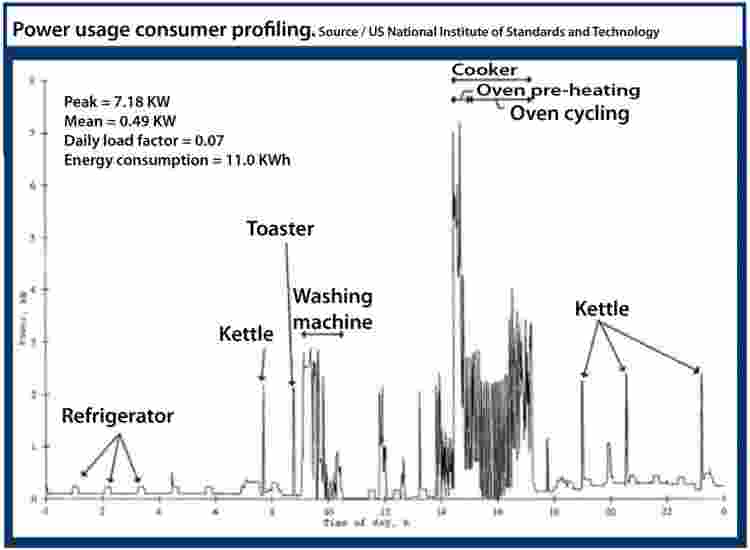
NIST power-usage-graph_web

Graph: National Institute of Standards and Technology

You Sure Drink a Lot of Tea: Smart meter data can show what’s going on in a home, because tea kettles, toasters, and other appliances have identifiable load signatures.

Back in 2007, when the Dutch government announced that all 7 million homes in the Netherlands would be equipped with smart meters by 2013, it anticipated little resistance…But consumers worried that such intelligent monitoring devices, which transmit power-usage information to the utility as frequently as every 15 minutes, would make them vulnerable to thieves, annoying marketers, and police investigations. They spoke out so strongly against these “espionage meters” that the (Netherlands) government made them optional.

It all sounds less paranoid when you consider that each appliance — the refrigerator, kettle, toaster, washing machine — has its own energy fingerprint, or “appliance load signature,” that a smart meter can read. Anyone who gets hold of this data gets a glimpse of exactly what appliances you use and how often you use them.
Privacy on the Smart Grid, Ariel Bleicher, October 2010 http://spectrum.ieee.org/energy/the-smarter-grid/privacy-on-the-smart-grid
IEEE — the Institute of Electrical and Electronics Engineers — is a professional and industry organization.

Denver (Colorado) Post —

The “smart” electric grid may be just a little too smart. Once a smart meter is attached to a home, it can gather a lot more data than just how much electricity a family uses.

It can tell how many people live in the house, when they get up, when they go to sleep and when they aren’t home.

It can tell how many showers they take and loads of laundry they do. How often they use the microwave. How much television they watch and what kind of TV they watch it on.

“This is technology that can pierce the blinds,” said Elias Quinn, author of a smart grid privacy study for the Colorado Public Utilities Commission.
“New electricity grids may be smart, but not so private,”  May 18, 2010: http://www.denverpost.com/frontpage/ci_15106430)

Smart Meters collect finely detailed personal energy usage data and wirelessly transmit that data to the utility company and to whoever has access to the feed. The level of detail collected by the meter can also be increased. Individual privacy was considered so important as to be enshrined in the California Constitution. This is an invasion of our privacy.

This recent article on a report by that Smart Meter data, without the Home Area Network of smart appliances — http://smartgridawareness.org/2014/05/16/smart-meter-privacy-invasion-alert/

Spectrum IEEE

Each appliance has its own energy fingerprint.

Smart Metering and Privacy: A Report for the Colorado PUC (Public Utilities Commission), Spring 2009

 “…the load signatures of various appliance categories are surprisingly unique, and an impressive amount of detail concerning customer usage habits could be discerned… smart meters allow for the collection and communication of highly detailed electricity usage information…all told, 52 million smart meters would be installed throughout the country over the next five to seven years. Smart-metered information, collected at levels as fine as one-minute intervals, can be disaggregated into its constituent appliance events, allowing both consumers and utilities (and anyone else with access to the information) to see exactly what makes up an individual household’s electricity demands.”
Elias L. Quinn: “Smart Metering & Privacy: Existing Law and Competing Policies,”
http://www.dora.state.co.us/puc/DocketsDecisions/DocketFilings/09I-593EG/09I-593EG_Spring2009Report-SmartGridPrivacy.pdf

Chaos Communication Conference, Germany (January 2012) –

Hackers analyzed Smart Meter data and were able to identify “the number of PCs or LCD TVs in a home, what TV program was being watched, and if a DVD movie being played had copyright-protected material.”            http://www.networkworld.com/community/node/79486
Hacking For Privacy: 2 days for amateur hacker to hack smart meter, fake readings

At the Las Vegas Consumer Electronics Show, January 2012:

Tech companies are poised to gather unprecedented insights into consumers’ lives– how much they eat, whether they exercise, when they are home and who they count as friends. Silicon Valley is in a gold rush for information, highlighted by Google’s announcement Tuesday that it would incorporate data posted by users on its social networking service into the results of its main search engine.

Microsoft’s Kinect game console collects some biometric information that Chief Executive Steve Ballmer said on Monday is a potential springboard for health-care and other industries.

“We are collecting data second by second,” said Tivo Senior Vice President Tara Maitra.

LG was among several companies to showcase “connected homes,” where appliances are connected to one another as well as energy grids via the Web. http://www.washingtonpost.com/business/economy/privacy-rights-activists-worry-about-potential-abuse-of-high-tech-devices-featured-at-ces-event/2012/01/10/gIQAX3kJpP_story.html

Harvard Business Review, October 2010

Aside from the home consumers, let’s imagine a company’s data center is making energy efficiency a top priority. The company management is keen on monitoring energy and reporting usage back to the grid. The data center facility controllers will communicate with smart meters and send data to the utilities to be analyzed. If in some way this data is leaked, it could pose serious issues to the overall security posture of the company and data center.
How Private Is Your Smart Grid Data? Usman Sindhu October 13, 2010
http://blogs.hbr.org/cs/2010/10/how_private_is_your_smart_grid.html 

The profile at the beginning of this section is from the National Institute of Standards and Technology. Much finer data collection is planned through the Home Area Network (HAN), with transmitters in all appliances, and additional “Smart” devices.

The UCLA Smart Grid project installed wireless sensors in rooms which can tell how many people are in the room. These “vacancy sensors” are becoming required in new building codes.


This and additional information on privacy and surveillance are on pages 19-27, https://smartmeterharm.org/2012/12/14/report-smart-meter-problems-dec-2012/
Posted in Uncategorized | Leave a comment

Your energy data — Who wants it and what can they do with it?

Who wants our information and why?

Who wants smart meter data? How could the data be used?
Utilities To monitor electricity usage and load; to determine bills
Electricity usage advisory companies To promote energy conservation and awareness
Insurance companies To determine health care premiums based on unusual behaviors that might indicate illness
Marketers To profile customers for targeted advertisements
Law enforcers To identify suspicious or illegal activity*
Civil litigators To identify property boundaries and activities on premises
Landlords To verify lease compliance
Private investigators To monitor specific events
The press To get information about famous people
Creditors To determine behavior that might indicate creditworthiness
Criminals To identify the best times for a burglary or to identify high-priced appliances to steal

Source: ”Potential Privacy Impacts that Arise from the Collection and Use of Smart Grid Data,” National Institute of Standards and Technology, Volume 2, pp. 30–32, Table 5-3.  http://spectrum.ieee.org/energy/the-smarter-grid/privacy-on-the-smart-grid Reprinted in www.burbankaction.com

California Public Utilities Commission:

Currently, there are about 200 firms or other providers of energy efficiency services who have Commission authorization to conduct energy efficiency programs or energy efficiency program evaluations and have access to information for this primary purpose under contract with the Commission. Beyond these firms, other government entities, such as local government and state agencies, implement energy efficiency programs and obtain access to consumption data under the Commission’s supervision.

…Still other third parties may acquire consumption data: (including) from the utility via the “backhaul” with the consumer’s authorization and pursuant to tariff conditions (currently Google obtains information in this matter from San Diego)…
CPUC Decision Adopting Rules to Protect the Privacy and Security of the  Electricity Usage Data, Rulemaking 08-12-009, p. 34, 35, 7-29-2011
http://docs.cpuc.ca.gov/WORD_PDF/FINAL_DECISION/140369.PDF

Data fusion

At a California PUC workshop on Dec. 9, 2011, PG&E representatives said that customers would be able to compare their energy usage online to others with the same home square footage. Asked how PG&E would know the square footage of our homes, a rep quickly responded, “That’s public information.”

Smart Grid TMC-Net.com:

 “GridGlo is working with utilities to combine consumer household behavioral data with energy usage data—along with a dollop of data on weather, demographics, motor vehicle registrations, and even satellite imagery—and from all that, to draw strategic operational and marketing conclusions. The process is called data fusion.
Behave Yourself! The Utilities ‘Have Got Your Numbers’ and Next They’ll Know Your Habits, Too
http://smart-grid.tmcnet.com/topics/smart-grid/articles/176270-behave-yourself-utilities-have-got-numbers-next-theyll.htm

 From the GridGlo website:

Our technology can tell a utility if their customers are married, have kids, living in a 5,000 square foot home, if and when they installed solar panels, if they drive a hybrid electric vehicle, if they had the same job for the last ten years, havent moved in that time and more. You put those components together and you begin to build an understanding of how this is all related to energy consumption.

A New York research firm that turns massive amounts of data into streamlined information, the companies revealed today.

GridGlo sells software and services that help utilities see how and why their customers, primarily homeowners, are using electricity in real-time. They also provide utilities with an Energy People Scoring Mechanism, or EPM score that the company hopes will become a standard like the FICO score is to credit card issuers and other financial institutions.

,,,GridGlos platform uses advanced data fusion technology to merge AMI data with social and behavioral data, providing new ways for Utilities to forecast, segment, and monetize their data.
http://www.gridglo.com/

GridGlo has now changed its name to “Trove”, as in treasure trove.

The possibilities for data fusion are endless, particularly with the implementation of the Home Area Network. Medical and pharmaceutical records, and data collected from intelligent transportation systems are just a few examples of the data that can be “fused” together to create complete portraits of our daily lives.

Data marketing

Smart Grid TMC-Net.com:

‘We realized utilities were getting all this data from advanced metering infrastructure (AMI) deployments and there was no clear understanding [of] how to monetize the data or use the data,’ said Isaias Sudit, CEO of the origins of GridGlo.”

 “’Smart grid utilities are evolving into brokers of information,’ says industry analyst Marianne Hedin.”

Behave Yourself! The Utilities ‘Have Got Your Numbers’ and Next They’ll Know Your Habits, Too
http://smart-grid.tmcnet.com/topics/smart-grid/articles/176270-behave-yourself-utilities-have-got-numbers-next-theyll.htm

From the CPUC proceeding on privacy and the Smart Grid, Docket #: R 08-12-009 (July 28, 2011)

  • Commissioner Timothy Alan Simon, “I support today’s decision because it adopts reasonable privacy and security rules and expands consumer and third-party access to electricity usage and pricing information. I hope this decision stimulates market interest in the data.”
  • “The privacy rules in today’s decision establish a solid framework for creating balance between protecting consumer privacy and fostering a new market for third-party participants,” said Commissioner Mark J. Ferron.

Press Release regarding Docket #: R 08-12-009, July 28, 2011

In May 2012, AT&T and Verizon filed comments on the CPUC’s Smart Grid Workshop summary about market access to consumer data from Smart Meters:

A means to achieve a greater degree of certainty is to establish forward-looking, pro-competitive principles from the beginning that prohibit barriers to market entry. New entrants need prompt, unfettered and reasonable access to the detailed customer usage data collected by a Smart Meter. And such access needs to reflect consistent, standardized methods across utilities. Principles such as these will spur investment and innovation in Smart Grid-enabled products and services and, in turn, will benefit customers, the environment and the economy. In short, the Commission should not delay the principles for access to detailed data at the customer side of the smart meter.

Joint Reply Comments of AT&T and Verizon to March 1, 2012 Smart Grid Workshop Summary, A. 11-06-006 et al., May 17, 2012


This and additional information on privacy and surveillance are on pages 19-27,

https://smartmeterharm.org/2012/12/14/report-smart-meter-problems-dec-2012/

Posted in Uncategorized | Leave a comment

Smart Meters, the internet of things, and surveillance

Surveillance meets 1984

CIA Director David Petraeus on the “internet of things” at In-Q-Tel summit, April 2012:

“‘Transformational’ is an overused word, but I do believe it properly applies to these technologies,” Petraeus enthused, “particularly to their effect on clandestine tradecraft.”

“Items of interest will be located, identified, monitored, and remotely controlled through technologies such as radio-frequency identification, sensor networks, tiny embedded servers, and energy harvesters — all connected to the next-generation internet using abundant, low-cost, and high-power computing,” Petraeus said, “the latter now going to cloud computing, in many areas greater and greater supercomputing, and, ultimately, heading to quantum computing.”
Reported in http://www.wired.com/dangerroom/2012/03/petraeus-tv-remote/

 The Washington Post included Smart Meters in this chart on NSA surveillance — http://timepoy.files.wordpress.com/2013/12/2_1.png?w=753

New cellular phone technologies (University of Texas, 2012), and conceivably Smart Meters as well, will be able to see through walls. This is the field of “remote sensing”. University of Illinois professor and Bioelectromagnetics Editor James Lin has demonstrated that the Soviet microwaving of the Moscow Embassy between 1953 and 1976 could have been for testing just such remote sensing capability. Much research has been done since then on remote sensing applications, including for medical purposes, including

 — “Behind thick layers of nonconductive walls”, “up to 30 meters”
Microwave sensing of physiological movement and volume change: a review, James Lin, 1992

— Under sponsorship of the U.S. Army, researchers used 850 MHz and 2.4 GHz microwave frequencies to monitor respiration and heart rate at a distance.
Note: electric Smart Meter frequencies are 900 MHz and 2.4 GHz.
A Digital Signal Processor For Doppler Radar Sensing Of Vital Signs, Lohman et al.,2001.

New devices, such as “baby radar” (University College Cork, Ireland, 2011), and other medical applications are being reported in the media frequently.

NBC News, “The Wi-Fi in your home can track your moves like Xbox Kinect”

A team at the University of Washington has rigged a standard Wi-Fi home network > to detect your movements anywhere in the home and convert them into commands to control connected devices ..The system is also capable of tracking people as they wander through rooms or out of the house, turning off lights or adjusting music volume depending on their location. http://www.washington.edu/news/2013/06/04/wi-fi-signals-enable-gesture-recognition-throughout-entire-home/
http://www.nbcnews.com/technology/wi-fi-your-home-can-track-your-moves-xbox-kinect-6C10194118

“Wi-Fi can give us all Superman-like vision, according to boffins at MIT”

Can Wi-Fi let you see people through walls?

It isn’t exactly Superman-like X-ray vision, but cheap, low-power Wi-Fi technology is gaining more attention as a remote sensing tool.

Do you really wish you had X-ray vision? Sure, it would be fun to see what your neighbors are doing behind those walls — until you see something you wish you hadn’t.

Regardless, researchers at MIT have developed a sensing technology that uses low-power Wi-Fi to detect moving people. It follows other wall-penetrating sensor tech using radar and heavy equipment.

…The Wi-Vi system by Dina Katabi and Fadel Adib sends out a low-power Wi-Fi signal and tracks its reflections to sense people moving around, even if they’re in closed rooms or behind

…Or the NSA could use it to see how badly you dance in front of your mirror.

http://people.csail.mit.edu/fadel/papers/wivi-paper.pdf
Reported at http://news.cnet.com/8301-17938_105-57591355-1/can-wi-fi-let-you-see-people-through-walls/#

The Home Area Network and Smart Meter mesh network are Wi-Fi systems.

New Samsung LED HDTVs

“will now include built-in, internally wired HD cameras, face tracking and speech recognition capabilities, and twin microphones. In the 2012 8000-series plasmas, the cameras and microphones are built directly into the screen bezel. The 7500 – 8000ES-series TV’s, however, will have the cameras permanently attached to the top of the set.”
http://info.themicroeffect.com/2012/04/06/cia-home-invasion-smart-tvs-and-the-internet-of-things/

In 1999:

“You have zero privacy anyway,” Scott McNealy told a group of reporters and analysts Monday night at an event to launch his company’s new Jini technology.

“Get over it.”

 McNealy’s comments came only hours after competitor Intel (INTC) reversed course under pressure and disabled identification features in its forthcoming Pentium III chip.

… Sun Microsystems is a member of the Online Privacy Alliance, an industry coalition that seeks to head off government regulation of online consumer privacy in favor of an industry self-regulation approach.

 … McNealy made the remarks in response to a question about what privacy safeguards Sun (SUNW) would be considering for Jini. The technology is designed to allow various consumer devices to communicate and share processing resources with one another.

 “I think Scott’s comments were completely irresponsible and that Sun and Intel and many of these leaders are creating public policy every time they make a product decision,” said Lori Fena, chairman of the board of the Electronic Frontier Foundation.
Sun on Privacy: ‘Get Over It’, Polly Sprenger, Jan. 26, 1999
http://www.wired.com/politics/law/news/1999/01/17538

2012:

In 2009, McNealy’s assessment was confirmed by Google’s CEO, Eric Schmidt. In an interview with NBC’s Mario Bartiromo, he proclaimed, “If you have something that you don’t want anyone to know maybe you shouldn’t be doing it in the first place.” Schmidt’s words have become Google’s new mantra. Welcome to 21st-century corporate morality….

In 2010 it was revealed that Google partnered with the CIA in a venture called “Recorded Future.” Google’s vast data archive can be harnessed to meet “security” needs. This is especially troubling in light of a controversial bill being pushed through Congress, the Cyber Intelligence Sharing and Protection Act (CISPA). The act would allow sharing of data between companies like Google and the National Security Agency (NSA) to combat alleged cyber-security threats.
The Terrifying Ways Google Is Destroying Your Privacy, David Rosen, May 20, 2012
www.alternet.org/story/155479/the_terrifying_ways_google_is_destroying_your_privacy

Journalist James Bamford talked to Democracy Now on March 21, 2012 about the new facility being constructed in Bluffdale, Utah, by the National Security Agency to store collected data. http://www.democracynow.org/2012/3/21/exposed_inside_the_nsas_largest_and#.T5F22Ve7pFU.mailto

There will certainly be a great deal of it.


This and additional information on privacy and surveillance are on pages 19-27,

https://smartmeterharm.org/2012/12/14/report-smart-meter-problems-dec-2012/

Posted in Uncategorized | Leave a comment

SMUD smart meter causes electrical failure & fire hazard in Sacramento, California

From EMF Safety Network
Posted on July 1, 2014

Margie Rothwell was having serious problems with the electricity in her home.  The power turned on and off for no apparent reason. The house fire alarm kept going off and the noises were scaring her dog.

She called her brother, who was a master electrician, to help her.  He found electrical lines not working and the smart meter digital readout was unreadable.  He recommended she call the utility SMUD right away, which she did.  (SMUD stands for Sacramento Municipal Utility District.)

A couple hours later, the SMUD technician came and when he got closer to the smart meter he said he smelled “burn”.

Margie recalled, “He had a very horrified look on his face when he looked at the burnt smart meter and meter socket.” The technician removed the smart meter and quickly put it in his truck, concealing the evidence.

The technician installed a temporary adapter which left her home with only 110 volts and limited power in parts of her house.

She was left with no dryer, no air conditioner, no electricity in the master bedroom, or anything that required 220 volts.

She asked the SMUD technician for a business card. He said he didn’t have one. She asked him for his name and he would not give her his full name.

Read the full story, with photos and video — http://emfsafetynetwork.org/smud-smart-meter-burn-out-causes-electrical-failure-fire-hazard/

Posted in Uncategorized | Tagged , , , , | Leave a comment

Low intensity RFR causes oxidative stress in cells, could cause broad spectrum of health disorders and diseases

RFR = radiofrequency electromagnetic radiation
Examples: cell phones, cellular antennas, wireless Smart Meters, Wi-Fi, cordless phones, wireless baby monitors, Wii, iPads

http://www.scopemed.org/fulltextpdf.php?mno=154583
Low intensity radiofrequency radiation: a new oxidant for living cells
Igor Yakymenko, Evgeniy Sidorik, Diane Henshel, Sergiy Kyrylenko

Published March 29, 2014

Excerpts:

“Unexpectedly, a strong non-thermal character of biological effects of RFR has been documented. As low as 0.1 μW/cm2 intensity of RFR [current U.S, FCC guidelines are 200-1000 μW/cm2] and absorbed energy (specific absorption rate, SAR) of 0.3 μW/kg were demonstrated to be effective in inducing significant oxidative stress in living cells.”

“Oxidative stress is an induced imbalance between pro-oxidant and antioxidant systems resulting in oxidative damage to proteins, lipids and DNA; and is closely connected to overproduction of reactive oxygen species (ROS) in living cells.”

“Whatever the particular first-step molecular mechanisms, it is clear that the substantial overproduction of ROS in living cells under low intensity RFR exposure could cause a broad spectrum of health disorders and diseases, including cancer in humans. Undoubtedly, this calls for the further intensive research in the area, as well as to a precautionary approach in routine usage of wireless devices.”

Click to access df_pm_ros-yakymenko_engl_140414.pdf

Press Release: Group of Ukrainian scientists assesses available studies on ROS:

Mobile phone radiation leads to oxidation in cells

The Ukrainian group of scientists around Igor Yakymenko at the Institute of Experimental Pathology, Oncology and Radiobiology in Kiev consider it to be proven that mobile phone radiation leads to harmful oxidation processes in cells through the overproduction of free radicals. In the editorial ” Low intensity radiofrequency radiation: a new oxidant for living cells” in the scientific journal “Oxidants and Antioxidants in Medical Science” of 29 March 2014 the group reported that of 80 studies, they had assessed, 92,5 % (= 76 studies) confirmed that mechanism of inflicting damage. “Unexpectedly, a strong nonthermal character of biological effects” had been documented, the group of scientists wrote. Low intensity radiofrequency radiation (RFR) emitted by mobile phone end-user devices “could lead to mutagenic effects through expressive oxidative damage of DNA”, because “the substantial overproduction of ROS in living cells under low intensity RFR exposure could cause a broad spectrum of health disorders and diseases, including cancer in humans”.

Oxidative stress is considered to be the main cause of exhaustion, headaches, inflammatory diseases, all the way to heart attacks. The results of the scientists from Kiev explain the acutely critical nature of the hype around mobile phones, smartphones and wifi. According to latest statistics, children and young people use mobile phone end-user devices near their bodies on average for more than 8 hours a day. Therefore, they are permanently exposed to potential damage.

These findings once again strip the German and international legal limits, based on the guidelines by ICNIRP, of their legitimacy. The legal limits are based on the denial of such non-thermal effects. These research results show, how – for the sake of profit – users are exposed to this radiation unprotected. The time of denial of non-thermal effects and the relativization of the current state of research in order to protect business interests must stop. Diagnose-Funk e.V. asks all scientists to confront public authorities with these study results, and to demand a change in favour of the precautionary principle.

Link and Download:

Full text Yakymenko et al. & Diagnose-Funk ‘Brennpunkt’: http://www.mobilfunkstudien.de
http://www.scopemed.org/fulltextpdf.php?mno=154583

1 Oxidative stress occurs when oxidative effects by free radicals (e.g. hydrogen peroxide) exceed the ability of antioxidant systems to neutralize them and the balance is in favor of oxidation. The damage in the cells can be oxidation of unsaturated fatty acids, proteins and DNA.

2 ROS ( Reactive Oxygen Species) : Oxygen containing molecules that are highly unstable and highly interactive with other molecules. They are formed by the incomplete one-electron reduction of oxygen. They extract electrons from other molecules becoming radicals themselves. Thus a chain reaction is initiated which can cause cellular damage by oxidative stress. These ROS include superoxides, peroxides, hydroxyl radical and hypochlorous acid.

3 “Increasing incidence of burnout due to magnetic and electromagnetic fields of cell phone networks and other wireless communication technologies”, Ulrich Warnke, Peter Hensinger, umwelt -medizin – gesellschaft | 26 | 1/2013, Download from
http://mobilfunkstudien.de/dokumentationen/v-z/warnke-mobilfunk-foerdert-stress-und-burnout.php

Posted in Uncategorized | Leave a comment