Electromagnetic Sensitivity page updated with Fair Housing Act information

Important information has been added to the Electromagnetic Sensitivity page about the U.S. Fair Housing Act. The section excerpted discusses the prohibition of discrimination on the basis of disability.

Notice that the rules don’t just pertain to the sale or rental of housing. It includes “other prohibited practices”, “otherwise make unavailable or deny a dwelling”, “in the provision of services or facilities in connection with such a dwelling”. It also  doesn’t just apply to those  who reside or intend to reside in a dwelling. It also  applies to “any person associated with that buyer or renter”, “any person associated with that person”.

https://www.justice.gov/crt/fair-housing-act-1

Sec. 804. [42 U.S.C. 3604] Discrimination in sale or rental of housing and other prohibited practices As made applicable by section 803 of this title and except as exempted by sections 803(b) and 807 of this title, it shall be unlawful–
(f)

(1) To discriminate in the sale or rental, or to otherwise make unavailable or deny, a dwelling to any buyer or renter because of a handicap of–

(A) that buyer or renter,
(B) a person residing in or intending to reside in that dwelling after it is so sold, rented, or made available; or
(C) any person associated with that buyer or renter.

(2) To discriminate against any person in the terms, conditions, or privileges of sale or rental of a dwelling, or in the provision of services or facilities in connection with such dwelling, because of a handicap of–

(A) that person; or
(B) a person residing in or intending to reside in that dwelling after it is so sold, rented, or made available; or
(C) any person associated with that person.

(3) For purposes of this subsection, discrimination includes–

(B) a refusal to make reasonable accommodations in rules, policies, practices, or services, when such accommodations may be necessary to afford such person equal opportunity to use and enjoy a dwelling;

Added to Essential Resources — United States

Fair Housing Act
https://www.justice.gov/crt/fair-housing-act-1
Posted in Uncategorized | Tagged , , , , , , | Comments Off on Electromagnetic Sensitivity page updated with Fair Housing Act information

Mobile Phone Whistleblower Project launched

https://www.mobile-phone-whistleblowing.org/

From Corporate Crime Reporter

Group Calls on Citizens to Blow the Whistle on Motorola Cell Phone Safety Studies

Jan 27, 2020

A new organization was launched last week to expose concealed information about the health and safety risks of mobile phones. 

The Mobile Phone Whistleblower Project – an initiative of Whistleblowing International – is calling on citizens – especially current and former employees of Motorola and other mobile phone and communications companies – to report information about fraud, deception, corruption or other misconduct within the industry.

The group said that Motorola operated a radio frequency research laboratory at its Plantation, Florida headquarters from 1993 to 2009.

It opened the facility shortly after the wife of Madeira Beach resident David Reynard sued two mobile phone companies following the death of her husband from a brain tumor,” the group said in a press release. “A federal court in Tampa dismissed the case in 1995, but the lawsuit received significant national media attention and spawned a still-ongoing debate over whether mobile phones can cause cancer and other health problems. Many published, peer-reviewed studies conducted since the 1960s have linked mobile phone radiation to a myriad of health effects.”

After opening the laboratory, Motorola began to shape the direction of mobile phone research and public discourse. The company played a significant role in funding research, deciding which scientific studies should be conducted, serving on editorial boards of scientific journals, and overseeing standard-setting organizations that determine official radiation exposure limits. The most influential such organization, the Institute of Electrical and Electronics Engineers (IEEE), continues to hold committee meetings at Motorola headquarters on Sunrise Boulevard.”

Through the Mobile Phone Whistleblower Project, it is hoped that current and former Motorola employees in the Libertyville, Illinois area — where Motorola Mobility had headquarter offices — will come forward with evidence and information about any efforts by the company to mislead mobile phone users and the general public about health risks.”

Continue reading

Posted in Uncategorized | Tagged , , , , , , | Comments Off on Mobile Phone Whistleblower Project launched

France: 85-yr-old wins lawsuit against EDF/Enedis for Linky meter overbilling

Linky meters are Smart Meters.

Posted by Robin des Toits

The Linky meter had multiplied its bill by five: Gilberte, 85 years old, made EDF fold – ladepeche.fr – 25/11/2019

The EDF bill for a Pas-de-Calais retiree had been multiplied by five after the installation of the Linky meter. After several months of proceedings, she has finally won in court. Gilberte is grateful. She lives “a bit old-fashioned”. In his Arras apartment in Pas-de-Calais there is a fridge, a TV and a washing machine. Amount of her electricity bill: around € 100 per year. 

In February 2017, EDF came to install the Linky meter in its accommodation. “A few months later, I received my first invoice. My consumption was multiplied by eight,” testifies Gilberte in La Voix du Nord . It was maddening. “She contacts EDF but, according to her, the company does not want to know anything.” They told me that I had cheated, that I had tampered with my old meter. I invited them to come and see that I had few cameras, but nobody came and they asked me to pay, “added the old lady in the Parisian .

The Energy Mediator offers her a € 50 discount on her bill. Out of the question for Gilberte who continues to transfer to EDF the same monthly payment as usual. EDF revived it and ended up cutting off electricity in September 2018 for two months.

Supported by two collectives, ACCAD and CALGEA62, Gilberte decides to go to court, convinced of the wrongs of the electricity supplier. The district court agreed with her, two and a half years later.

“According to the old meter, the consumption of Mrs. Morel was on average 6 KWH per month (…) according to the Linky meter, it was 275 KWH per month”, explains Pierre Rose, member of the anti-Linky ACCAD collective . 

EDF and Enedis are ordered to pay her 1,500 euros in damages and interest and 800 euros in legal aid. This court decision is a first. “We take note of this decision and we will apply it. It is a perfectly isolated and exceptional case”, reacts Enedis to La Voix du Nord .

Despite this victory, Gilberte remains suspicious. Every night, when she goes to bed, she cuts the circuit breaker on her Linky meter.

Jean-Marie Louis

———————————————- —
Source :  https://www.ladepeche.fr/2019/11/25/le-compteur-linky-avait-multiplie-sa-facture-par-cinq-gilberte-85-ans-fait-plier-edf , 8561665.php

https://www.robindestoits.org/Le-compteur-Linky-avait-multiplie-sa-facture-par-cinq-Gilberte-85-ans-fait-plier-EDF-ladepeche-fr-25-11-2019_a2843.html

Posted in Uncategorized | Tagged , , , , , , | Comments Off on France: 85-yr-old wins lawsuit against EDF/Enedis for Linky meter overbilling

France: 300,000 “possibly faulty” circuit breakers made by GE, ABB, Hager, and Eaton, installed by Enedis since 2017

Posted on Robin des Toits:
[google translation]

WEST-FRANCE INFO. 130,000 circuit breakers identified by Enedis are faulty: a security risk – ouest-france.fr – 10/31/2019

Joël Le Gall / Ouest-France

Enedis has identified thousands of faulty circuit breakers, installed since 2017. They could affect the safety of the installation in private homes. A localization campaign is underway.

302,000 circuit breakers supplied to Enedis under the General Electric, Hager, Eaton and ABB brands are identified as possibly having a manufacturing defect. “The differential trigger system may not work” , we recognize at Enedis.

The circuit breakers concerned were manufactured between May 2017 and April 2019. Currently 170,000 have been identified and replaced. Brittany and the Pays de la Loire would be particularly concerned. This means that at least 130,000 remain in the wild, posing a risk to human safety ..

What is the circuit breaker for?

It cuts  the current in the event of an incident (overload, short circuit, etc.). It appears on the electrical panel which is often found in the entrance or in the garage. The circuit breaker is different from the meter which is used to measure electricity consumption

What are the risks ?

The fault on these faulty circuit breakers can lead to a malfunction of the differential trip. Clearly, the current could not be automatically cut in the event of a short circuit or overheating, causing a real risk for people (fire, electrocution, etc.).

An electrician explains: If the installation concerns a standard house, this defect will have little impact. There are other safeties on the electrical panels which are more sensitive than these circuit breakers in the event of a problem  ”. On the other hand if it is a building that does not meet standards it can be more annoying. The most important risk is that of electrocution, if the circuit breaker does not blow in the event of a wire insulation fault. “

How to know if you are affected

The manager of the public electricity distribution network has launched a major localization campaign. In early summer, up to 50,000 letters were sent. Rebelote since mid-October to identify the 170,000 faulty circuit breakers installed at customer sites. Users are invited to make a diagnosis, via the internet or by phone (0 800 730 820). You just need to give your name and “delivery point” (14 digits on your invoice). If the circuit breaker is affected, the Enedis teams replace it free of charge. “It is essential to carry out the diagnosis” , alerts Enedis.
— 
Source https://www.ouest-france.fr/economie/entreprises/enedis/info-ouest-france-130-000-disjoncteurs-installes-par-enedis-sont-defaillants-un-risque-pour-la-6589091

https://www.robindestoits.org/INFO-OUEST-FRANCE-130-000-disjoncteurs-identifies-par-Enedis-sont-defaillants-un-risque-pour-la-securite-ouest-france-fr_a2813.html

Posted in Uncategorized | Tagged , , , , , | Comments Off on France: 300,000 “possibly faulty” circuit breakers made by GE, ABB, Hager, and Eaton, installed by Enedis since 2017

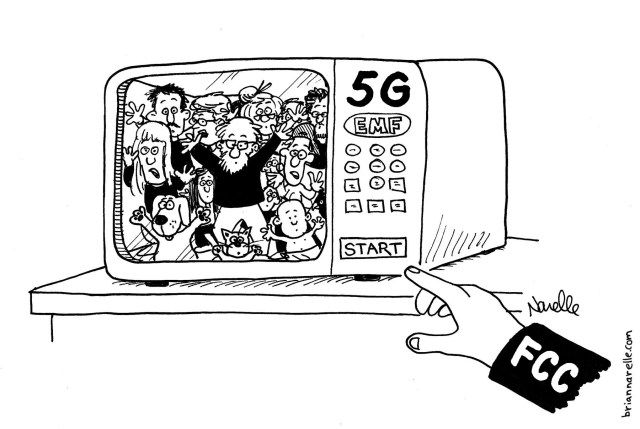
Cartoon on the FCC, 5G, and us

Artist: Brian Narelle
Unaltered image that includes artist’s name and website may be used for posters, flyers, etc.

Posted in Uncategorized | Tagged , , , | Comments Off on Cartoon on the FCC, 5G, and us

California American Water Company to roll-out Smart water meters; proposes analog opt-out — public hearings scheduled

California American Water Company (Cal-Am) is requesting authorization from the California Public Utilities Commission to roll-out Smart/AMI water meters in two service areas – the Ventura District and the Central District (Monterey County) — Application 19-07-004.

Cal-Am also proposes an opt-out program that would install an analog non-digital meter in place of the AMR or AMI water meters. They propose these opt-out fees:

$70. initial fee, and
$13. per month

The $70. fee would only apply if Cal-Am has to install an analog meter. If an analog meter is still in place, the customer would not be charged the $70.

The Ventura and Central Districts currently have pilot AMI meter programs, and Cal-Am states that the Central District program is an opt-in program.

In this CPUC application, Cal-Am also wants to raise water rates in its service territory and to change certain CPUC requirements for the company.

CPUC Commissioner Genevieve Shiroma, the assigned commissioner for this proceeding, did not include the opt-out proposal in her scoping memo of the issues to be resolved in the proceeding (see pages 4-8). A CPUC spokesman told me that the opt-out is not being considered by the Commission, and that the public needs to raise it during the public participation hearings before the Administrative Law Judge to make sure it is included.

A few other relevant issues in the scoping memo include:

4. Evaluate the adequacy of Cal-Am’s Customer Service.
5. Evaluate whether Cal-Am follows all statutory and regulatory requirements.
7. Whether there are any safety issues which the Commission needs to address.

Cal-Am does not mention ADA accommodation in relation to its AMI/AMR wireless water meters. An ADA accommodation of receiving an analog meter is not an opt-out, and under the ADA, opt-out fees would be considered surcharges and are not allowed. It is not meter “choice” when a person’s medical condition or disability requires them to have an analog meter.

The California Public Utility Commission is holding these public participation hearings in Cal-Am’s service territory. The public is invited to attend and comment at these hearings, and you can submit additional written information into the record there: 

Continue reading

Posted in Uncategorized | Tagged , , , , , , , , , , , , , | Comments Off on California American Water Company to roll-out Smart water meters; proposes analog opt-out — public hearings scheduled

Honeybees absorb high levels of RF-EMF

Figure 4. Relative electric feld strength in and around a mid-sagittal plane of the Honey Bee Drone at the nine studied frequencies. Grey scale shows the electric feld strengths relative to 1V/m electric field strength.

Figure 4. Relative electric field strength in and around a mid-sagittal plane of the Honey Bee Drone at the nine studied frequencies. Grey scale shows the electric field strengths relative to 1V/m electric field strength.

What this modeling shows is that the situation is not good now, and it’s going to get much worse under 5G regimes.

Published January 2020:

Radio-Frequency Electromagnetic Field Exposure of Western Honey Bees

PDF

Thielens A, Greco MK, Verloock L, Martens L, Joseph W. Radio-Frequency Electromagnetic Field Exposure of Western Honey Bees. Sci Rep. 2020 Jan 16;10(1):461. doi: 10.1038/s41598-019-56948-0.

Abstract

Radio-frequency electromagnetic fields (RF-EMFs) can be absorbed in all living organisms, including Western Honey Bees (Apis Mellifera). This is an ecologically and economically important global insect species that is continuously exposed to environmental RF-EMFs. This exposure is studied numerically and experimentally in this manuscript. To this aim, numerical simulations using honey bee models, obtained using micro-CT scanning, were implemented to determine RF absorbed power as a function of frequency in the 0.6 to 120 GHz range. Five different models of honey bees were obtained and simulated: two workers, a drone, a larva, and a queen. The simulations were combined with in-situ measurements of environmental RF-EMF exposure near beehives in Belgium in order to estimate realistic exposure and absorbed power values for honey bees. Our analysis shows that a relatively small shift of 10% of environmental incident power density from frequencies below 3 GHz to higher frequencies will lead to a relative increase in absorbed power of a factor higher than 3.

Excerpts (emphasis added)

From Discussions

The results of our numerical simulations, see Fig. 5, show an increase of Pabs with frequency up to 6–12GHz. Figure 4 illustrates the mechanism behind this increase: as the frequency increases the EMFs are less likely to diffract around the honey bees, that are relatively small in comparison to the wavelengths <6GHz, and can penetrate further in the models, generating higher internal electric fields and consequently higher Pabs values.

…The results in terms of Pabs obtained for the honey bees in this study fall right in between those obtained in 11 for the smaller Australian Stingless Bee and the larger Desert Locust, which confirms again the dependency of Pabs on phantom size. The same size-related effect was described for humans in 28,33,38 and comparable frequency trends were observed in humans that have larger full-body sizes at MHz frequencies 28,38. It should be noted that this manuscript focused on exposure of individual insects in free space. In reality, honey bees might cluster, creating a larger absorption cross section and potentially higher absorption at lower frequencies.

…As our RF-EMF exposure measurements near bee hives demonstrate, see Table 2, most of the current RF-EMF exposure is located at frequencies ≤1GHz. Additionally, Fig. 5 demonstrates that the Pabs in all studied Honey bee models is lowest at frequencies ≤1GHz. This implies that in reality, potential shifts in telecommunication frequencies to higher frequencies might induce even larger increases that the ones estimated in Table 4 since in that analysis an average value over all Pabs values ≤3GHz is assumed.

From Conclusions

Assuming that 10% of the incident power density would shift to frequencies higher than 3GHz would lead to an increase of this absorption between 390–570%. Such a shift in frequencies is expected in future networks.

https://www.nature.com/articles/s41598-019-56948-0

Click to access s41598-019-56948-0.pdf

Posted in Uncategorized | Tagged , , , , , , , , , , | Comments Off on Honeybees absorb high levels of RF-EMF

IEEE Fellow James Lin calls on WHO to raise wireless radiation (RF) cancer classification

The time is right for the IARC to upgrade its previous epidemiology-based classification of RF exposure to higher levels in terms of the carcinogenicity of RF radiation for humans.
—  Dr. James C. Lin

Following the National Toxicology Program study release in 2018, electrical engineer, researcher, and IEEE Fellow Dr. James Lin’s paper “Clear Evidence of Cell-Phone RF Radiation Cancer Risk” was published in the IEEE Microwave Magazine (Sept./Oct 2018). Dr. Lin is Professor of Electrical Engineering, Professor of Bioengineering, and Professor of Physiology and Biophysics, at the University of Illinois at Chicago

Recently, IEEE published another article by Dr. Lin — – “The Significance of Primary Tumors in the NTP Study of Chronic Rat Exposure to Cell Phone Radiation“. (November 2019 IEEE Microwave Magazine) In it, Dr. Lin calls for an upward carcinogenicity reclassification of RF EMF – radiofrequency electromagnetic radiation — by the World Health Organization’s International Agency for Research on Cancer (IARC).

Lin JC. The Significance of Primary Tumors in the NTP Study of Chronic Rat Exposure to Cell Phone Radiation [Health Matters]. IEEE Microwave Magazine. 20(11):18-21. Nov 2019. DOI:10.1109/MMM.2019.2935361.

Abstract

Most media accounts of the U.S. National Toxicology Program’s (NTP’s) final report have understandably focused on the statistically significant finding of “clear evidence” that both GSM and code-division multiple access (CDMA)-modulated 900-MHz wireless RF radiation led to the development of malignant schwannoma, a rare form of tumor, in the hearts of male rats. In addition to this, unusual patterns of cardiomyopathy, i.e., damage to heart tissue, were observed in both RF-exposed male and female Sprague-Dawley rats compared with concurrent control animals, although the findings for female rats were deemed as providing only uncertain or “equivocal” evidence for schwannomas and malignant gliomas, compared to concurrent controls.

Excerpts (emphasis added):

In all fairness, the primary cancer or overall cancer rates detected in any organ or tissue inside the animal body do not appear to have been purposefully overlooked or unnoticed. Indeed, the results for total primary cancer or tumor occurrences in NTP animal studies can be found in the appendices of its final reports [1]. However, although the data may not have been purposefully disregarded or ignored, the NTP excluded them from its publicized report summaries. An independent analysis of the data showed that rats exposed to GSM and CDMA RF radiation had significantly higher overall or total primary tumor rates than did the concurrent control rats [4].

Continue reading

Posted in Uncategorized | Tagged , , , , , , , | Comments Off on IEEE Fellow James Lin calls on WHO to raise wireless radiation (RF) cancer classification

Russian government recommendations to parents on children’s cell phone use, includes limiting cell phone conversations to 2 minutes or less; at least 15 minutes break between calls

From the Russian Federal Service for Supervision of Consumer Rights Protection and Human Wellbeing

About Parent Recommendations for Using Your Mobile Phone Safely

01/10/2020

1. A conversation on a mobile phone should not last more than 2 minutes, and the minimum pause between calls should be at least 15 minutes. It is much safer to write messages than to hold the phone near your ear.

2. Hold the handset of the mobile phone at a distance from the ear, for its lower part and vertically. The attenuation of radio waves occurs in proportion to the square of the distance traveled, therefore, by moving the handset away from the ear by just a centimeter and thus increasing the distance to the brain by half, you can reduce the power, radiation exposure to the brain, four times.

3. It is better to bring the handset to your ear after the subscriber answers. At the time of the call, the mobile phone operates at its maximum capacity, regardless of the communication conditions in the given place. At the same time, 10-20 seconds after the start of the call, the radiated power is reduced to the minimum acceptable level. It is pointless to put a phone to your ear also because the first long beep does not appear immediately.

4. Many children often send SMS messages or are excessively addicted to games built into cell phones. Such regular and prolonged tension on the growing hand and fingers can cause various disorders of the bones and joints. In addition, while playing, the child is forced to examine a small image, looks at the backlit screen for a long time, all the time at the same distance from the eyes. This is a serious strain on the eyes and can have a very negative effect on vision.

5. It is recommended to remove glasses with a metal frame during a conversation: the presence of such a frame can lead to an increase in the intensity of the electromagnetic field affecting the user.

6. It is not recommended to place mobile phones near you while you sleep.

7. Do not constantly keep your mobile phone with you, for example, in your trouser pocket.

8. Contacts with a mobile phone should be limited, especially if this is not necessary. 

9. It is better to carry a mobile phone in a bag; you should not keep a cellular phone on your chest, belt or chest pocket for a long time.

– – – – – – – – – – – – 

The Federal Service for Supervision of Consumer Rights Protection and Human Well-Being (Rospotrebnadzor) is a federal executive body that exercises responsibility for the development and implementation of state policy and legal regulation in the field of consumer protection, development and approval of state sanitary and epidemiological rules and hygienic standards, as well as the organization and implementation of the federal state sanitary and epidemiological surveillance and federal state supervision in the field of consumer protection.

https://rospotrebnadzor.ru/region/functions.php

https://rospotrebnadzor.ru/about/info/news/news_details.php?ELEMENT_ID=13375

Posted in Uncategorized | Tagged , , , , , | Comments Off on Russian government recommendations to parents on children’s cell phone use, includes limiting cell phone conversations to 2 minutes or less; at least 15 minutes break between calls

Global Protest to Stop 5G, January 25, 2020

Stop 5G International

International Appeal to Stop 5G on Earth and in Space

Global events scheduled

Press release

January 6th, 2020
For Immediate Release

Contact: Kate Kheel, USA kate@stop5ginternational.org
Tanja Katarina Rebel, UK tankarebel@stop5ginternational.org
Pernille Schriver, Denmark denmark@stop5ginternational.org

GLOBAL DAY OF PROTEST AGAINST 5G, JANUARY 25, 2020
Events Planned in 31 Countries So Far
______________

INTERNATIONAL APPEAL WILL BE DELIVERED TO GOVERNMENTS
AROUND THE WORLD
Signed by Scientists and Doctors from 202 Countries and Territories
______________

THE ISSUE: MICROWAVING OUR PLANET

While the media’s attention with regard to environmental issues has been captured by climate change, fracking, and plastics in the ocean, an International Appeal to Stop 5G on Earth and in Space has been quietly making its way around the world. Signed by 4,800 scientists, 2,800 medical doctors, 770 beekeepers, 2,000 environmental organizations, and 180,000 others from 202 countries and territories, this Appeal calls on the world’s governments to stop the deployment of 5G.

On January 25, 2020, environmental groups are planning events in 31 capital cities so far, with more being added daily. Their goal is to stop the deployment of millions of 5G antennas on Earth and 50,000 5G satellites in space, and to secure emergency high-level meetings with officials in governments and international governmental organizations including the European Union, the United Nations, and the World Health Organization.

The issue is microwave radiation, which has been steadily intensifying for over two decades courtesy of the wireless revolution. 5G will bring a huge increase in radiation, virtually overnight, everywhere—in cities, suburbs, parks, nature preserves, wildlife refuges, oceans, Greenland, and Antarctica. Instead of cell towers every few miles, there will be cell towers—small but powerful—in front of every third to fifth home. Instead of 2,000 satellites orbiting the Earth, there will shortly be 50,000.

The organizers of the events of January 25, 2020 include people who have already been so severely injured by wireless devices that they can no longer participate in society at all. They are fighting for their own lives, the lives of their children, and the lives of the insects, birds, animals, and all of us.

Click to access press-release-Jan-2020.pdf

Posted in Uncategorized | Tagged , , , , , | Comments Off on Global Protest to Stop 5G, January 25, 2020