CPUC internal emails now in a searchable database for citizen activists to investigate

“This is the political equivalent of the citizen science project. What we’re hoping to do is give citizen activists the opportunity to explore and chart new constellations of corruption.”

In total, the database contains more than 130,000 emails and other documents exchanged between state regulators and utility executives…

From San Diego Tribune:

By Jeff McDonald | 4:52 p.m. May 23, 2016

The Santa Monica consumer group that prompted an investigation into Gov. Jerry Brown’s top aide’s contacts with regulated utilities earlier this year has built a searchable public database of thousands of internal emails to and from her former employer, Pacific Gas & Electric, and others.

The emails, released under the California Public Records Act and as part of the utility’s response to the 2010 gas pipeline explosion in San Bruno, were posted by Consumer Watchdog on a new website called PUCPapers.org.

The California Public Utilities Commission has been under criminal investigation since 2014 for its handling of the San Bruno explosion as well as the premature closure of the San Onofre Nuclear Generating Station in 2012.

“The documents have already uncovered cozy dealings between regulated utilities and the government that go far beyond former PUC President Michael Peevey and one disgraced PG&E executive, to extend throughout the PUC, the Governor’s Office and other government agencies,” said Jamie Court, the Consumer Watchdog president.

“This is the political equivalent of the citizen science project,” he added. “What we’re hoping to do is give citizen activists the opportunity to explore and chart new constellations of corruption.”

In total, the database contains more than 130,000 emails and other documents exchanged between state regulators and utility executives, largely related to the San Bruno explosion, the San Onofre closure and the approval last year of the Carlsbad Energy Center power plant.

Much of the material previously was posted on the commission’s website in 2014 and 2015 or released to consumer groups under the public records law. But officials did not make the database searchable.

Earlier this year, Consumer Watchdog uncovered emails that reference former PG&E executive Nancy McFadden’s exchanges with Peevey and former utility colleagues, who appeared to have been discussing ways to get more utility-friendly people appointed to the commission.

McFadden, who resigned from PG&E in 2010 to become Brown’s executive secretary, became the subject of a Fair Political Practices Commission investigation in March after failing to disclose stock transfers and holdings regarding PG&E. She amended her disclosures but the case remains ongoing. According to PUCPapers.org, McFadden’s name came up at least 1,300 times in emails and other records, reflecting both her time at PG&E and her work as top aide to Gov. Brown.

jeff.mcdonald@sduniontribune.com

http://www.sandiegouniontribune.com/news/2016/may/23/consumer-group-builds-puc-email-database/


Posted in Uncategorized | Tagged , , , , , | Comments Off on CPUC internal emails now in a searchable database for citizen activists to investigate

Your cell phone money-back guarantee

By Will Thomas

All cell and portable phones ought to come with this ironclad money-back guarantee:

Brain damage is absolutely guaranteed every time you make a call on a cell or portable phone. After two minutes of cell phone exposure, your blood-brain barrier will fail, allowing proteins to enter your skull and cause nerve damage. Fibromyalgia, Multiple Sclerosis, Alzheimer’s and Parkinson’s disease are linked to distorted proteins found in brains after cell and portable phone exposure. Headaches are a sign of a serious blood-brain barrier breach. So is fatigue. Constant tiredness is probably single most common cell phone “user” complaint. [Electronics Australia Magazine Feb/00]

Changes in blood-brain barrier last for up to five hours after each exposure.

Brain damage is cumulative over repeated exposures. Premature aging is guaranteed. This too, is cumulative. Hearing loss is guaranteed after just 12 months for people who use their phones for more than 60 minutes a day. (Two years for 30 minutes a day.) And cell phone-savvy doctors are saying that early Onset Alzheimer’s is going to decimate the current Generation X-Rayed screen-heads before they are 30 years old. [entnet.org; medicalnewstoday.com Sept 20/07]

GUARANTEED
Brain damage
Early Onset Alzheimer’s *
Hearing Loss
Memory loss **
Premature Aging
Single and double-strand DNA breaks

GUARANTEED IN CHILDREN/TEENS – PROBABLE IN ADULTS
Lifelong learning, attention & concentration disabilities (ADD, Autism) ***
Asthma ****

HIGH RISK IN TEEN AND ADULT DRIVERS
Teens have the highest crash rates in USA – and least sleep. 81% of young people 15 to 20 years of age sleep with their cell phone on. Car crashes leading cause of death for teenagers across United States. “Driving while talking on a cell phone is as bad as or maybe worse than driving drunk.” -New England Journal of Medicine If you put 20-year-old drivers behind wheel with a cell phone, their reaction times same as a 70-year-old driver. “It’s like instant aging,” says the UK chief medical officer. Except older drivers, who compensate with experience.

PROBABLE IN ADULT MALES
Infertility *****

PROBABLE IN CHILDREN AND ADULTS – ELECTROHYPERSENSITIVITY
Insomnia, depression, headaches, fatigue, impaired brain function, brain fog, double vision, auditory confusion, skin rash, nausea, muscle weakness, joint illnesses, infections, skin problems, heart and circulation disorders, eye and ear disorders, gastro-intestinal disorders.

PROBABLE IN CHILDREN – ESPECIALLY IF EXPOSED IN WOMB
Autism, allergies, behavioural disorders, learning disorders ******

HIGH RISK IN CHILDREN AND ADULTS
Brain tumours ********
Breast Cancer
Ear Cancer
Cataracts

* “Heavy daily cell-phone usage could lead to great incidence of disorders such as Alzheimer’s and cancer.” -Dr. Theodore Litovitz, a biophysicist and professor emeritus of physics at Catholic University in Maryland. [Reuters Apr 23/08; wirelessconsumers.org Dec 3/01]

British medical journal The Lancet announced global Alzheimer’s rates “exploding” – in 2005! [Lancet Dec 17/05]

** “Memory loss is one of the first indications of dementia and is a common side effect of wireless phone use.” [Dr. Henry Lai, Bioelectromagnetics Research Laboratory, University of Washington: paper presented in Italy Nov 21-25/99]

*** Exposure to pulsed microwaves damages long-term learning and memory centers. Those exposed become slow learners.

Only one in three American college grads can read a complex book and extrapolate from it. Overwhelming majority of college students are unable to understand arguments in a newspaper editorial or to comprehend a simple comparison table. Education standards cannot account for plummeting comprehension in adults, as well as high school students. [sciencedaily.com Dec 02/99; “Neurological Effects of Radio Frequency Electromagnetic Radiation” a paper presented by Dr. Henry Lai at the Mobile Phones and Health Symposium, in Vienna, Austria Oct 25-28/98 Washington Post Dec 25/05]

**** After asthma cases increased 25% throughout metropolitan Sydney, and death rates jumped by 5% following complete wireless coverage in that Australian city, a government study found that cell phone radiation “excites” antigens – substances which cause allergies – and stressed the human body. [emf-health.com Dec 23/05]

One in three people can expect to be diagnosed with asthma. [American Journal of Respiratory and Critical Care Medicine Feb 15/10]

***** Men who have their cell phone on standby throughout the day have about a third less sperm than those who do not. Most of the remaining sperm are incapable of fertilisation. [BBC June 27/04]

Cell phones interfere with sperm viability, motility, and morphology. The longer a man uses a cell phone the greater the damage to sperm. Wireless laptop computers and now the iPad also emit microwave radiation. These computers are held closer to genitals and are used for longer periods than cell phones.

****** In USA, 1 in every 6 children is now diagnosed with a neurological disorder like Autism. Mercury poisoning from vaccines is also implicated. [Boston Globe July 1/05]

Cell phone-altered brains “could lead to a lack of concentration, memory loss, inability to learn and aggressive behaviour,” warns Dr. Gerald Hyland. This MD does not recommend reducing cell phone exposure. He says, “My advice would be to avoid mobiles.” [Mirror Dec 26/01]

In 29 countries, most children have a cell phone at age 9. [New York Times Mar 12/08]

British children use their mobile phones for up to 45 minutes every day. [Reuters June 29/01]

The “cellular” industry is now focusing on children as young as 5. [New York Times Mar 8/08]

Olle Johansson, Associate Professor of Neuroscience at the Karolinska Institute in Stockholm, says simply, “Parents should take their children away from that technology.” [Dialling Our Cells by William Thomas]

******* Every 100 hours of mobile phone use raises your odds of contracting brain cancer by another 24%. [Daily Mail June 15/10]

40% across-the-board increase in the number of brain tumors in the past 20 years. [Observer Mar14/99]

People who talk on mobile phones are up to FIVE-TIMES more likely to develop brain tumours than those who stick to landlines. [Daily Mail June 15/10]

We are already experiencing a “brain tumour pandemic” in children since the advent of cell phones and other wireless technologies.

Young people under the age of 20 are 420% more at risk of forming brain tumours, according to a Swedish study conducted by Dr. Lennart Hardell, because of their soft skulls, brain size, cell turnover time – and exposure to wireless radiation. [bclocalnews.com Aug 10/10]

“Because mobile phone RF penetrates deeper into a child’s brain, more brain tissue would be exposed,” warns Dr. Henry Lai.

SIX CELL PHONE TIPS FROM THE EXPERTS

  1. Do not use a cell phone except in a real emergency.
  2. Limit calls to 2 minutes or less.
  3. Limit cell phone use to five minutes per month, max.
  4. Never use a cell phone while driving. Park your vehicle and get clear of its steel structure, first. Do not use cell phones on buses, trains or planes.
  5. Never use a cell phone near small children.
  6. Pregnant women should avoid cell phones, portable phones and other wireless devices in home and office –and cell phone towers.

EIGHT THINGS YOU CAN DO TO REDUCE EMF EXPOSURE

  1. Do not live within two miles (five kilometers) from a cell phone tower. Get the tower removed. Or move.
  2. Avoid using wireless routers and portable phones.
  3. In your home, unplug all electrical appliances when not in use. (Switching TVs, wired routers and similar devices “off” does not turn them off. Intersecting electrical fields result.)
  4. Keep your bedroom free of electrical appliances –especially near your head while you sleep. Use a battery-operated alarm clock, never a plug-in clock radio! Unplug lamps when not in use.
  5. Replace dimmer switches with regular switches to eliminate high-frequency “dirty electricity”. Have your home wiring properly grounded. Even if done to Code, chances are high it is leaking dirty electricity into water pipes and other conductors.
  6. “Opt out” of your power company’s wireless smart meters. (See “dirty electricity” above.)
  7. Take the best quality daily vitamin and mineral supplements available to scrub free radicals. Give and receive affection often –hugs are a huge immune booster.
  8. Take melatonin supplements to replace sharply diminished levels after age 40. Melatonin helps prevent breast cancers and scrubs free radicals in the brain. (Cell phones and wireless radiation destroy melatonin.)

More on cell phones and wireless hazards:
http://willthomasonline.net/cell%20phones%20and%20wireless%20hazards.htm

Source: http://willthomasonline.net/your%20money%20back%20cell%20phone%20guarantee.htm

Posted in Uncategorized | Tagged , , , , , | Comments Off on Your cell phone money-back guarantee

Biomarkers for electromagnetic sensitivity / electro-hypersensitivity

Electromagnetic sensitivity (EMS) is the United States Access Board’s term for  electro-hypersensitivity (EHS).

From EMF Analysis

It has been known since 2002 that our bodies react to non-thermal EMF exposure without our conscious awareness. This makes the flawed subjective psychological tests (Can you feel the cell phone now? How about now?) much less relevant.

The following are biomarkers that medical doctors in Europe, Russia, Canada and the United States are using to diagnose electro-hypersensitivity (EHS)  If you are experiencing the common symptoms of EHS, you can bring the following to the attention of your medical doctor. Also bring him/her a copy of this book, which provides a more detailed description of the common EHS biomarkers, along with an intro letter from a medical doctor that is also electro-sensitive.

To do these tests, it is best to be in a room that is shielded from external microwave radiation and electrical pollution. This can be difficult to do correctly, which is why many tests have incorrect protocols. A cordless DECT phone or Wi-Fi router are the best stimuli as they can easily be blinded from the individual and they constant emit microwave radiation.

Blood Analysis:

  • Blood sugar levels in EHS individuals increase after 30 minutes of EMF exposure.
  • Live blood analysis of EHS individuals while being exposed to microwave radiation produces Rouleaux formations and “Bottle Cap” formations indicative of oxidation stress in red blood cells. See the following video from “Take Back Your Power“:

<iframe width=”484″ height=”272″ src=”https://www.youtube.com/embed/y4JDEspdx58&#8243; frameborder=”0″ allowfullscreen><!–iframe>

Brain and Nervous System Analysis:

  • Electro-Encephalographical (EEG) Analysis with EHS persons showing large expressiveness in alpha-rhythm parietal-occipital areas.
  • Slow EEG readings and Central Nervous System reactivity are also indicative of EHS.
  • Brain glucose levels are affected by mobile phone radiation.

Cardiac Analysis:

  • 24-hour blood pressure monitoring with EHS individuals not experiencing the expected night-time decline when exposed to EMF pollution.
  • Electro-Cardiography (ECG) with EHS individuals experiencing higher arterial pressure when exposed to EMF pollution.
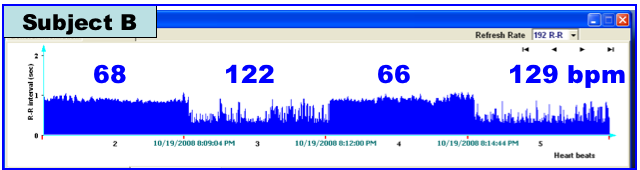
  • Heart Rate Variability (HRV) tests with EHS individuals experiencing rapid changes in heart rate variability when exposed to blinded DECT cordless phones and Wi-Fi routers. The following illustration was done by Dr. Magda Havas and shows how an EHS individual’s heart rate can be affected by a DECT cordless phone. A non-EHS individual will not see a fluctuation in HRV when exposed to the DECT phone.

Effects of Cordless Phone Radiation on Heart Rate

Hormone Analysis:

EMF exposure has been found to disrupt the production of the following hormones in EHS individuals:

  • Melatonin (decrease)
  • Seratonin (decrease)
  • Cortisol (increase/decrease depending on source of EMF pollution)
  • Adrenaline (increase)
  • Serum Testosterone  (decrease)
  • Serum Progesterone  (decrease)
  • Dopamine  (increase/decrease)
  • Plasma ACTH  (decrease)
  • T3 & T4 Thyroid Hormones (decrease)

The above EHS Biomarkers were developed by the following organizations:

Dr. Dietrich Klinghardt also provides a list of biomarkers that change when humans are exposed to EMF pollution. The following video is excellent. Dr. Klinghardt begins to talk about smart meters and the biomarkers around minute 25:30.

Here are the biomarkers he tests that are affected by EMF pollution:

  • TGF-Beta 1 increase  (inflammation marker)
  • MMP-9  increase  (inflammation marker)
  • Copper increase  (signifies chronic inflammation)
  • Hormone abnormalization
  • Neurotransmitter abnormalization

He can be found at  www.klinghardtacademy.com

Finally, I want to point out the work of Dr. Martin Pall. He is doing some of the most groundbreaking work on this subject. He is linking many illnesses that people are experiencing to the NO/ONOO cycle in our cells. You can read more of his work here. In the coming years he will likely help find the mechanism related to EHS.

http://thetenthparadigm.org/

Electrical Sensitivity Biomarkers

Posted in Uncategorized | Tagged , , , , , , , , , , , , , , , | Comments Off on Biomarkers for electromagnetic sensitivity / electro-hypersensitivity

Ransomware attacks on electric and water utilities’ data on the rise

This certainly puts at risk of exposure and/or data corruption all the personal energy and lifestyle data flowing from Smart Meters to utilities. At the same time, if these attacks can even accidentally corrupt data that controls nuclear power plants, for instance, or wireless network emission levels, just as a hacker intentionally altered controls to chemicals for a municipal water system, and do it remotely, that is far, far more dangerous.

From Fierce Big Data

May 4, 2016 | By Pam Baker

Data breaches that result in stolen data are not the only threats organizations have to worry about now. Ransomware attacks are spreading across industries too. The latest on that front are attacks on electric and water utilities ranging from Israel to Michigan.

“The nature of a ransomware attack, where attackers encrypt the victim’s data until they pay, is not a direct threat to critical infrastructure systems. Ransomware attacks are based on the ability of the attacker to halt-and-release the victim’s data, which is less likely in physical systems,” said Itsik Mantin, director of security research at Imperva. “The main risk ransomware presents for critical infrastructure systems is an accidental one. Ransomware tends to corrupt all the data it finds, both locally on the infected machine and everywhere else on the network, regardless of whether the data is a picture of the user from his last vacation or a configuration file used by a critical system.”

Ransomware found its opening through a phishing attack on Israel Electric Authority back in January. While the media freaked as if the attack took out that nation’s power grid, that’s not what happened. Although given other forms of attacks on utilities, it might one day. But no, this was a case of ransomware which Yuval Steinitz, the Israeli Minister of National Infrastructure, Energy and Water said was “one of the largest cyber attacks that we have experienced.”

Now comes word that the State of Michigan, Lansing’s Board of Water & Light was similarly attacked. It began as a phishing attack on April 25th and led to the authority keeping systems, including phone servers, locked down until Monday.

“Despite the controls on the perimeter and on endpoints, security officers should assume that the attacker will make it in, one way or another, either by compromising a user’s endpoint or when the attacker is the user himself,” said Mantin.

“Like most of the threats on the enterprise, ransomware attacks focus on the business critical data and can be effectively mitigated by having security controls protecting the places where the data is stored: databases, files or cloud applications, and over the applications through which it is accessed.”

So, what does ransomware mean in terms of ultimate threats to utilities?

“The nature of a ransomware attack, where attackers encrypt the victim’s data until they pay, is not a direct threat to critical infrastructure systems,” said Mantin.

“Ransomware attacks are based on the ability of the attacker to halt-and-release the victim’s data, which is less likely in physical systems. The main risk ransomware presents for critical infrastructure systems is an accidental one. Ransomware tends to corrupt all the data it finds, both locally on the infected machine and everywhere else on the network, regardless of whether the data is a picture of the user from his last vacation or a configuration file used by a critical system.”

While ransomware attacks on utilities seem to be picking up steam and are hurting the organizations they hit, let’s not forget that other threats loom large too. One example, the recent Iranian hacktivist group that seized the control system for a dam in New York, “an intrusion that one official said may be ‘just the tip of the iceberg,'” according to an NBC News report.

One point all these breaches bring home is that organizations must make serious moves in protecting data now, before something worse happens. Data is the alpha and omega of our existence now.

For more:
– read the article
– see BML’s Facebook page
– see the NBC News report

http://www.fiercebigdata.com/story/ransomware-attacks-electric-and-water-utilities-data-rise/2016-05-04

Posted under Fair Use Rules.

Posted in Uncategorized | Tagged , , , | Comments Off on Ransomware attacks on electric and water utilities’ data on the rise

Warning: TWACS — the worst Smart Meter?

From EI Wellspring

TWACS smart meters problematic to public health and safety

PDF: http://www.eiwellspring.org/smartmeter/TWACS.pdf

The TWACS smart meters communicate with the utility by adding low frequency signals to the electrical lines. Some utilities promote such power line carrier (PLC) systems as a positive alternative to wireless smart meters. The reality is that all PLC technologies are problematic, including the “pulsing” TWACS systems.

The basic facts are that the TWACS system

  • creates powerful dirty electricity
  • the dirty electricity is a constant presence, possibly 24/7
  • the dirty electricity turns all wires throughout the house into antennas
  • keeping an analog meter will not help much
  • the signals cannot be blocked or filtered
  • scientific studies link dirty electricity with various health effects
  • some people are sensitive to dirty electricity
  • TWACS lacks basic security features

This article covers all these issues in detail.

Continue reading

Posted in Uncategorized | Tagged , , , , , , | Comments Off on Warning: TWACS — the worst Smart Meter?

FCC finds power line communication (PLC) can reach or exceed radiation limits

It was apparently a surprise to the FCC engineers that the power lines themselves act as significant antennas for the BPL signals. They seem to have expected that the main source of radiation would be the equipment (coupler), but they found that even 230 meters (700 ft) down the line from a coupler, the radiation was still significant:

NOT A POINT SOURCE. Emissions exhibit no noticeable decay 230 m down line from couplerb

Also:

Strong fields follow power line for 0.5 mile. Not a point source.c

That it is not a point source is important, since the radiation levels diminish rapidly with distance from point sources, and much slower from line sources. This means that the BPL radiation reaches further from a line than if it was coming from a box or small antenna. It also means that any section of the power line can radiate.

From EI Wellspring:

The Federal Communications Commission (FCC) is the agency which regulates wireless systems in the United States. The FCC issues licenses to users of the wireless spectrum, to ensure that one transmitter does not interfere with another. The agency also investigates complaints of interference.

In the years 2003 to 2004, the FCC Laboratory measured seven Power Line Communication (PLC) systems, and found that it could clearly pick up the radiation from all of them. This was also the case where the electrical cables were underground, though underground cables clearly radiate less than aerial power lines.

Some of the FCC measurements were in response to complaints from radio amateurs, who were located up to 0.7 miles (1100 meters) from power lines carrying PLC signals.

The seven PLC systems were all of the Broadband over Power Line (BPL) type.

The FCC Laboratory found that one of the BPL systems violated the United States radiation standards, while two other systems reached the limit. The FCC limits are much higher than those in Europe and Japan.

Keywords: Power line communication, broadband over power lines, power line network, line source, Federal Communications Commission, power line radiation, interference, PLC, BPL, PLT, FCC

Making the reports public

The technical reports covering the seven PLC/BPL systems were not intended to be made public. They consist of approximately 150 projection slides all together.

When the FCC took no action against commercial BPL systems interfering with HAM radio operators, it was sued by the American Radio Relay League (ARRL). The ARRL is the U.S. organization of radio amateurs.

The FCC released the reports during the lawsuit, but blanked out important information.

The United States Court of Appeals ordered the FCC to release the blanked out information (D.C. circuit 2008, 524 F. 3d 227), though it took a year and a Freedom of Information request to get it released.

The court also ordered the FCC to address the complaints by the ARRL, which it did (see later).

The measured systems

The FCC Laboratory measured seven PLC/BPL systems, located in four Eastern states. The locations are listed in the following table1:

Town Operator Frequencies Lines Wireless to house
Allentown, PA Amperion 2-6 MHz, 20-30 MHz overhead yes
Allentown, PA Main.Net 3-17 MHz over & under  
Potomac, MD Current Technologies 30-50 MHz overhead  
Briarcliff Manor, NY Not specified 19-23 MHz over & under  
Holland Meadows, NC Amperion/Progress Energy 17-21 MHz overhead yes
Whitehurst, NC Amperion/Progress Energy 23.2 MHz underground  
Woodchase, NC Amperion/Progress Energy 21-25 MHz over & under  

Two of the systems were a hybrid of PLC and wireless. The signals were carried to the area from a central location, using BPL on the power lines along each street. The short distance into each house was handled by wireless Wi-Fi. Equipment to convert between the wireline PLC/BPL signals and wireless was mounted on utility poles or on ground-mounted transformers.

Some systems carried the BPL signals on overhead power lines, some on underground lines. Some did both.

Continue reading

Posted in Uncategorized | Tagged , , , , , , , , , , | Comments Off on FCC finds power line communication (PLC) can reach or exceed radiation limits

League of United Latin American Citizens – LULAC – adopts resolution for moratorium on Smart Meters and for no cost opt-outs

From Coalition for Safe Meters

Adopted July 11, 2015

League of United Latin American Citizens

RESOLUTION FOR A MORATORIUM ON THE INSTALLATION OF ‘SMART’ METERS AND NO COST OPT-OUT

WHEREAS, since its inception on February 17, 1929 in Corpus Christi, Texas, LULAC, the League of United Latin American Citizens, the largest, oldest and most successful Hispanic civil rights and service organization in the United States, has championed the cause of Hispanic Americans in education, employment, economic development and civil rights, and

WHEREAS, LULAC members throughout the nation have developed a track record of success in advancing the economic condition, educational attainment, political influence, health and civil rights of the entire population of the United States, and

WHEREAS, utilities are now engaged in subjecting customers to wireless technology by their installation of so-called ‘smart’ technology, which includes ‘smart’ grid infrastructure and radiation pulsing meters on homes and businesses across the country, and

WHEREAS, utility regulatory legislation is enacted with the provision that it not conflict with any authority of the United States, however, wireless radiation pulsing meters and the data they collect violate the Fourth Amendment to the Constitution which ensures the “right of the people to be secure in their persons, houses, papers, and effects, against unreasonable searches and seizures,” and

WHEREAS, the Federal Energy Policy Act of 2005, which proposed the use of wireless ‘smart’/radiation pulsing meters, mandates that utility companies ‘offer’ wireless meters and install them ‘upon customer request’, however, utilities are installing these meters without the consent of the property owner, and

WHEREAS, municipal governments and utilities across the country have not warned the public and their customers of inherent health, safety, and privacy problems with ‘smart’ grid technology and the wireless radiation pulsing meters, and

WHEREAS, we are concerned that monopoly utilities have approved this technology without public knowledge or debate and in many cases without a vote of local government or the citizenry, and

WHEREAS, these monopoly utilities argue that they will save money by eliminating the cost of meter readers, however, cost benefit studies have in many cases not been undertaken or proven this assertion to be false, and

WHEREAS, utilities have not warned the public of known health hazards to ‘at-risk’ populations, which include those with EMR sensitivities, individuals with pacemakers, individuals with metal in their bodies (teeth and prosthetics), and

WHEREAS, utilities have failed to warn customers that the World Health Organization has designated exposure to Radio Frequency a Class 2B (Possible) Carcinogen and that the United States Military have identified radio-frequency (RF) radiation as a health risk, and

WHEREAS, persons in densely populated areas may be at higher risk of health effects due to the proximity to the meters, a population which includes not only the poor and minorities but the elderly that have downsized to live in apartment complexes and condos, and

WHEREAS, some utilities classify apartments and condos as ‘non-residential’, and have a policy that forces ‘smart’/RF meters on them, Clearly this is an arbitrary decision on their part that is dismissive of property rights and which puts the apartment or condo owner and their tenants in harm’s way when meters are clustered near an apartment or condo unit, and

WHEREAS, ‘smart’/RF meters are proven vulnerable to hacking, intrusion, and the ‘smart’ grid to be more susceptible to terrorist attack and disruption;

THEREFORE BE IT RESOLVED, that the League of United Latin American Citizens supports the Federal Energy Policy Act of 2005 that time-based meters be provided upon customer request only, and

BE IT FURTHER RESOLVED that our organization supports the right of the property owner to have an ANALOG meter (and not be forced to have a non-communicating RF/’smart’/time based meter installed), and

BE IT FURTHER RESOLVED, that our organization supports the right of the property owner to disallow a tenant from having an RF/’smart’/time-based meter installed, and

BE IT FURTHER RESOLVED, that our organization supports the right of the property owner (or tenant with permission of the property owner) to have a previously installed RF/’smart’/time-based meter replaced with an ANALOG meter, at no cost, by the utility, if it is determined that the utility did not have proper permission to install the meter, and

BE IT FURTHER RESOLVED that our organization opposes all fees associated with refusing RF/‘smart’/ time-based meters, especially a monthly charge that will be disproportionately harmful to the poor, and

BE IT FURTHER RESOLVED that we support a Moratorium on the installation of RF/‘smart’ meters until such time that we determine that all safety, health, and privacy concerns have been resolved to the satisfaction of this organization.

Voted and approved at the 2015 National LULAC Convention – July 11, 2015.

Roger C. Rocha, Jr.
LULAC National President

Click to access LULAC_OfficialSmartMeterMoratorium.pdf

Posted in Uncategorized | Tagged , , , | Comments Off on League of United Latin American Citizens – LULAC – adopts resolution for moratorium on Smart Meters and for no cost opt-outs

Since 2012, UK Chief Fire Officers Association has supplied warning labels for meters

From Chief Fire Officers Association
February 17, 2012

Label

Electrical Safety

CFOA have been working jointly with the Electrical Safety Council for some time. After an investigation by East Sussex Fire & Rescue Service into the frequency of fires originating at the electrical intake position in (mostly) residential properties a proposal was put forward by the ESC.

They proposed to create warning labels and leaflets that warn householders not to store combustible materials close to the electrical intake equipment in their homes. The labels and leaflets are intended to be offered to householders during FRS home safety visits. The label should be fitted near to the householder’s electrical intake position and the householder given the accompanying leaflet.

The warning is particularly appropriate where the electrical intake equipment (service head, meter and/or consumer unit) is in a cupboard which is used to store items such as coats, cleaning materials and other items that may ignite easily. Fires in under-stair cupboards are particularly dangerous, as the means of escape from upstairs can be cut off.

The Electrical Safety Council is making the labels and leaflets available to FRS across the UK. If you would like to receive copies of the label and leaflet, they can be ordered, free of charge, from ESC in units of 1,000 per box by emailing: enquiries@esc.org.uk.

Furthermore, through an agreement with The Association of Meter Operators, these labels will also be available for use by meter operators, on a voluntary basis, when visiting homes to replace electricity meters. Meter operators may start to use the labels before the smart meter programme gets underway – from 2012 onwards – as the warning is not specifically related to smart metering.

Flyer
http://www.cfoa.org.uk/download/20802

http://www.cfoa.org.uk/12619


Posted in Uncategorized | Tagged , , , , , | Comments Off on Since 2012, UK Chief Fire Officers Association has supplied warning labels for meters

Just revealed: UK Government warned of smart meter security threat back in 2012

From Computer Weekly
by Bryan Glick, Editor in Chief
24 Mar 2016 13:

The government was warned four years ago that its plans for a nationwide smart meter roll-out represented a “potentially significant” security and privacy threat, Computer Weekly has learned.

The government was warned as long as four years ago that its plans for a nationwide roll-out of smart meters represented a “potentially significant” security and privacy threat, Computer Weekly has learned.

A report in the Financial Times last week said that GCHQ had “intervened” to help boost the security of the £11.7bn programme to install smart meters in every UK home.

An unnamed senior Whitehall official told the FT that every smart meter used the same encryption key for data communication, opening up a single point of failure for hackers to take over every device if they accessed the key. As a result, GCHQ added further security measures.

Yet the security risks inherent in the design of the smart meter network were raised as long ago as March 2012 in a report produced by the Cabinet Office to review plans for the Department for Energy and Climate Change (DECC) programme.

The review – co-authored by government chief technology officer Liam Maxwell – was highly critical of the proposal to create a “monopoly” data and communications company (DCC) to act as a middle-man between energy providers and their customers. Even so, a contract to set up and run DCC was awarded to Capita in 2013, in a 12-year, £175m deal.

The Cabinet Office report highlighted the risk of having a “new GB-wide entity with reach into every home”.

Read more about smart meters

The report, seen by Computer Weekly, went on to point out: “The proposed technical model inserts a new third-party between consumers and energy providers. It thus introduces an additional and potentially significant security and privacy vulnerability.

All 28 million households would be connected to the DCC, presenting a major vector for cyber-attacks given the vulnerability of a single, centralised entity managing all the switching into every home. It also introduces a central point for surveillance and privacy compromise.”

The report said that CESG – the information security arm of GCHQ – had “voiced strong concerns about the proposed approach”, and the document recommended an independent review of the proposed security and privacy architecture.

“Misleading”

DECC said that the FT article was “misleading” and that it had worked with GCHQ from the start.

“Smart meters will help hardworking families and businesses to take control of their energy use, bringing an end to estimated bills and helping bill-payers to become more energy-efficient. They’re part of this government’s commitment to make Britain’s energy infrastructure fit for the 21st century,” said a DECC spokesperson.

“Smart meters will operate on a secure system that only authorised parties, such as energy suppliers and network companies, can access. Working with experts across industry and across government, we have put in place robust security controls which are based on international standards and industry good practices.”

Single point of failure

The Cabinet Office report further raised the risk of denial of service attacks cutting out communications between consumers and energy providers. It said the centralised model that has since been implemented raised “enduring concerns” by introducing a single point of failure and an access point to the entire smart meter network.

“The DCC will have the ability to disable any meter remotely, a facility that creates a significant cyber security threat in the form of enabling an attacker – insider or outsider – to centrally disrupt or otherwise interfere with energy supplies,” said the report.

In an interview published in March 2016 in The Brewery Journal – a publication from PR firm Freud Communications – Ian Levy, technical director at CESG, said the organisation had “recently” examined the smart meter project to ensure its security.

“In the design of the system, we’ve assumed that vulnerabilities exist in each component, and designed the system so it’s tolerant to those weaknesses,” he said.

Long list of concerns

The Cabinet Office review of the smart meters project in 2012 highlighted a long list of concerns relating to the programme beyond the security threat, warning that it ran the risk of “replicating the problems of major government IT projects of the last 15+ years”.

One concern raised was: “[The programme] imposes a solution based on using single large suppliers with exclusive 10+ year contracts rather than being based on open standards, interoperability and an open marketplace.”

Another issue was: “The programme is following an old-style rather than agile procurement processes, and currently using a competitive dialogue restricted to a limited number of large suppliers able to meet the high procurement bar and long contractual period.”

Other suppliers subsequently involved include CGI, with an eight-year contract worth £75m to develop and operate the system controlling the movement of messages to and from smart meters. Arqiva and Telefonica have 15-year contracts worth £625m and £1.5bn respectively to establish regional wide area networks connecting the data application with gas and electricity meters.

The Cabinet Office made 31 separate recommendations suggesting significant changes to the smart meter programme in a wide range of areas – not just security – including a three-month “reset” period to reconsider the project. It is not clear which, if any, of those recommendations were implemented.

Halt, alter or scrap

The smart meter programme has come under increasing scrutiny in the past year as concerns grow about the likelihood of success. In March last year, the Institute of Directors called for the project to be “halted, altered or scrapped” immediately to avert an expensive IT failure.

In the same month, MPs on the Energy and Climate Change Committee said the plans were veering off-track. “Without a significant and immediate change to the present approach, the programme runs the risk of falling far short of expectations,” said committee chair Tim Yeo.

http://www.computerweekly.com/news/4500279800/Government-warned-of-smart-meter-security-threat-back-in-2012

Posted under Fair Use Rules

Posted in Uncategorized | Tagged , , , , , , | Comments Off on Just revealed: UK Government warned of smart meter security threat back in 2012

UK engineering organization questioned worker training, roll-out haste, and fires in 2012

It’s alarming to read this 2012 article.

The UK-based Institution of Engineering and Technology is a 140-year old professional organization.

From the Institution of Engineering and Technology
Engineering and Technology Magazine

Smart Meters, Dumb Fires

17  December 2012
By Kris Sangani

The energy supply industry is gearing up for a mass rollout of smart meters across the UK, but should reports of smart-meter fire-related incidents be a cause for concern?

The energy supply sector, like all infrastructure sectors, is draped in red tape. But despite the complex web of meetings between regulators, civil servants, energy companies and other interested parties, the sector is in danger of losing sight of one of the most important aspects of all: the safety of consumers in their own homes.

The UK’s main energy suppliers have been given strong incentives to install as many smart meters as they can, as rapidly as possible, and are in the process of mobilising an army of installers. But what technical background do these installers have?

Reports of fires related to smart meters in the USA and Australia have quite rightly provoked concern among consumers. That concern seems well justified; following an enquiry with the Health and Safety Excutive, E&T has uncovered the fact that the UK has suffered its share of incidents.

Kieran Jenkins, factory manager for consumer unit manufacturer Proteus Switchgear, describes an incidents in Wolverhampton in March 2012.

“Initially, the insurance company had suggested that the fault was with our consumer unit, which had been working without fault for over four years,” explains Jenkins. “But when we looked into the matter we noted that a smart meter had been installed just weeks before and the meter tail was not properly secured.”

A massive rollout of smart meters to every domestic home in the UK will come as part of the government’s strategy to reduce carbon emissions. The existing meters were, in many cases, installed decades ago.

It is the energy companies that are tasked with figuring out exactly how to fulfil this undertaking. The major part of the roll-out is expected to start in 2014 and is scheduled to be completed by 2019, with the majority of consumers receiving new meters during this window.

However, millions of smart meters could be operational before this as energy companies have been rolling out the new devices to some customers on a trial basis.

Smart meter rollout

No programme is as large as that of British Gas, which has already installed more than 600,000 smart meters – mainly in business premises, but in some homes as well. By the end of this ‘foundation stage’, British Gas would have installed more than a million smart meters. Other suppliers such as E.ON, EDF and First Utility are also participating in the foundation stage.

One advantage of smart meters is that the suppliers will no longer have to employ an army of people to knock on doors to physically inspect meters and ensure that readings are accurate and no unauthorised tampering has taken place.

However, the supplier will need to mobilise legions of smart-meter installers. Most have reached the logical conclusion that they ought to retrain some of their existing meter operators, inspectors and readers. They are also advertising job vacancies specifying no experience necessary since you do not have to be a qualified electrician to replace an existing meter with a smart one.

Codes of practice

One of the largest suppliers of meter readers is the utility division of G4S who have had a long-standing deal with British Gas to install smart meters for its business customers.

G4S currently has around 300 smart-meter installers and a growing number with dual-fuel capability; the company anticipates that these numbers are increasing with the rollout of the domestic smart-metering market. But how are they managing the process of retraining this workforce?

“We work to MOCOPA (Meter Operator Code of Practice Agreement) for electricity installations and MAMCOP (Meter Asset Manager Code of Practice) for gas installations. We are also audited by the British Standards Institute and Gas Safe, among others,” explained G4S in a statement to E&T.

British Gas added: “All meter workers are assessed to ensure they are competent to undertake the work issued to them. All tools and personal protective equipment are supplied by G4S and we have an auditing regime in place to check that the meter installers follow correct processes and leave all installations in a safe and tidy state.

“Smart energy experts are trained to a Level 2 Diploma in Smart Metering and take part in an apprenticeship scheme with the National Skills Academy for Power – Qualification Credit Framework,” British Gas continued. “A competence assessment is carried out to Gas Industry standards (Gas Safe), Electric Industry standards via MOCOPA, and where required through the local Distribution Network Operators. All training is carried out in full compliance with the Gas Safety (Installation and Use) Regulations, the Health and Safety at Work Act, Electricity at Work Regulations and RIDDOR.”

E.ON also gave a statement: “We deliver a comprehensive training programme for our smart-meter installers which involves a mixture of classroom-based courses and in-field experience. This is coupled with an extensive mentoring programme. Our electricity-meter installers are MOCOPA certified and our gas-meter installers are GasSafe certified, and we have a stringent set of criteria which we apply to ensure that we recruit people who are technically proficient, safety conscious and skilled in delivering excellent customer service.”

Safety as standard

However, Gemserv, which administers the MOCOPA standard, does not certify individuals. Instead, as the registration authority, it authorises meter-operator companies to issue a ‘competency certificate’ to individuals deemed to be working to an adequate standard.

Others have voiced concerns about the safety of the work being carried out. The Electrical Safety Council (ESC), whose recommendations are supported by a range of industry bodies, wants an isolating switch built into smart meters. This would allow contractors a simple and safe means of isolating the electricity supply in UK homes when necessary, such as for the replacement of a consumer unit.

The only way currently to isolate the supply is to remove the electricity distributor’s cut-out fuse but electricians are not authorised to do this. The ESC claims that efforts to provide such permission have been blocked by the electricity supply industry.

“This is a once-in-a-lifetime opportunity to provide a simple and relatively inexpensive engineering solution to a major obstacle to safe working practice and consumer protection; and we believe our recommendations are both financially and operationally justified,” explains Mike Clark, ESC technical director.

Despite being unauthorised, many electrical contractors remove cut-out fuses when necessary, as the legitimate alternatives cost time and money for both contractors’ businesses and their clients, says the ESC.

As an added safety measure, smart meters are being designed to give a ‘last gasp’ alarm signal if the supply to the meter is cut. This will immediately alert the authorities to any unauthorised removal of a cut-out fuse.

Electrical Safety Regulations

The ESC has also highlighted the consequences of disturbing meter tails during the installation process.

Meter-tail connections at the main switch in consumer units may be loosened when meters are replaced, creating a possible fire hazard,” claims Clark. “We would therefore like to see the meter installer having to check the tightness of these connections before re-energising installations, something that is not currently being made a requirement.”

All incidents relating to the Electrical Safety Quality Continuity Regulations (ESQCR) are managed by the Health and Safety Executive (HSE) and, as such, ought to be reported to the HSE, usually by the fire services.

An HSE spokesperson said: “Since 2010, HSE has received three reports of near misses to the ESQCR Electrical Incidents Database involving smart meter installations. The reported issues are not specific to the meters themselves, but appear to be related to incorrect or faulty installation practices.”

But this may not be the full picture. A 2010 report produced by a fire officer working for the East Sussex Fire Service for the Association of Chief Fire Officers suggested a significant under reporting of meter related incidents: “since it is likely that a percentage of incidents involving overheated electrical equipment are never reported to the Service and instead are dealt with entirely by the local electrical supply company,” the report says.

Preparing for the rollout

Needless to say that this by no means conclusive proof that there is a problem with the rollout of smart meters. But enough experts have raised questions about the training and speed of the current foundation stage. The actual rollout is the most aggressive smart meter transition in the world and all the checks and balances to ensure safety have to be in place for it to be safe and secure for every consumer.

In other regions, where similar trials are taking place, there have already been dozens of incidents of smart-meter related fires reported. Some have been attributed to poor design while others have been put down to poor installation.

Energy suppliers need to be wary as smart meters have already attracted criticism due to data privacy concerns, security of data and the increase in bills to pay for the rollout. This is on top of existing criticism of energy companies and their existing pricing policies.

We contacted several UK energy suppliers for interviews. No spokesperson was offered when we went to press.

http://eandt.theiet.org/magazine/2012/12/in-the-safety-of-our-own-homes.cfm

Posted under Fair Use Rules.

Posted in Uncategorized | Tagged , , , , , , , | Comments Off on UK engineering organization questioned worker training, roll-out haste, and fires in 2012